

Before the abolition of slavery in 1848, Furcy undertook one of the longest legal battles against slavery in French history. Legally born free, he was nevertheless kept in bondage by the colonial courts of Bourbon Island. His case reveals how the law was subordinated to slaveholding interests — and why his freedom was only recognized from afar.
Furcy (1786–1845): the story of a free man recognized too late
The Furcy case is neither an anomaly nor a moral fable foreshadowing the abolition of 1848. On the contrary, it serves as a precise revelation of the mechanisms of French colonial law, its structural limitations, and its submission to local economic interests.
If Furcy is now presented as a symbol of judicial resistance to slavery, his story above all exposes a more troubling reality: colonial justice was incapable of producing his freedom, and that freedom was only acknowledged from a distance, by foreign or metropolitan courts detached from the slaveholding balance of Bourbon Island.
Between 1817 and 1845, Furcy’s legal struggle highlights a fundamental tension: that between written law (notably the old principle according to which no one is a slave in France) and colonial practice, shaped by the need to preserve an economic order founded on servitude.
Furcy’s mother, Madeleine, was born in a French trading post in India during the eighteenth century. She was later brought to mainland France, where she changed owners before being taken to Bourbon Island (Réunion). This trajectory was far from legally insignificant.
Under the Ancien Régime, a consistent principle prevailed: an enslaved person setting foot on French soil became free, unless specific formalities had been observed to maintain their servile status during a temporary stay. Yet in Madeleine’s case, no evidence shows that such formalities were ever fulfilled. Worse still for slaveholding interests, Madeleine was formally emancipated on July 6, 1789, nearly twenty-five years before her death.
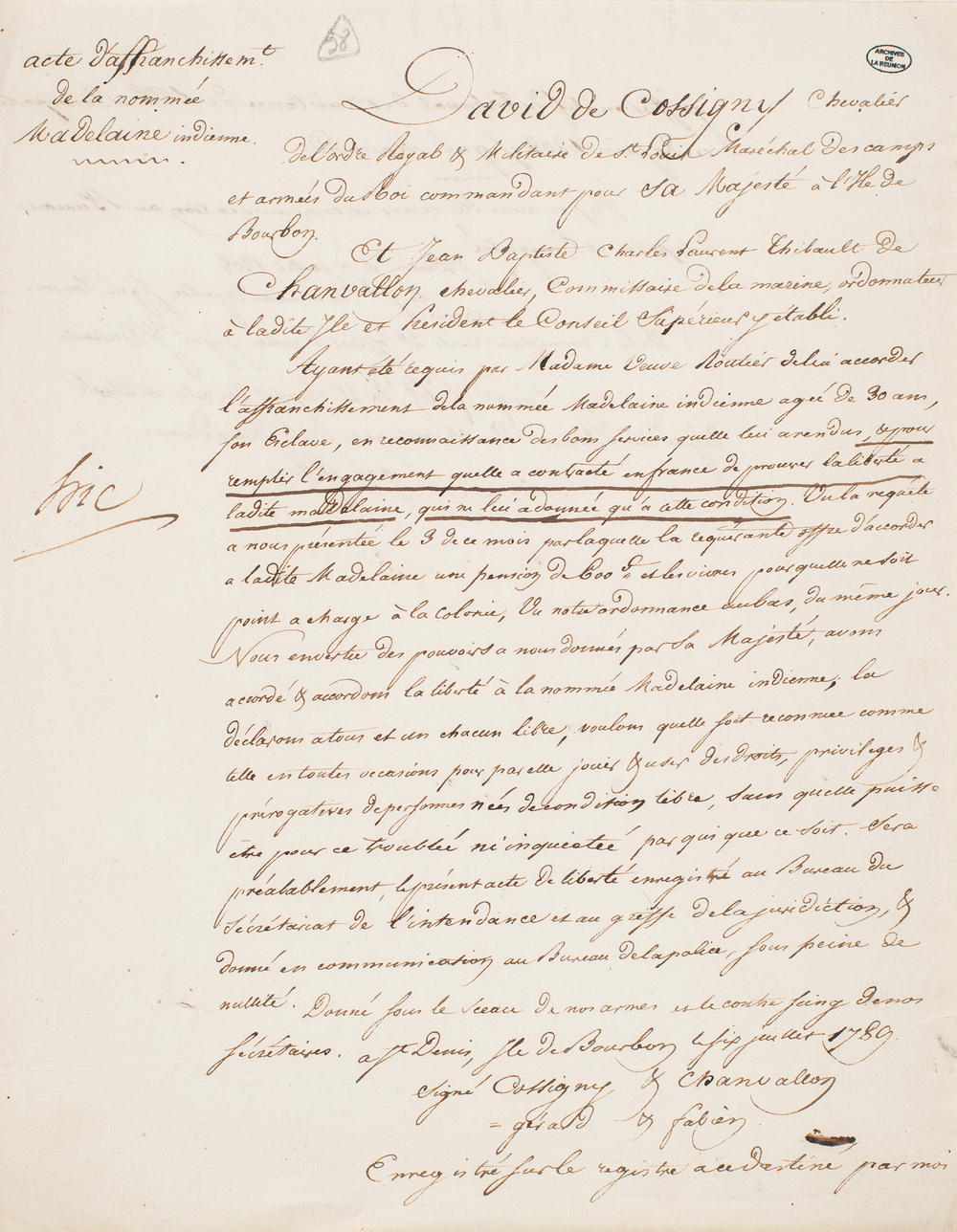
This point is crucial: Madeleine was legally free long before Furcy’s birth, and no valid title of ownership establishes any lasting lawful servitude.
Furcy was born in 1786. Legally, the principle was clear: the child follows the condition of the mother. If Madeleine was free (or should have been considered free), Furcy could not legally be a slave.
Yet unlike his sister Constance, who was emancipated shortly after birth, Furcy remained in bondage. He was listed as a slave and deprived of all legal capacity: he could neither marry freely, acknowledge his children, nor dispose of his own person.
This contradiction between law and practice was not an administrative mistake: it reveals a central mechanism of slave society, in which the census carried more weight than the law itself, and where the repetition of an illegal fact ultimately produced an appearance of legitimacy.
At the beginning of the nineteenth century, Bourbon Island rested upon a plantation economy in which slavery formed the foundation of prosperity. The great landowning families (among them the Desbassayns) dominated not only the land and the economy, but also local institutions.
In this context, challenging the legal status of a slave amounted to threatening the entire system. Every judicial precedent was potentially explosive: recognizing Furcy’s freedom meant opening the door to thousands of similar claims, especially among enslaved people of Indian origin.
Unlike the Caribbean colonies, Bourbon largely escaped the revolutionary upheavals. In 1796, a delegation sent to enforce the abolition decreed in 1794 was expelled before it could even act.
This local resistance to any radical reform stemmed less from ideological loyalty than from a logic of preserving the social order.
In 1816, the Crown appointed Gilbert Boucher attorney general before the royal court of Bourbon. A career magistrate already aware of the excesses of the colonial judicial system, he arrived on the island with a clear mission: to restore the authority of royal justice.
From the moment he took office, he suspended several judges for corruption and favoritism. Across the island, these decisions were perceived as an earthquake. They inspired hope among the oppressed and fear among the elites alike.
When Constance, Furcy’s sister, filed a memorandum with the prosecutor’s office in November 1817, Boucher and his deputy Jacques Sully-Brunet did not recommend a direct lawsuit against the owner Joseph Lory. Instead, they proposed something more fundamental: a declaration of free status.
This choice was strategic. The aim was not to negotiate an improvement in servile conditions, but to affirm that Furcy was not legally a slave.
On November 22, 1817, Joseph Lory received notice of Furcy’s declaration of freedom. His reaction was immediate and brutal. He had the bailiff punished, declared Furcy a runaway slave, and had him arrested.
This arrest was legally fragile, if not outright illegal. Furcy had not fled — he had claimed a legal status. Yet he was imprisoned as a fugitive slave.
Gilbert Boucher alerted the authorities to the irregularity of the detention. He convened a meeting of magistrates to examine several fundamental questions:
- Could Indians legally be reduced to slavery?
- Did French soil render a colonial slave free?
The answers revealed deep fractures. While Boucher defended the strict application of legal principles, his colleagues invoked the political danger of such recognition. The law was consciously subordinated to colonial stability.
Furcy’s lawyer, Maître Petitpas, developed a strong argument:
- Madeleine was Indian and could not legally be enslaved;
- She became free in France;
- She was formally emancipated;
- No title of ownership existed;
- Furcy, born of a free woman, could not be a slave.
Yet the court rejected the claim. It relied on the census and on a restrictive interpretation of the mother’s emancipation. The reasoning is revealing: the preservation of social order outweighed legal consistency.
Despite the order returning him to his owner, Furcy remained imprisoned and was then sent in 1818 to Mauritius, then under British administration. There he endured ten years of forced labor on a property connected to the Lory family.
This transfer was not an ordinary judicial procedure: it was a form of strategic exile, intended to silence a case that had become locally embarrassing.
In Mauritius, Furcy managed to establish that he had never been registered as a slave with the British authorities. In the absence of evidence to the contrary, he was presumed free.
He then began a new life, became a merchant, and acquired a respectable social position. For the first time, the law worked in his favor, precisely because it was exercised outside the French slaveholding system.
On April 29, 1835, the Court of Cassation overturned the ruling of the Saint-Denis court of appeal. This marked a turning point: metropolitan justice implicitly disavowed colonial justice.
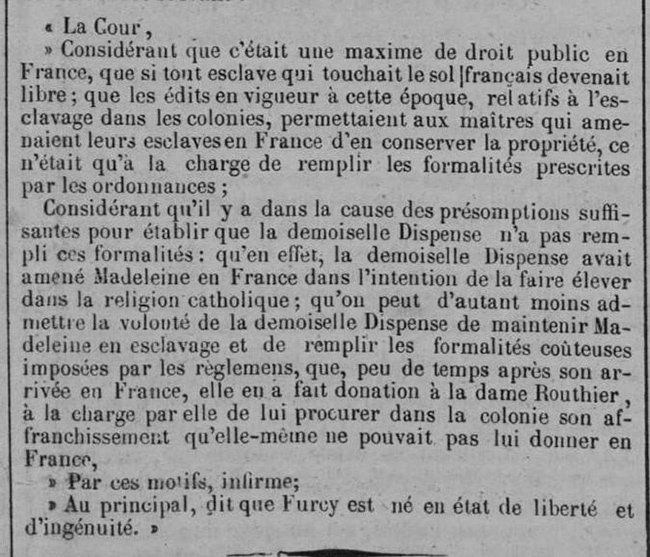
On December 23, 1843, the royal court of Paris ruled definitively. It declared Furcy free from birth, reminding that:
- French soil emancipates;
- The formalities required to maintain slavery had not been respected;
- Madeleine had never been lawfully sold.
In 1845, Furcy obtained damages. The amount was significant, but the reasoning of the local judges sought to minimize Joseph Lory’s responsibility, portraying him as a good-faith holder.
This compensation did not challenge the system itself. It repaired an individual case without touching the structures.
A freedom from elsewhere
The Furcy case demonstrates that abolition could not come from within the colonial system itself. Neither the local courts nor the Bourbon authorities were capable of — or willing to — apply the law against slavery.
Furcy’s freedom was recognized through displacement: geographical displacement, legal displacement, displacement of the center of decision-making. It did not announce abolition; it exposed the contradictions that would eventually make abolition inevitable.
Three years later, in 1848, slavery was abolished. Not as an act of grace, but because the system had ceased to be legally sustainable.
Notes and references
- Laurent Zuchowicz, Furcy, or the story of a judicial salvation from the outside, Villèle Museum
- Departmental Archives of Réunion
- Gazette of Bourbon Island (1817–1818)
- Gazette des tribunaux, December 24, 1843
- Sudel Fuma, Slavery in Réunion, CNRS Éditions
- Decision of the Royal Court of Paris, December 23, 1843

