

Long portrayed as the “showcase” of West Africa, Côte d’Ivoire descended into civil war on the night of September 19, 2002. Behind the crackle of gunfire and the partition of the country lay decades of political, social, and identity fractures, fueled by personal ambitions and external interference. Looking back at a crisis that reshaped the nation’s contemporary history, between the legacy of Houphouët-Boigny, the invention of ivoirité, and fierce struggles for power.
Côte d’Ivoire, September 19, 2002: The Day the African Showcase Shattered
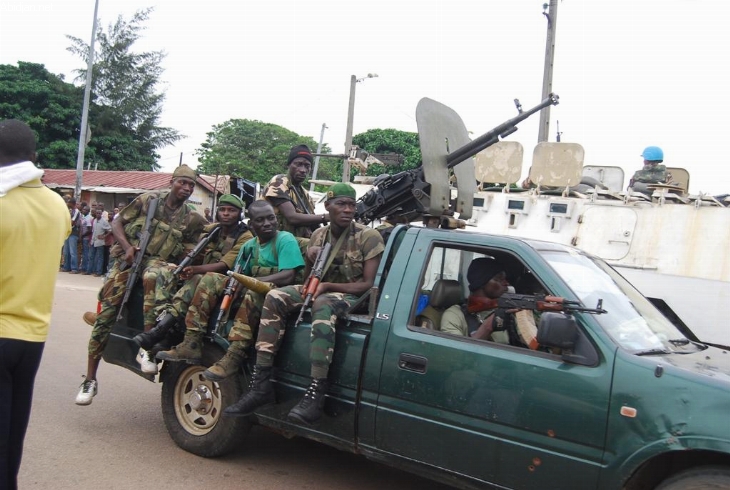
Abidjan, September 19, 2002. Night falls over the lagoon as bursts of gunfire shake the capital. Shots ring out near the presidential residence, while other explosions echo in Bouaké and Korhogo. Within hours, Côte d’Ivoire is plunged into turmoil. Two major political figures are killed: Interior Minister Émile Boga Doudou and former head of state Robert Guéï.
Rumors spread through working-class neighborhoods: a coup d’état is underway. Yet while the attempt fails in Abidjan, it succeeds elsewhere. The attackers retreat to the North, establishing a frontline that cuts the country in two. The South remains loyal to President Laurent Gbagbo; the North organizes itself around a new armed force soon known as the “New Forces.”
Côte d’Ivoire, once a symbol of prosperity, now stands on the brink. To understand this turning point, one must look back at the decades that prepared it: the legacy of the Houphouët miracle, social and ethnic fractures, the rise of ivoirité, and the weight of political rivalries that transformed an economic success story into a battlefield.
For nearly thirty years, the country had embodied a model of success. Félix Houphouët-Boigny, the nation’s first president after independence in 1960, had consolidated national unity around the Democratic Party of Côte d’Ivoire (PDCI) and the wealth generated by cocoa and coffee. Abidjan shone as the modern capital of an Africa under construction. Yet beneath this showcase lay deep tensions: rapid population growth, the influx of migrants from the Sahel, dependence on global commodity prices, and political patronage networks.
When Houphouët-Boigny died in 1993, the fragile balance collapsed. The country suddenly found itself orphaned of its “father of the nation.” The succession pitted Henri Konan Bédié, Speaker of Parliament, against Alassane Dramane Ouattara, then Prime Minister. In this struggle for power, a new word emerged: “ivoirité.” Behind the term lay an exclusionary ideology. To be fully recognized as Ivorian, one now had to prove “pure” ancestry, a requirement aimed directly at Ouattara, who came from the North and was suspected of having Burkinabé roots. Ivoirité became both a political tool and an identity time bomb, deeply dividing society between a predominantly Christian South and a predominantly Muslim North.
In December 1999, General Robert Guéï’s coup overthrew Bédié. Côte d’Ivoire lost its reputation as an exceptional bastion of stability in West Africa. The following year, a new Constitution further restricted access to power: Article 35 required both parents of a presidential candidate to be Ivorians by birth. The provision was crafted to exclude Ouattara. The 2000 presidential election was marked by fraud, violence, and popular unrest: Guéï attempted to declare himself the winner, but mass demonstrations forced recognition of Laurent Gbagbo’s victory. The shadow of civil war was already looming.
On the night of September 19, 2002, the spark was lit. The Patriotic Movement of Côte d’Ivoire (MPCI), led by Guillaume Soro, joined forces with two western-based movements, the MPIGO and the MJP. Together, they quickly seized control of half the country. The North and parts of the West fell under their authority, while the South remained in government hands. The frontline became a gaping scar running across the nation.
In the South, Gbagbo relied on the regular army (FANCI), reinforced by militias such as Charles Blé Goudé’s Young Patriots and by mercenaries from Eastern Europe. In the North, the New Forces united fighters, traditional Dozo hunters, and Sahelian networks. Porous borders with Burkina Faso and Mali facilitated the flow of weapons. The conflict became regional in scope.
International mediation efforts multiplied. In January 2003, the Linas-Marcoussis Agreements imposed a government of national reconciliation, granting the rebels control of the Interior and Defense ministries. But in the streets of Abidjan, crowds denounced the deal as a betrayal and attacked French interests, accusing Paris of imposing a solution unfavorable to the regime. Relations between France and Côte d’Ivoire deteriorated sharply.
In November 2004, the rupture became complete. The Ivorian army bombed Bouaké, killing nine French soldiers. France responded immediately by destroying the Ivorian air force on the ground. In Abidjan, thousands of young people took to the streets, targeting French nationals and Western expatriates. Gunfire erupted near the Hôtel Ivoire. The rift between Gbagbo and France became irreversible.
The Ivorian war was a dirty war. Massacres marked its course: Duékoué, Korhogo, Monoko-Zohi. Mass graves were uncovered. Death squads operated in the capital. Reports by the United Nations, Amnesty International, and Human Rights Watch denounced war crimes and crimes against humanity committed by both sides. Yet the logic of violence prevailed, fueled by fear and propaganda. State media, notably Radiotélévision ivoirienne (RTI), became instruments of nationalist mobilization.
Political figures grew increasingly radicalized. Laurent Gbagbo embodied a form of nationalism that played on the ambiguities of ivoirité. Guillaume Soro, a former student leader, emerged as a charismatic rebel commander. Charles Blé Goudé galvanized crowds with incendiary speeches. In the background, Alassane Ouattara and Henri Konan Bédié remained on the sidelines, waiting for their moment. Military commanders became local strongmen, from Philippe Mangou to Issiaka Ouattara, known as “Wattao.”
For five years, the country endured a frozen conflict. A “zone of confidence,” controlled by UNOCI and Operation Licorne, divided Côte d’Ivoire in two. The economy collapsed. Cocoa farmers suffered, investors fled, and public services deteriorated. Displaced populations crowded into precarious camps. The country, once a model, sank deeper into hardship.
In 2007, war fatigue opened a path forward. Under the mediation of Blaise Compaoré, President of Burkina Faso, the Ouagadougou Agreements were signed. Guillaume Soro became Prime Minister under Laurent Gbagbo. The New Forces pledged to disarm, and the reunification process began. Yet the peace remained fragile, undermined by mistrust and accumulated grievances.
The 2002–2007 Ivorian crisis produced no true victor. It left behind a fractured nation whose scars remain visible today. The agreements prevented total collapse, but they failed to resolve the root causes: ivoirité, the North–South divide, and the weight of foreign interests. In reality, the 2010–2011 conflict, which led to Gbagbo’s downfall and Ouattara’s rise to power, was the direct continuation of this first unfinished crisis.

