

Re-elected for an eighth term at the age of 92, Paul Biya is facing unprecedented backlash. Cities set ablaze, hundreds arrested, a people losing faith in both the vote and the future. An investigation into a country frozen between loyalty, fear, and the desire for change, where every bullet seems to answer a ballot.
A victory that sets the country ablaze
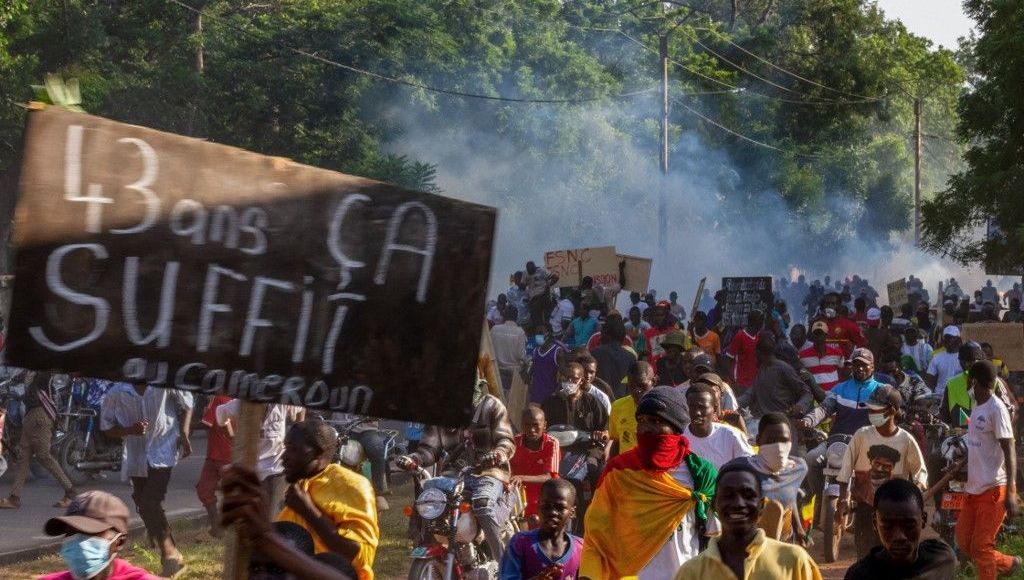
October 27, 2025, Yaoundé. Clément Atangana, president of the Constitutional Council, calmly announces the results of Cameroon’s latest presidential election: Paul Biya has been re-elected with 53.66% of the vote. At 92 years old, Cameroon’s strongman secures an eighth term after more than forty-three years in power. Within minutes, in Dschang, in the west of the country, the headquarters of the Cameroon People’s Democratic Movement (CPDM) goes up in flames. Fire, screams, videos replayed endlessly online: the election has reignited the embers of an old anger.
Within hours, Cameroon descends into turmoil. Protests erupt, repression intensifies. Casualty reports remain unclear, but the words grow heavier: “war zone,” “gunfire,” “civilian deaths.” What was meant to be a routine electoral ritual becomes the reflection of a country running out of breath.
Cameroon, October 2025: after the verdict, the streets — an investigation into a contested victory
On October 12, 2025, Cameroonians head to the polls. Twelve candidates are running, but two faces dominate the race: Paul Biya, the eternal president, and Issa Tchiroma Bakary, a former minister turned opposition figure. The scene feels familiar: decaying campaign posters, lines stretching under the sun, ballot boxes sealed under the watch of soldiers.
Behind the democratic façade, doubt lingers. The body overseeing the election, ELECAM, has long been contested. Its members are appointed by the president of the Republic. The same hand acting as referee, player, and judge. Opposition leaders speak of an “election without suspense,” a theater where the ending has already been written.
On October 27, Clément Atangana delivers the verdict: Paul Biya, 2,474,179 votes; Issa Tchiroma, 35.19%. Turnout: 57.8%. The word “stability” echoes throughout his speech. In the streets, it sounds like a provocation. “Forty years of stability means forty years of stagnation,” says a young man in Douala.
The spark begins in Dschang. The local CPDM headquarters is set on fire, while the courthouse is partially destroyed, according to several witnesses. Local authorities describe it as “organized sabotage”; residents call it “the people’s revenge.” Security forces retaliate. Bullets whistle through the air, bodies collapse. One woman recounts:
“My son sold fritters. He never protested. We found him by the roadside the next morning.”
In Garoua, Bafoussam, and Douala, unrest spreads rapidly. Slogans merge with the smoke: Biya must go!, Our vote matters! The government bans demonstrations. Armored vehicles roll into the streets. Young people improvise makeshift barricades. In working-class neighborhoods, tires burn and anger becomes song.
Official figures do not exist. The government remains silent. According to Associated Press, at least four people were killed and around one hundred arrested during the first days of unrest. Reuters reports twenty-three deaths and more than five hundred arrests by the end of the month. Local NGOs speak of far heavier tolls. In Douala, a doctor speaking anonymously confides:
“We received more than twenty gunshot victims in two days. Some of them never left alive.”
State media continues broadcasting music programs. No mention is made of the riots. Information spreads in fragments through social media — until internet access is cut in several regions.
A university town, Dschang becomes the symbol of a generation breaking away. Young people, often educated yet unemployed, saw this election as the last hope for peaceful change. When the results are announced, rage takes over the streets. The flames devouring the ruling party’s headquarters become the flames of a collective cry: They stole our future.
Verified videos show civilians armed with stones facing off against gendarmerie pickup trucks. The next day comes a wave of mass arrests. Students, shopkeepers, bystanders — everyone becomes a suspect. “Here, they arrest the poor, not the guilty,” whispers a teacher.
In the north, in Garoua, tensions take a dramatic turn. The residence of Issa Tchiroma Bakary, the leading opposition candidate, is surrounded by security forces. Witnesses claim to have seen “snipers” on nearby rooftops. In a statement, Tchiroma accuses the government of “armed intimidation.” The army denies the accusation, referring instead to a “protective security arrangement.”
Supporters of the defeated candidate pitch tents outside his home, turning it into a besieged fortress. Electricity is cut several times a day. Some activists disappear, others flee to Chad. The government speaks of “provocateurs fleeing.” The opposition calls it “forced exile.”
ELECAM, created to guarantee transparency, has instead become a symbol of suspicion. Its members, appointed by presidential decree, are widely perceived as an extension of the regime. The opposition denounces fictitious polling stations, pre-filled ballot boxes, and duplicate registrations.
Tchiroma demands an independent audit of the election. Cameroonian law provides no such mechanism. During an interview that quickly went viral, a government representative snaps: “An audit? On what legal basis?” The discussion ends there. In reality, the country has no legal mechanism for external verification. Truth remains a matter of state.
Since 1982, Paul Biya has built a system in which change appears impossible without rupture. Yesterday’s single-party rule has evolved into a hegemonic party structure. Counterpowers have been neutralized, institutions locked down. Opponents are tolerated as extras, never as true rivals.
Cameroonians speak of a country split in two: the world of palaces and the world of the streets. In the first: air conditioning and trips to Geneva. In the second: heat and fear. The same faces, the same promises, the same silences.
In makeshift hospitals, doctors count the wounded. “Young people, mostly young people,” says a nurse in Douala. Some were shot while trying to film the protests. Others simply for running. Families search police stations for missing relatives. Some never arrive there.
In Bafoussam, a mother holds up a photograph of her 17-year-old son:
“He only wanted to vote for change.”
The face of the revolt is that of a generation that has never known another president besides Paul Biya.
Tchiroma’s party offices are raided. Computers are seized, activists arrested for “spreading false information.” Foreign television channels are no longer allowed to broadcast without special accreditation. The word “repression” becomes taboo once again.
A foreign YouTuber who came to film the situation in Douala is assaulted, robbed, and briefly detained. “They treated me like a spy,” he says. “I realized that filming here already means taking sides.”
Social media becomes the country’s only newspaper. Truth and manipulation blur together. In this digital fog, every video becomes a weapon, every silence a confession.
The African Union describes the election as “generally compliant,” while acknowledging “irregularities.” Western chancelleries retreat into diplomatic caution. Human rights organizations, meanwhile, sound the alarm:
“Bullets must not replace ballots.”
In European media, the Cameroonian crisis receives little attention. The world’s focus lies elsewhere. Yet in Yaoundé, fear spreads like invisible gas. The streets are calm, but the calm smells of ashes.
Cameroonians swing between anger and exhaustion. Some still hope for national dialogue. Others believe in nothing anymore. “They tell us voting means having a voice. But here, voting means risking your life,” summarizes one student.
The generational divide is absolute. Those who grew up with Biya defend his longevity as a guarantee of stability. The youth see it as a curse. In between stands a disillusioned middle class that no longer expects anything.
In marketplaces, conversations drift from politics to daily survival: rising prices, unemployment, corruption. And yet, despite everything, the idea of change persists. It slips into words, into glances, into silence itself.
Possible outcomes diverge sharply. Some advocate for de-escalation: targeted releases, religious mediation, symbolic audits of vote tallies. Others fear a hardening of the regime: mass arrests, curfews, deeper militarization.
Civil society struggles to survive somewhere in between. Lawyers’ associations, youth collectives, and local NGOs document abuses and archive evidence. Their goal: to preserve the memory of this moment.
But power does not like memory.
It prefers oblivion.
The country of silence
The Cameroon of 2025 is not merely a country in crisis. It is a country doubting its own voice. Paul Biya’s victory, even if legal, appears as a joyless victory — without people, without momentum, without a future. It prolongs time; it no longer invents it.
On the deserted streets of Douala, one graffiti message says it all:
We do not want war. We want our vote to count.
Scrawled in haste, the phrase captures better than any speech what millions of Cameroonians feel: a people trapped between obedience and exhaustion, between fear and dignity.
A country that, after standing upright in silence for so long, may one day collapse in a scream.
Notes and references
- Reuters, “Cameroon’s Biya, 92, announces bid for eighth presidential term,” July 13, 2025.
- Reuters, “Cameroon sets presidential vote for October 12,” July 11, 2025.
- Reuters, “Cameroon opposition’s Tchiroma claims election victory, urges Biya to concede,” October 14, 2025.
- Reuters, “Cameroon’s Biya, 92, re-elected for an eighth term,” October 27, 2025.
- Reuters, “Four killed in Cameroon protests ahead of election results, opposition says,” October 26, 2025.
- The Guardian, “World’s oldest serving head of state declared winner in Cameroon election,” October 27, 2025.
- Al Jazeera, “Cameroon President Biya declared election victor; challenger protests,” October 27, 2025.
- Wikipedia, “2025 Cameroonian presidential election.”
- Reuters, “Cameroon’s Biya re-elected, official results show.”
- Background article, “Cameroon: How Paul Biya’s strategists are trying to lock up the next presidential election,” The Africa Report, 2024.

