

Since September 25, 2025, Madagascar has been gripped by a wave of social unrest that caught the authorities off guard. What began as a protest against electricity and water outages quickly turned into a nationwide uprising, engulfing the capital and several major cities, triggering looting, violent repression, and the dissolution of the government. In the space of a week, Malagasy youth, often referred to as “Generation Z,” reminded the world that energy, far more than a technical service, is a matter of political survival.
From Simple Power Cuts to a Major Political Crisis: A Look Back at a Week of Protests in Madagascar.
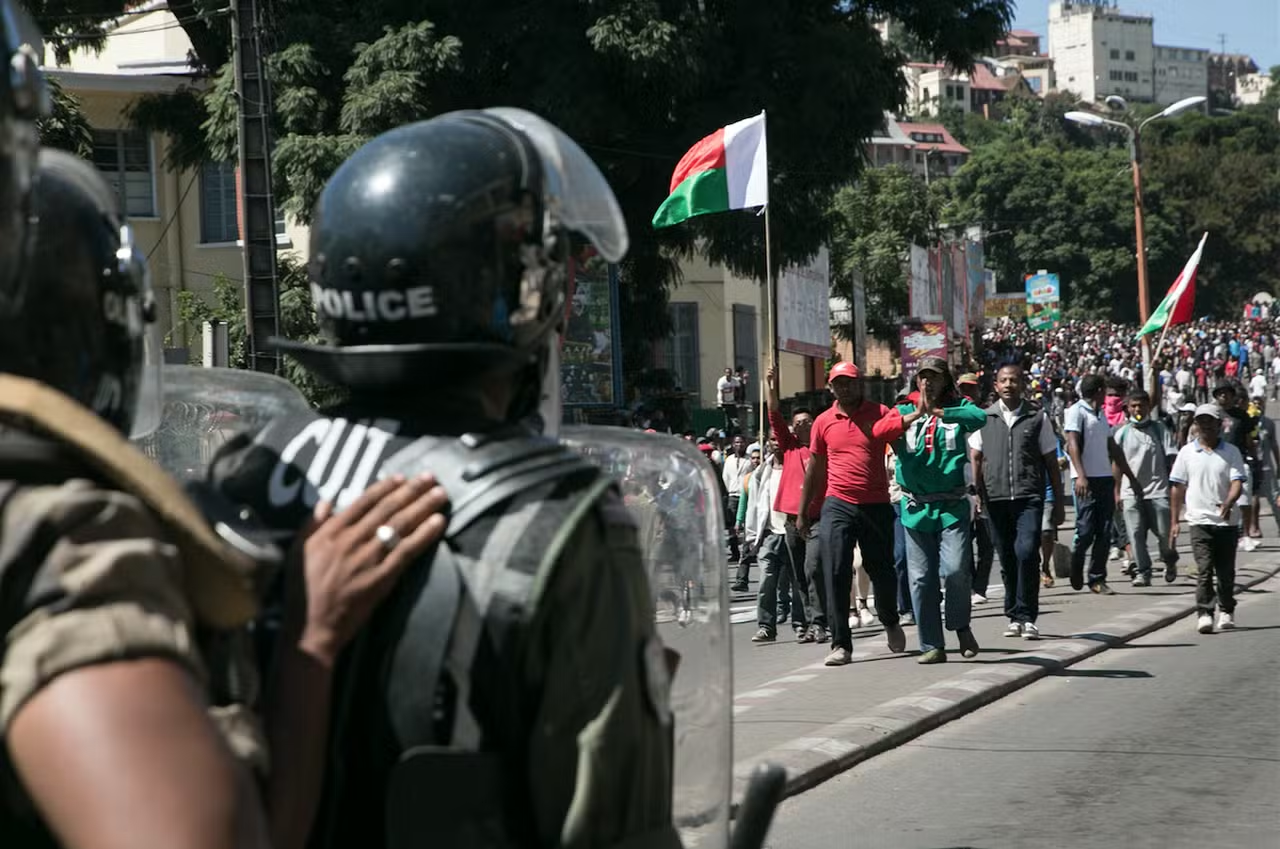
Antananarivo was the scene of the first demonstrations. The district of Ambohijatovo, quickly sealed off by security forces, turned into a battlefield. Tear gas, live ammunition, and the deployment of an armored vehicle: the images shocked observers far beyond Madagascar’s borders. But the flames of protest soon spread beyond the capital. In Toamasina, the country’s main port, in Antsiranana in the north, Mahajanga in the west, and Toliara in the southwest, marches took place, giving the movement a truly national dimension.
Very quickly, the targets expanded. In Ankorondrano, the brand-new cable car station, a showcase symbol of the modernity championed by President Andry Rajoelina, was set ablaze. Businesses linked to figures close to the government were looted, and the residences of lawmakers were attacked. Public anger was no longer directed solely at power outages: it had turned against a system perceived as corrupt and disconnected from reality.
At the heart of the crisis lies JIRAMA, the national electricity and water company. Its aging infrastructure, massive technical losses, and chronic inability to meet demand have made it the scapegoat for a much deeper malaise. According to the World Bank, only 39.4% of Malagasy citizens had access to electricity in 2023. By 2025, assessments suggested that the real figure was closer to 35%, highlighting a stark divide: nearly 80% of urban residents were connected, compared with fewer than 10% of rural inhabitants. In some neighborhoods of Antananarivo, power cuts last up to twelve hours a day.
This reality stands in sharp contrast to official rhetoric. Speaking before the United Nations just days before the protests, Rajoelina praised a 66% increase in electricity access over six years. Yet in the streets of the capital, families were lighting their homes with candles. That dissonance was enough to ignite the powder keg.
Youth then took the lead. Students, high school pupils, influencers: a connected generation, with neither leaders nor political parties, succeeded in transforming widespread frustration into a national mobilization. Social media became the movement’s headquarters, where gathering points, slogans, and images of repression were shared. As their banner, protesters adopted the pirate flag from the Japanese series One Piece: a pop-culture symbol turned political standard.
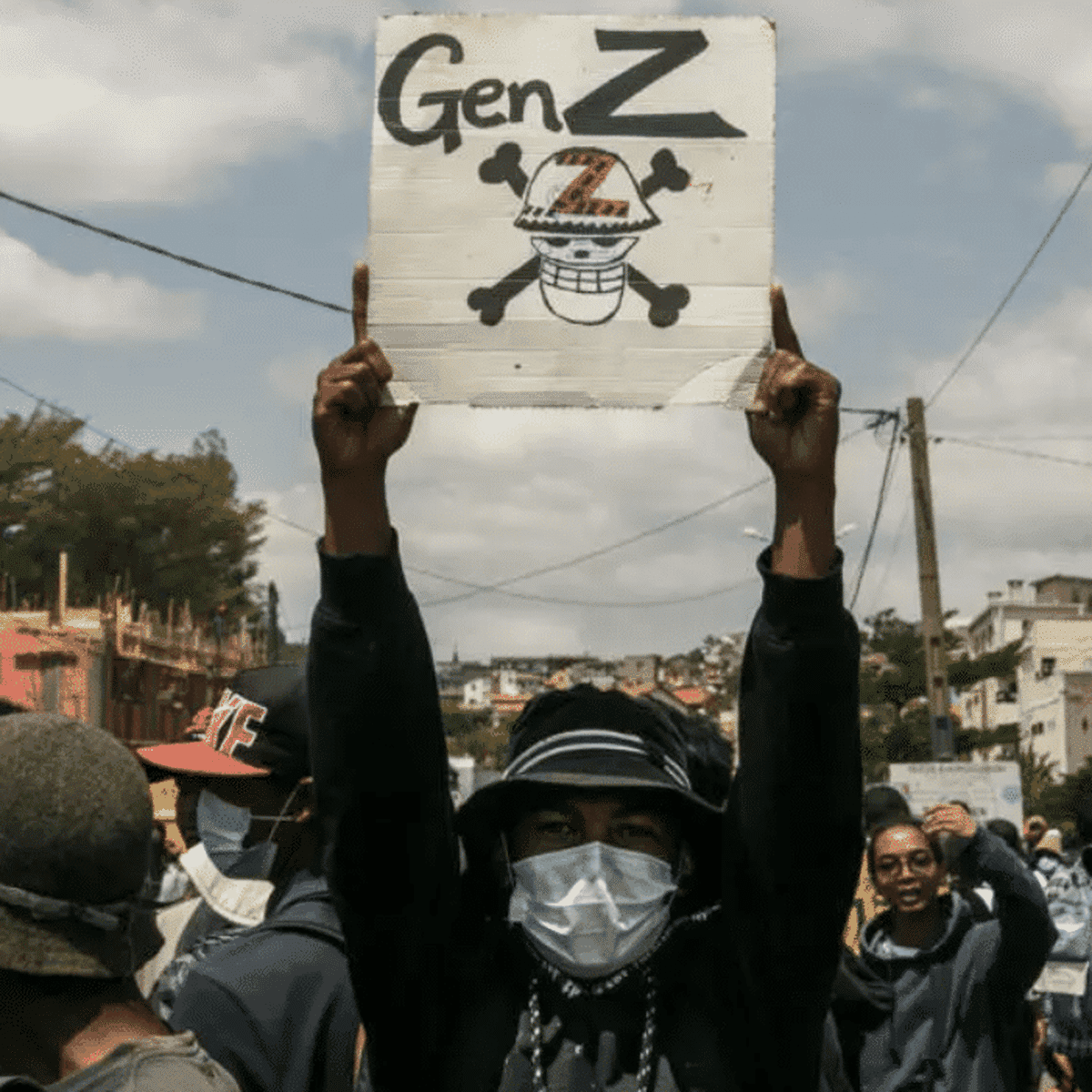
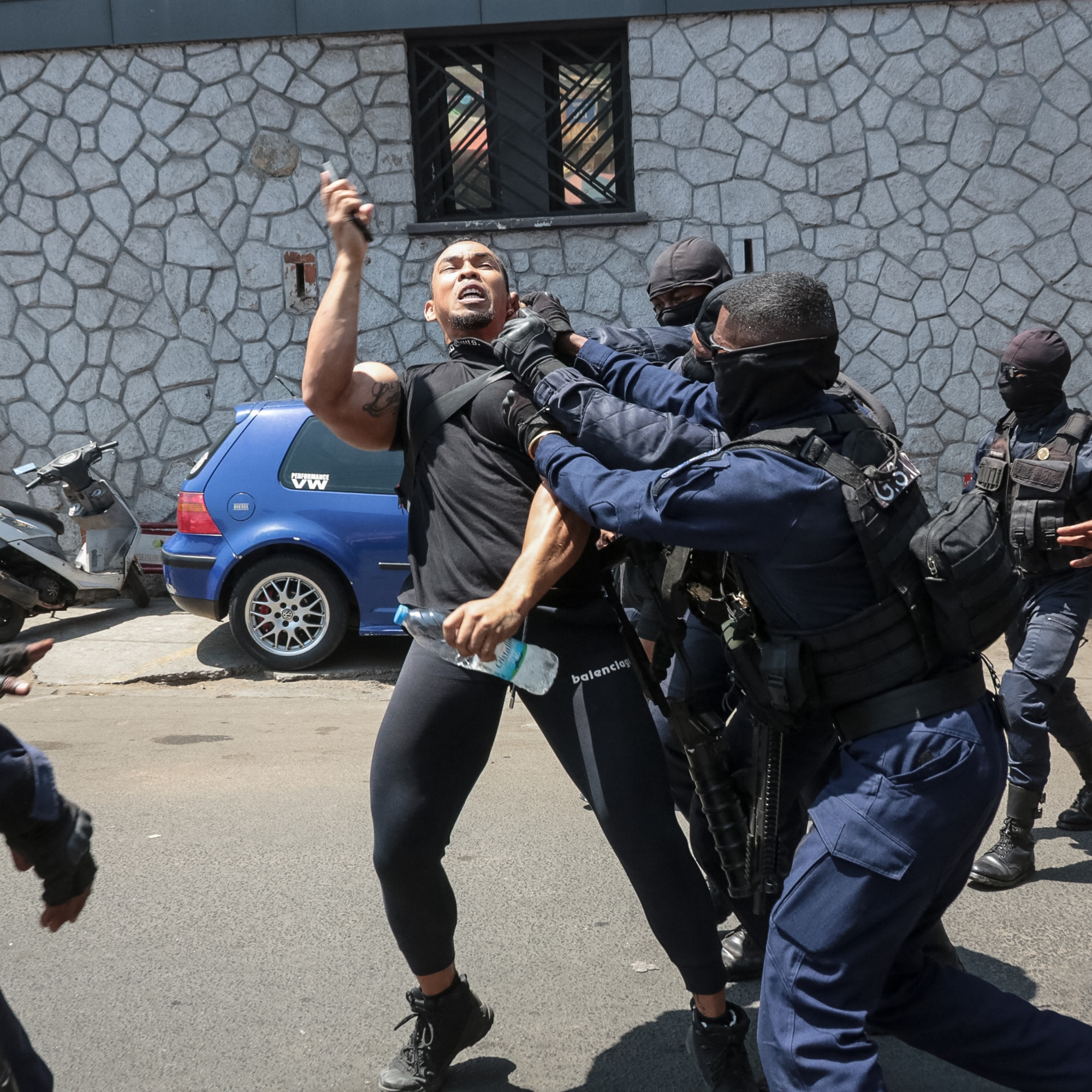
The repression matched the regime’s fears. Security forces used live ammunition, tear-gas grenades, and violent charges against demonstrators. The United Nations denounced the “disproportionate and unnecessary” use of force. The Office of the High Commissioner for Human Rights confirmed a provisional toll of at least 22 deaths and more than 400 injuries.
Caught off guard, Rajoelina attempted to regain the initiative. On September 26, speaking from New York, he dismissed his Minister of Energy, accusing him of failing to do his job. On September 29, upon returning to Antananarivo, he announced the dissolution of the Ntsay government and promised not to seek another term. But the streets did not calm down. The very next day, demonstrators were openly demanding his resignation.
Student anger crystallized around major energy projects, symbols of a state that promises but fails to deliver. Volobe Amont, expected to generate 120 MW, has been stalled for years. Sahofika, another hydroelectric megaproject announced at 192 MW, never progressed beyond financing agreements. These two projects, intended to free the country from its dependence on imported fuel, have become glaring evidence of the regime’s impotence.
In this climate, economic violence multiplied. Supermarkets linked to individuals close to the government were set on fire, the cable car station was destroyed, and lawmakers’ residences were attacked. Beyond the destruction, one message became clear: the anger targets corruption as much as social injustice. But the cost is high. The distributors’ association warned that it could take up to three months to restore the supply of essential goods.
This crisis is first and foremost a youth crisis. A generation that refuses to accept rolling blackouts as inevitable, that denounces the glaring inequality between the children of leaders sent abroad to study and the reality faced by high school students in Antananarivo or Antsiranana. A generation that, through memes, livestreams, and ironic slogans, has invented its own form of political protest.
But the crisis is also political. Since the widely boycotted presidential election of 2023, Rajoelina’s legitimacy has been challenged. His absence from the country during the first demonstrations, while he was in New York, was seen as proof of his disconnect from the population. His promise to “take responsibility” and “not seek another term” failed to calm the streets.
The international community is concerned. SADC is calling for dialogue, the African Union has offered mediation, and the United Nations is demanding independent investigations into the violence. Within the country, the Council of Christian Churches and the Bar Association are calling for respect for fundamental rights, beginning with access to water and electricity.
What Future After the Protests in Madagascar?
Three scenarios are emerging. The first would be de-escalation, with the appointment of a consensus prime minister, the urgent relaunch of energy projects, and regional mediation. The second would be one of gradual erosion, with weekly demonstrations, a slowing economy, and lasting polarization. The third, and darkest, would be a hardening of the crisis: increased repression, more victims, and the internationalization of the conflict before the United Nations Security Council.
Whatever happens next, the September 2025 revolt will remain a turning point. It serves as a reminder that political stability is often decided by the most ordinary aspects of daily life: a light bulb that turns on, a tap that runs. In Madagascar, it was the absence of these basic necessities that triggered a major political crisis. One generation has understood this reality—and it is not ready to return to the shadows.

