

Triangular trade cannot be reduced to a simple exchange between Europe, Africa, and the Americas. It was one of the first fully globalized economic systems, built on the deportation of millions of Africans and the exploitation of their labor on plantations. Through its mechanisms, its violence, and its logic of accumulation, it profoundly transformed the economic, political, and social balances of the modern world, while leaving behind enduring legacies that continue to shape contemporary inequalities.
Triangular Trade: Anatomy of a System, Birth of a World
Dawn has barely broken over the harbor. The wooden hull creaks beneath the hurried footsteps of men at work. Below deck, the air is already unbearable. Bodies packed together, chained two by two, struggle to breathe in a space that no longer belongs to them. Above them, the captain checks his accounts. How many human units to deliver, how many acceptable losses, how much profit to expect. Triangular trade begins here, in this frozen tension between life and market value.
For this system, too often reduced to a mere exchange between three continents, was in reality one of the first fully integrated mechanisms of global capitalism. It was not simply a trade network, but a global architecture in which every territory, every body, every resource was assigned a precise function. Europe produced, Africa supplied, America transformed. And at the center of this machinery stood a brutal reality: the mass deportation of human beings reduced to the status of merchandise.
Over nearly four centuries, at least eleven million Africans were torn from their lands and transported to the Americas. Even this staggering figure says nothing of those who died before ever reaching the ships, nor of those who disappeared within the gaps of the system. Triangular trade did not merely move populations: it reconfigured the world.
A World Economy in the Making
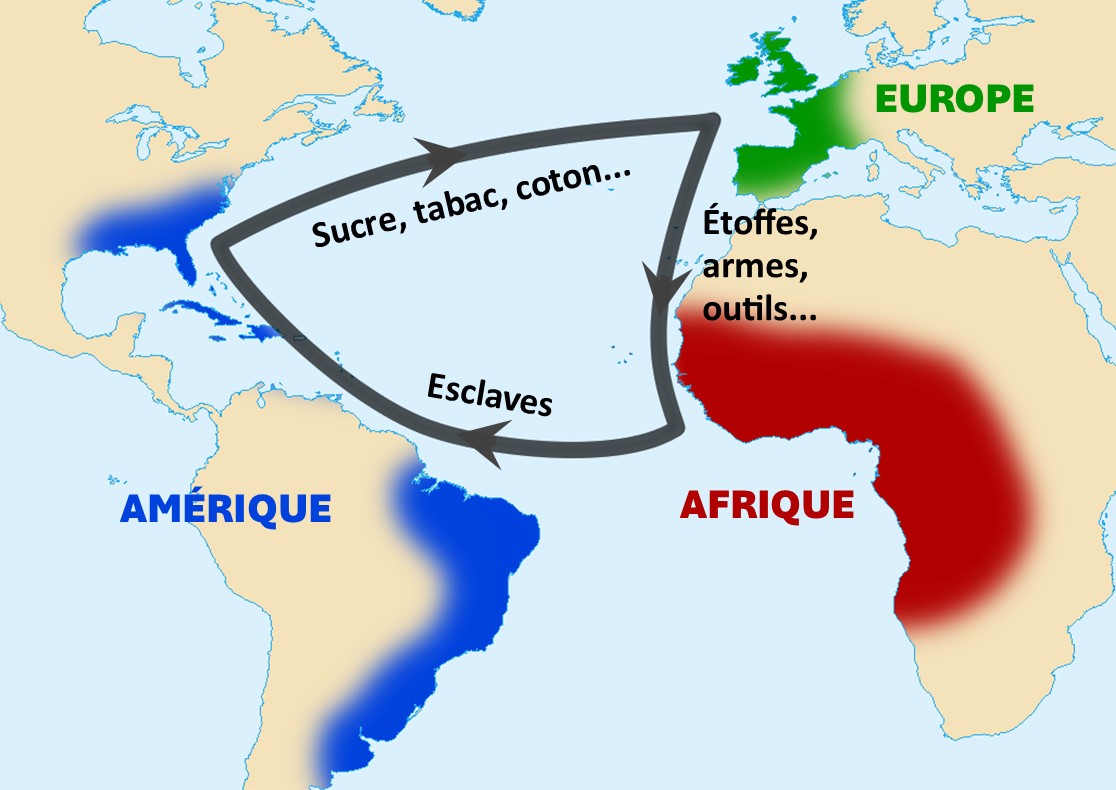
Triangular trade emerged within a major transformation in economic history: the gradual formation of a world economy dominated by Western Europe. From the 15th century onward, the great maritime discoveries were not limited to the exploration of new territories; they profoundly redefined trade circuits, power relations, and mechanisms of wealth accumulation. The opening of transatlantic routes, mastery of the oceans, and the ability to organize flows on a massive scale enabled European powers to surpass the limits of regional economies and construct an interconnected, hierarchical system oriented toward expansion.
Within this context, the question of labor became central. The American colonies, particularly in the Caribbean and Brazil, were not designed as autonomous societies, but as specialized production zones integrated into an export-driven logic. Sugar, which rapidly became one of the pillars of this system, offers a striking illustration. Its cultivation and processing required an intensive, continuous, and extremely coercive labor organization. Added to this were other productions—coffee, cocoa, cotton, tobacco—whose demand continued to rise in Europe as these products shifted from luxury goods to everyday consumer staples.
Yet European populations settled in the colonies were insufficient to meet these demands, and Indigenous populations, devastated by disease, violence, and labor conditions, could not be sustainably exploited on such a scale. Atlantic slavery therefore emerged not merely as a solution, but as a condition for the system’s operation. It provided an abundant labor force, legally dehumanized and thus entirely integrated into a logic of property and profitability.
It is within this framework that triangular trade takes on its full dimension. It was not simply a trade route, but a sophisticated logistical apparatus capable of articulating three geographic spaces into a single coherent economic system. Ships departed European ports loaded with manufactured goods—firearms, textiles, alcohol, barter items—which served as currency along African coasts. The captives obtained in exchange were transported to the Americas, where their sale made it possible to acquire colonial commodities. These products were then reintroduced into European markets, where they fueled both consumption and capital accumulation.
This constant circulation of goods, capital, and human beings was accompanied by the development of increasingly sophisticated financial and commercial instruments. Expeditions were insured, financed, and pooled. Risks were calculated, distributed, and integrated into costs. In this way, triangular trade contributed to the emergence of a structured mercantile capitalism built on investment, credit, and speculation.
European ports played a decisive role in this dynamic. Nantes, Liverpool, Bordeaux, and Lisbon were not merely departure points: they became centers of organization, financing, and redistribution of wealth. Shipyards expanded, banks strengthened, commercial networks spread. Entire urban economies developed around this trade, involving shipowners, merchants, insurers, craftsmen, and laborers. The prosperity of these cities depended largely on their ability to integrate efficiently into this transatlantic system.
But this prosperity came at a cost, one that remained largely invisible in traditional narratives. Behind the accumulation of capital, behind the expansion of infrastructures and institutions, lay a fundamental reality: the transformation of human beings into economic units. Triangular trade did not merely produce wealth; it also produced a global hierarchy in which certain regions were assigned to production, others to exploitation, and still others to consumption.
Far from being a mere episode in commercial history, triangular trade constituted one of the foundations of the modern world economy. It inaugurated a global mode of organization in which the circulation of wealth was inseparable from the forced circulation of human beings, and in which European growth relied upon the systematic extraction of human and material resources from other regions of the world.
Africa: Between Constraint, Adaptation, and Imbalance
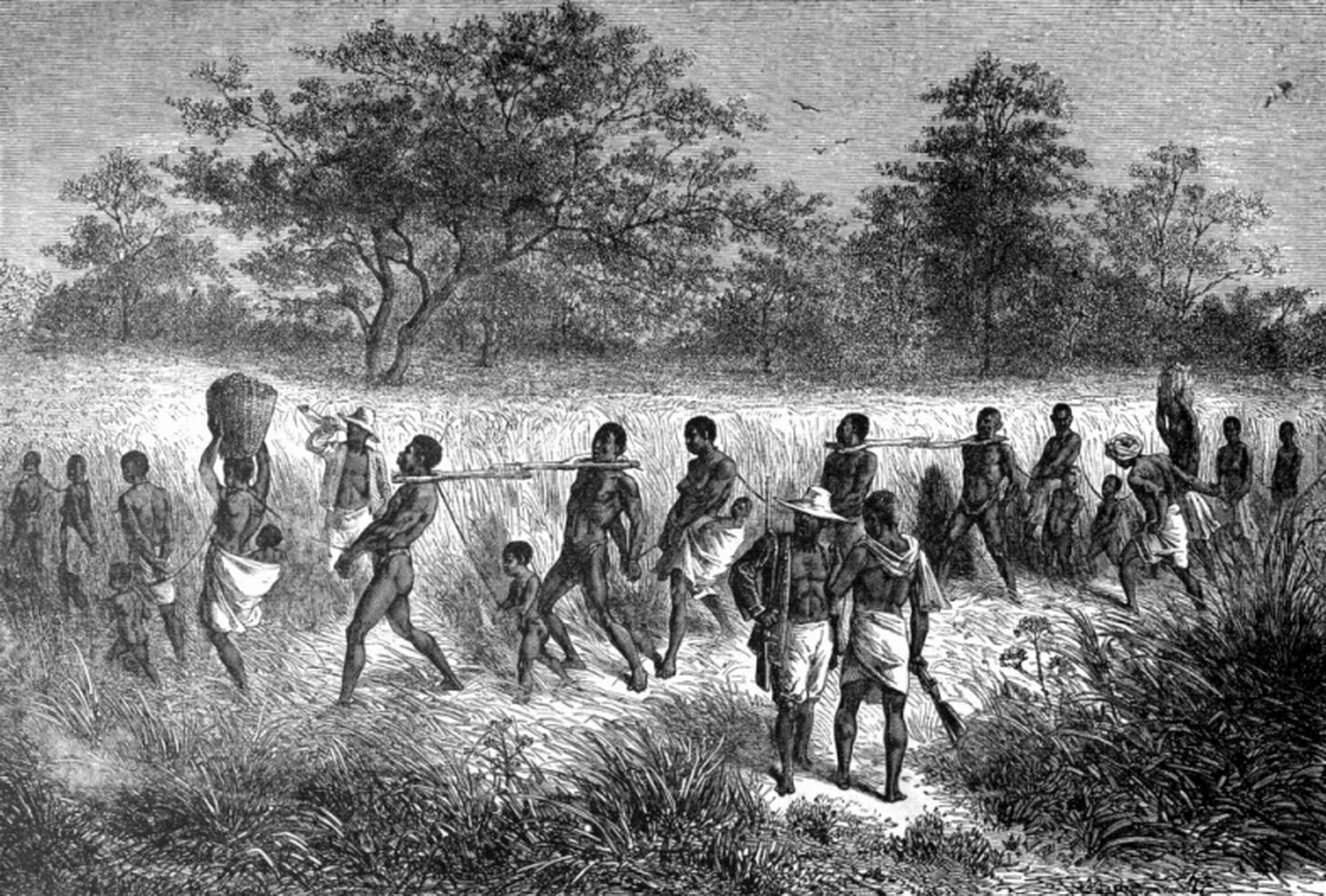
Reducing Africa’s role to that of a mere reservoir of captives is a simplification that prevents a true understanding of the complexity of the Atlantic system. Triangular trade in fact relied on a multiplicity of African actors embedded within varied political and economic structures, interacting with European merchants according to their own logics. For the most part, Europeans did not penetrate deep into the continent. Their presence was limited to coastal zones organized around fortified trading posts, and their capacity for action depended heavily on local intermediary networks. This structural dependence granted African societies an active role in the functioning of the system, without allowing them to control its deeper dynamics.
These intermediaries took different forms depending on regions and periods. They included merchants specializing in long-distance trade, political leaders seeking to strengthen their authority, and armed groups profiting from the opportunities created by the trade. Captives came from multiple sources: prisoners of war, individuals seized during raids, people sold for debts, or those condemned under local judicial systems. This diversity of situations reminds us that the slave trade was not imposed uniformly, but developed within specific social contexts marked by internal power relations.
However, interpreting this participation as voluntary adherence to a balanced system would be deeply misleading. Triangular trade introduced a constant external pressure that transformed local dynamics. European demand for captives, sustained and growing, acted as a destabilizing factor. It encouraged the intensification of conflicts, multiplied capture expeditions, and reshaped political structures around access to human resources. The massive introduction of firearms—estimated at several hundred thousand units per year during the 18th century—played a decisive role in this transformation. It altered balances of power, fostered the emergence of militarized authorities, and made conflicts both more frequent and more destructive.
In certain regions, this dynamic led to a genuine restructuring of societies. Some states strengthened themselves by controlling trade routes and organizing the capture of captives, while others, more vulnerable, were destabilized, fragmented, or absorbed. Economic logics gradually shifted toward activities linked to the slave trade, to the detriment of other forms of production. This forced specialization limited the development of diversified economies and reinforced dependence on external exchanges.
The human consequences of this system were immense and extended far beyond the number of deported individuals alone. In certain regions, such as Angola, losses linked to capture, forced marches toward the coast, and waiting conditions before embarkation could reach between 45 and 50 percent. This means that for every person actually boarded onto a ship, another died upstream, in circumstances often invisible in European archives. Historian Patrick Manning thus estimated that for nine million deported individuals, more than twenty million people had been captured, giving some sense of the scale of the demographic trauma.
This shock was not limited to population decline. It affected the very structure of societies. Captives were predominantly young individuals of working age, disrupting production systems and weakening communities. Social bonds were broken, family networks destroyed, demographic balances profoundly altered. In some areas, the constant fear of raids transformed settlement patterns, survival strategies, and relations between groups.
Africa was therefore not simply exploited within the framework of triangular trade; it was deeply transformed by it. The system did not merely extract individuals—it redefined the continent’s political, economic, and social structures. By imposing a large-scale logic of predation, it established dynamics of imbalance whose effects extended far beyond the end of the Atlantic slave trade.
[Translation continues in the same structure and tone.]

