

Too often reduced to folkloric figures or images of religious exoticism, the orishas of the Yoruba pantheon in fact constitute a true architecture of power, justice, and social order. From the thunder of Shango to the iron of Ogun, from the waters of Yemaya to the crossroads of Eshu, these deities structure a worldview in which politics, morality, and the sacred are inseparable. This article explores nine major orishas—their functions, their internal tensions, and their living legacy within contemporary African diasporas.
For too long, the orishas have been reduced to picturesque “characters,” decorative figures of religious exoticism. This is the classic mistake: confusing surface (images, colors, offerings, dance) with function. In the Yoruba universe, an orisha is not merely a name. It is an organized force. A way of reading the world. An invisible institution that gives meaning to justice, war, health, the economy, desire, and death. In other words: a politics.
This politics does not unfold in marble palaces. It plays out in the mud of paths, in the forest, in the forge, along riverbanks, in the marketplace, at the crossroads. It is transmitted through speech, music, and ritual. And it crossed the Atlantic. Under the violence of the slave trade, and later through diasporic recompositions, the orishas changed languages, sometimes names, often faces—but rarely roles. They continue to articulate, in their own way, what every society must confront: how to discipline force, how to render justice, how to survive crises, how to hold together.
Here are nine of the most powerful orishas—not in the sense of “most famous,” but in the sense that they structure the major zones of reality: authority, transformation, technique, care, memory, and relationship.
9 Powerful Orishas of Yoruba mythology
1) Shango: justice that falls from the sky
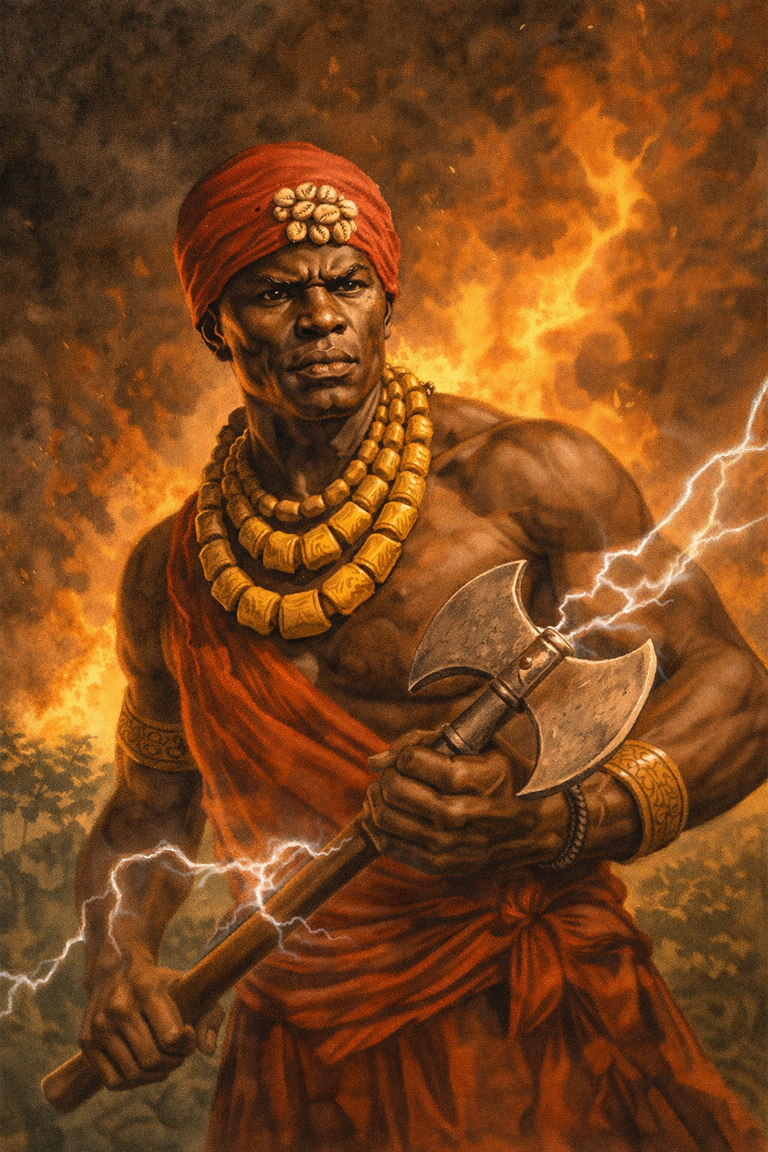
Shango is one of the most striking figures of the Yoruba pantheon: thunder, lightning, fire, dance, verdict. His most famous symbol is the oshe, a double-headed axe carried as a ritual emblem and a sign of power. The image is clear: Shango’s justice does not deliberate for long. It cuts.
But Shango is not merely a “weather” deity. The narratives also connect him to a political memory: that of an ancestral king associated with the ancient Oyo kingdom, who became an orisha after his death. This dual nature—cosmic force and royal authority—explains his place. Shango is the point where power must justify itself, where force must answer for its actions.
In ritual practice, Shango is linked to music, especially the bàtá drums. Their presence is not sonic decoration but a sacred architecture: rhythm becomes order, dance becomes language, collective energy becomes tribunal. Shango reminds us that justice is not only a written rule; it is a social balance to be maintained, sometimes through sanction, sometimes through example.
And yet Shango is no saint. His power is also his danger: anger, excess, unpredictability. This is precisely what makes him “political.” He embodies the question that haunts all authority: how to exercise force without tipping into fury? How to punish without becoming injustice oneself?
2) Ogun: iron, war (and the road)
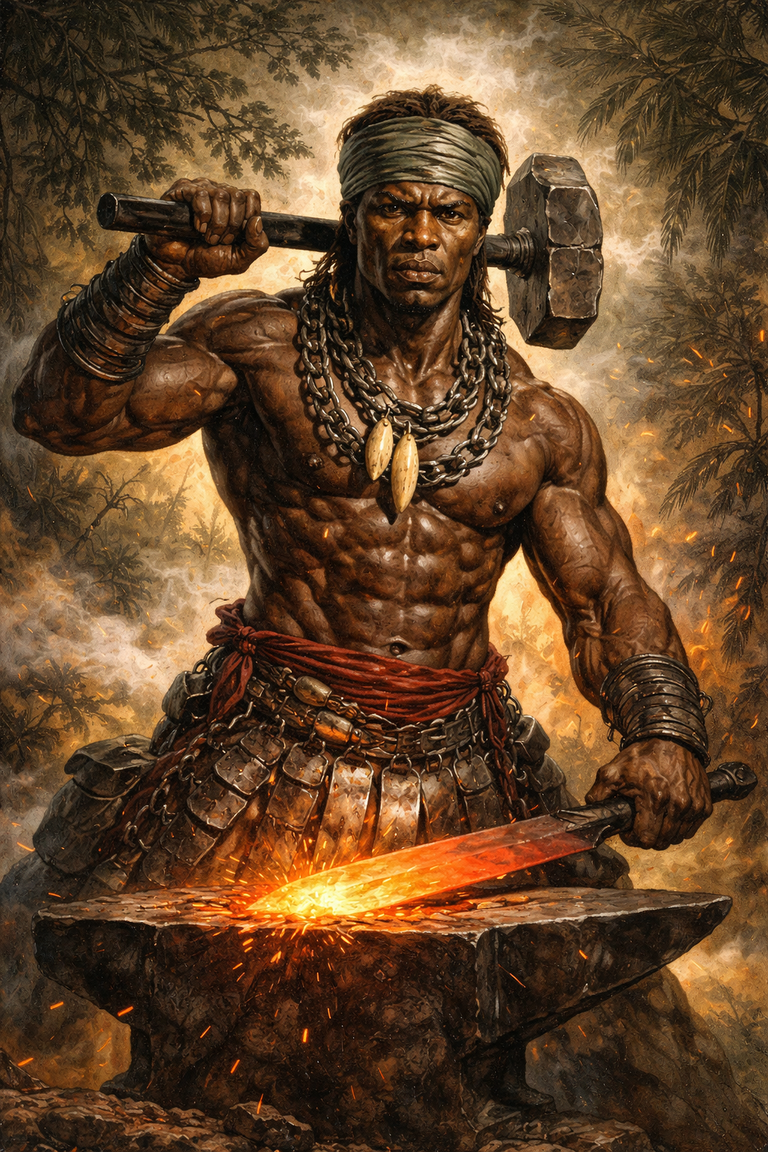
Ogun is the orisha of iron, metallurgy, and war. At first glance, he is the archetypal warrior. But in Yoruba logic, iron is not only the weapon—it is also the tool. Ogun governs what cuts through the forest, opens a path, builds a world. He is the power that makes infrastructure possible: the machete that clears land, the blade that shapes, the material that bends to will.
This ambivalence is fundamental. Ogun teaches that technology is never neutral. It can protect or destroy. It can nourish a community or bring it to its knees. In the stories, Ogun is often feared as much as he is honored: respected because his strength is useful, feared because it can spiral out of control.
Politically, Ogun is the figure of material sovereignty: a people’s capacity to produce, transform, and defend itself. Without iron, no tools. Without tools, no control of territory. Without control, no lasting freedom. Ogun is a blunt reminder: societies do not survive on ideals alone. They survive on techniques, bodies, resources—and limits placed on violence.
3) Yemoja (Yemaya): the sea as matrix and border
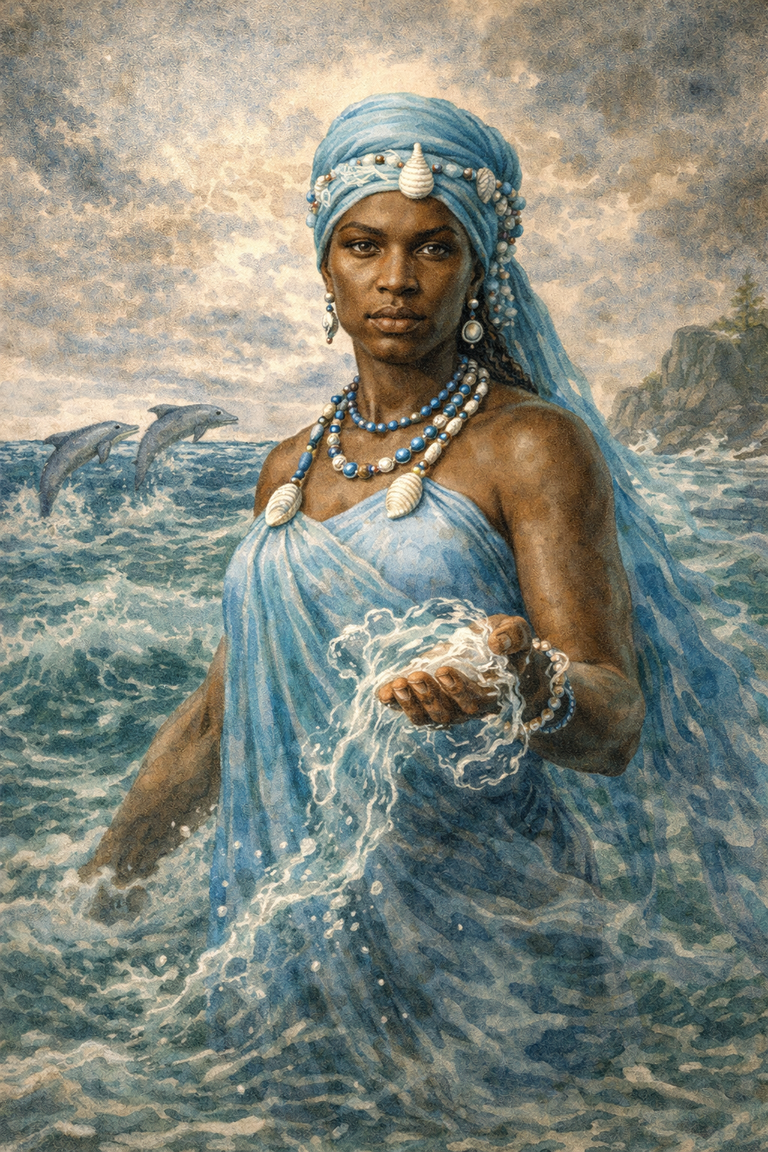
Yemoja is often presented as the “mother of waters,” “queen of the sea,” a protective maternal figure. And this is true: she is associated with fertility, protection, and the origin of life. But to reduce Yemoja to gentleness would be a mistake. The ocean protects and engulfs. It carries and it shatters. It preserves memory and it erases it.
Yemoja is especially important for understanding the transatlantic dimension of the orishas. In several diasporic traditions—particularly in Brazil and Cuba—her figure became strongly associated with the sea, navigation, and destiny. This shift (from river to ocean, depending on variants) is not a minor nuance; it is a historical rereading. In the diaspora, the sea is not merely a natural element. It is a site of trauma, separation, and survival. Yemoja thus becomes a power of consolation, but also a sovereign of borders—those one crosses, and those one does not choose.
Politically, Yemoja embodies collective protection: the community as matrix. She reminds us that a people’s strength does not rest only on its warriors, but on its mothers, its systems of mutual aid, its capacity to keep children—and memory—alive.
4) Osun (Oshun): the sweetness that governs
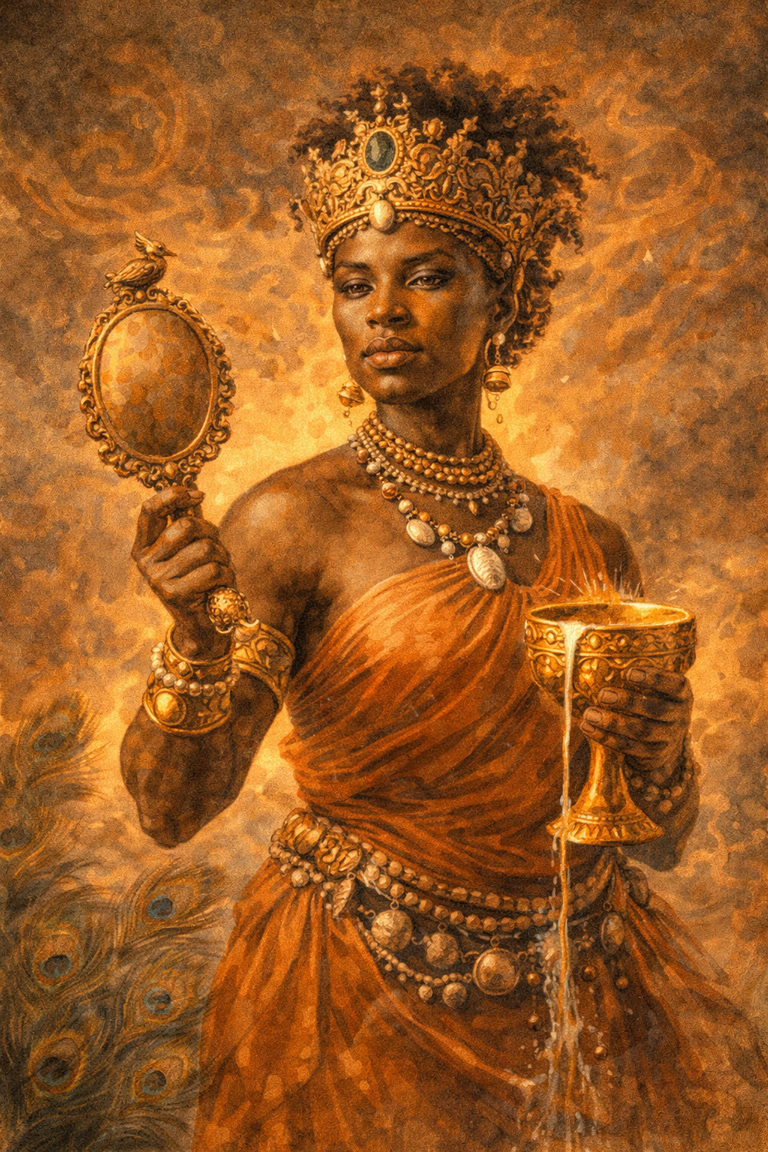
Osun, orisha of fresh waters, beauty, love, and fertility, is often reduced to a cliché: the “charming” goddess. But Osun is more dangerous than her image suggests. She governs circulation: water, affection, wealth, prosperity. She is linked to the river that nourishes, irrigates, connects. To govern circulation is to govern life.
Osun reminds us of a political truth: there are non-martial forms of power. Powers that do not brandish blades yet determine social equilibrium. Desire, alliance, fertility, attraction—these forces build or destroy societies. Gentleness is not the absence of strength; it is another strength.
In many stories, Osun appears as the one who restores harmony—sometimes through cunning, sometimes through seduction, sometimes through invisible diplomacy. Her symbols (often associated with honey and sweetness) are not confections; they are a politics of cohesion. Osun teaches that the world also holds together through what soothes, repairs, and connects.
5) Oya (Iyansan): wind, rupture, queen of change
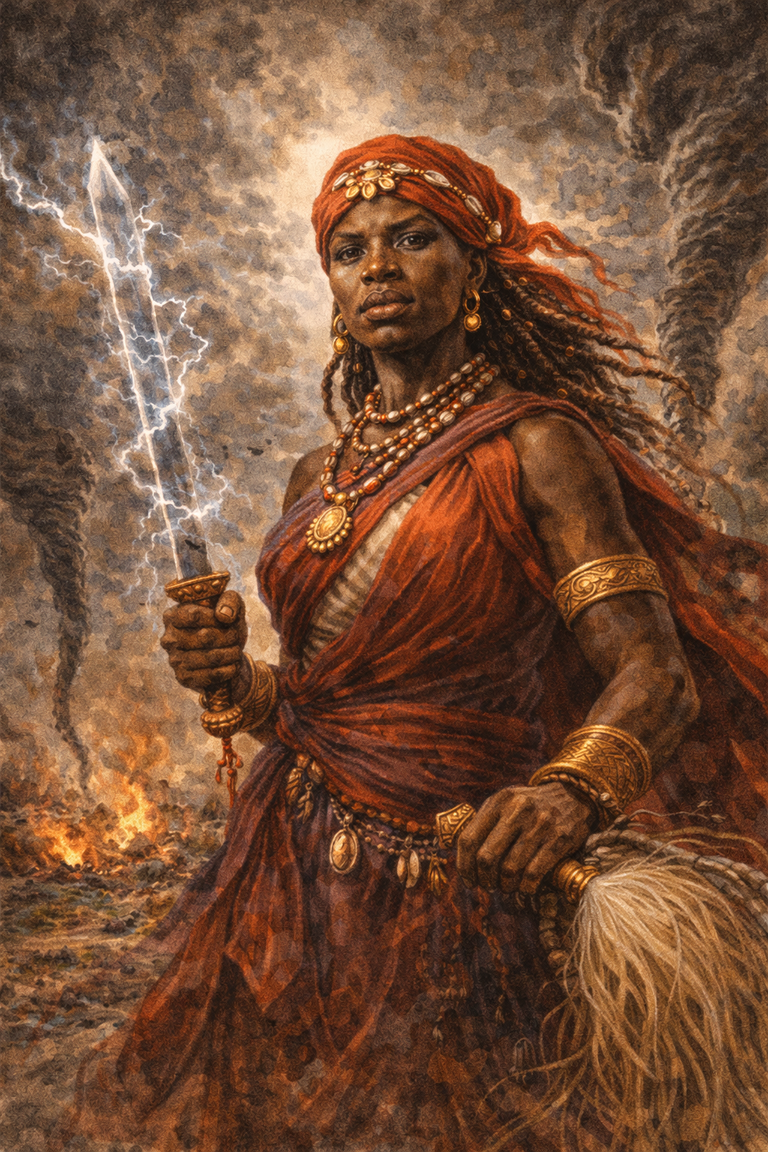
Oya is the orisha of wind, storms, and transformation. She is the power of upheaval. Where Shango cuts, Oya overturns. Where Ogun opens a path, Oya changes the direction of the world.
In some traditions, Oya is linked to the spirits of the dead—the ancestors, the forces of the beyond. She governs thresholds: life/death, old/new, stability/crisis. She is therefore a profoundly political orisha, embodying revolution in its original sense: the moment when order is no longer enough and mutation becomes necessary.
Oya is not merely destructive. She is also the promise of regeneration. The wind that tears apart is also the wind that cleanses. In the history of peoples, there are moments when “calm” is a form of submission. Oya reminds us that there is a violence of the status quo—and that change can be a moral necessity.
6) Oxossi (Oshosi): justice as precision
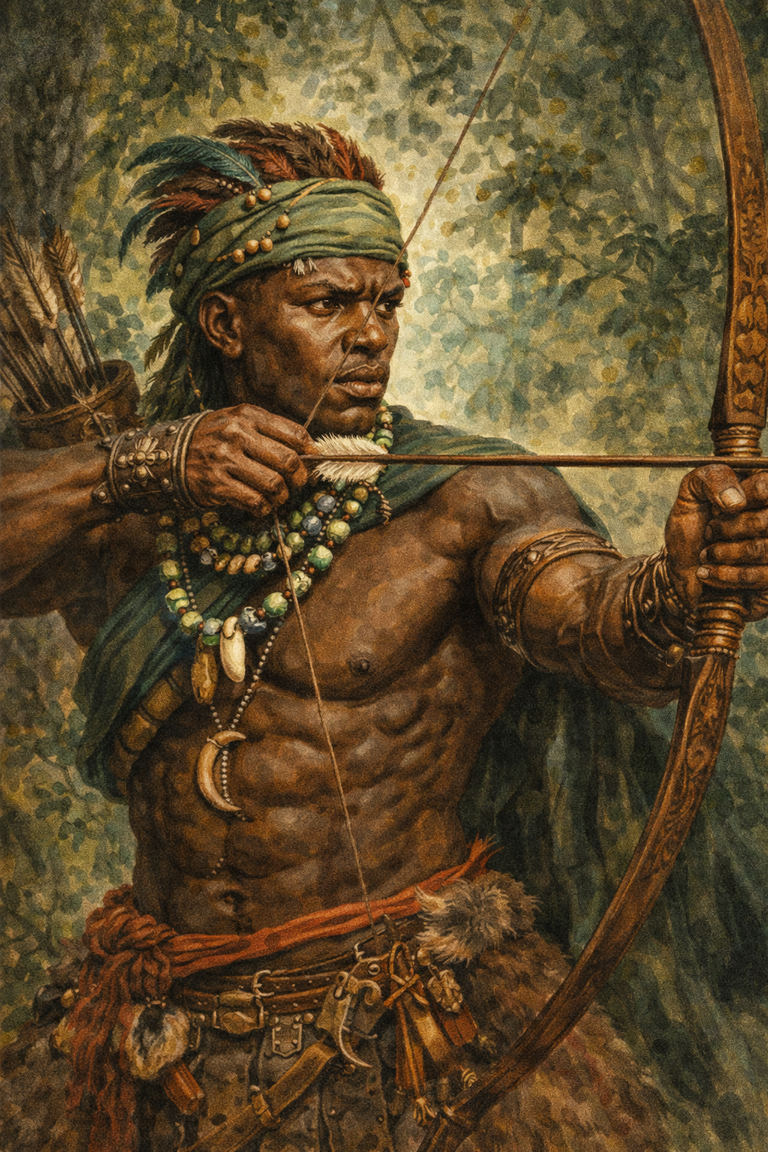
Oxossi is the divine hunter: bow, arrow, forest, prey. But his domain extends far beyond the hunt. Oxossi is the orisha of precision: hitting the target, finding what is hidden, seeing clearly through the thickness of the world.
This is why he is often associated with justice—not justice as thunder (Shango), but justice as discernment. Oxossi says: before punishing, one must understand. Before acting, one must aim accurately. In society, this capacity is strategic: it is the difference between protection and blind violence.
Oxossi embodies another form of power: situated knowledge, field intelligence, patient understanding. Politically, he reminds us that force is worthless without information, and that a community also defends itself through vigilance, reading signs, and the art of anticipation.
7) Eshu: the crossroads, crisis, and the truth of language
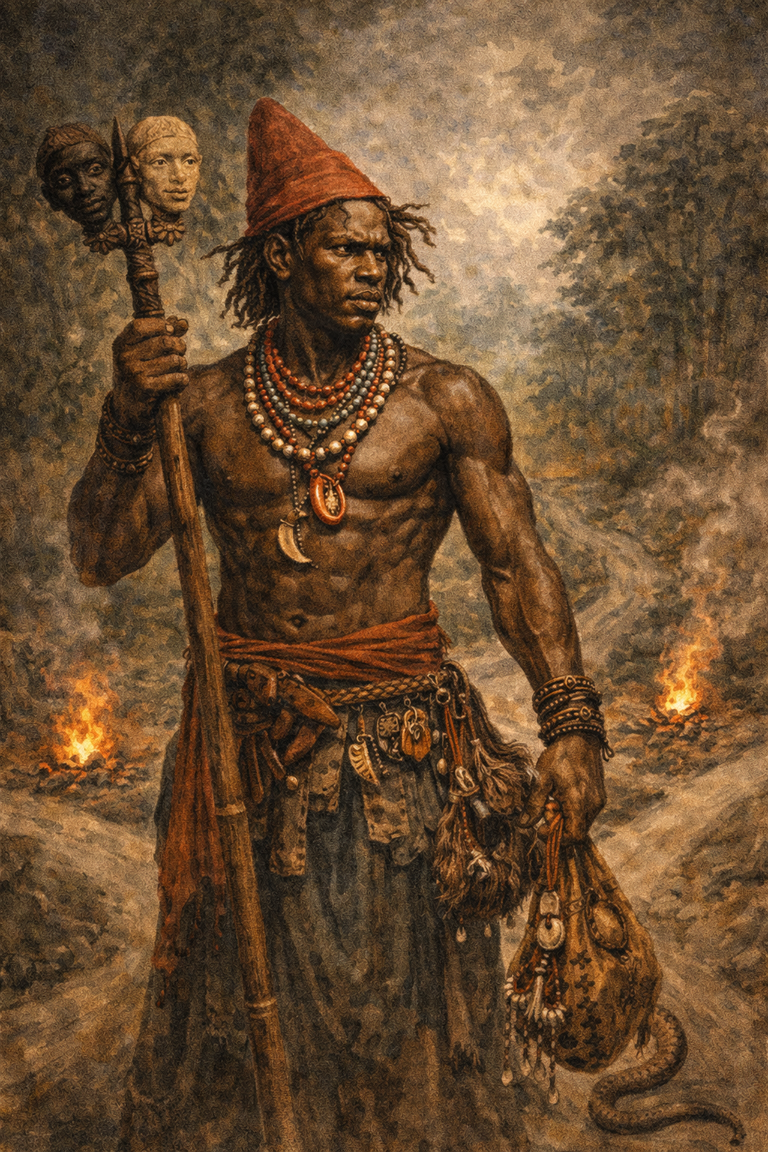
Eshu is one of the most misunderstood orishas, especially in Westernized accounts that wrongly equated him with the “devil.” Eshu is first and foremost the messenger, the mediator, the power of the crossroads. He governs thresholds: roads, markets, passages, decisions.
Why is he so feared? Because he reveals a truth many prefer to ignore: the world is permeated by ambiguity. Intentions contradict themselves. Words turn against their speakers. Decisions produce unforeseen effects. Eshu is not “evil”; he is the complexity of reality.
Politically, Eshu is central. No society survives without negotiation, translation, and conflict management. The crossroads is where choices are made—and where mistakes occur. Eshu reminds us that power also depends on meaning: whoever controls interpretation controls action. And whoever refuses to acknowledge Eshu (within ritual logics) condemns themselves to blindness—that is, to error.
8) Babalú-Ayé (Obaluaye): disease, stigma, healing
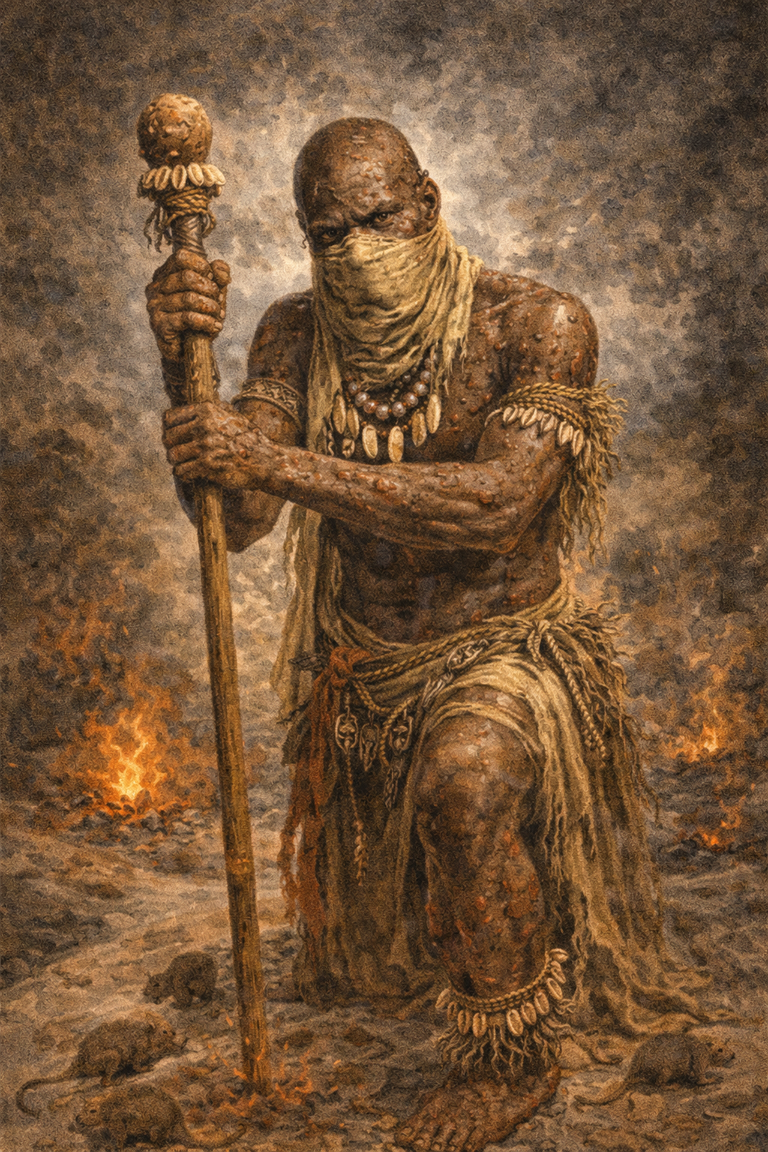
Babalú-Ayé is the orisha associated with illness and healing, sometimes linked to smallpox or other epidemic afflictions depending on tradition. He carries a harsh political truth: health is a question of power. Who has access to care? Who is protected? Who is isolated, stigmatized, forgotten?
In the narratives, Babalú-Ayé may be feared because he “brings” disease, but he is also honored because he “grants” healing. This duality is not contradictory. It teaches that illness is not only biological—it is social. It reveals the fractures of the collective.
Babalú-Ayé reminds us that to govern is also to protect bodies, and that a society’s ethics are legible in how it treats the most vulnerable: the sick, the poor, the excluded. His cult often emphasizes compassion, respect, and responsibility. It is a politics of care—and a critique of indifference.
9) Oba: loyalty, sacrifice, wounded dignity
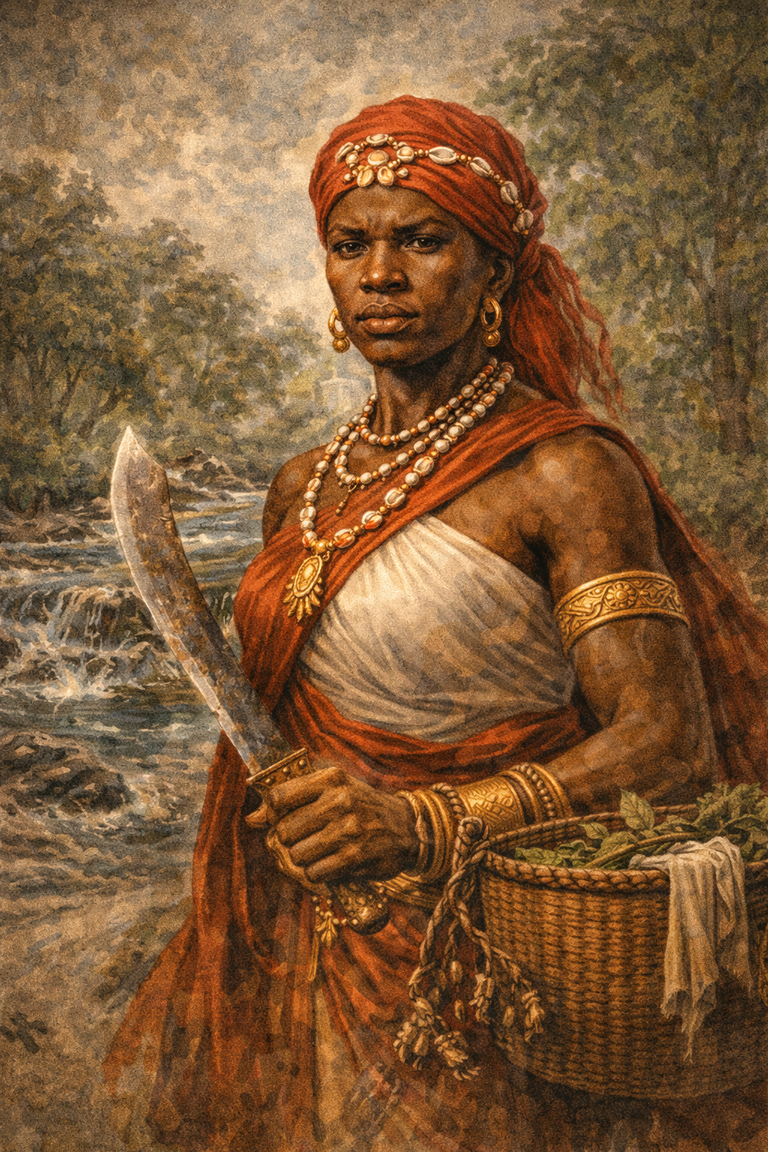
Oba is an orisha associated with a river (the Oba River) and, in many narratives, with the circle of Shango. She is often described as a figure of loyalty, stability, and conjugal bond. Her best-known myth (the “ear” myth), which exists in several variants, centers on one idea: love can become a terrain of symbolic violence. Relationship can demand a price.
Oba represents the politics of intimacy—what social order does to bodies, to women, to dignity. Where Shango speaks of public justice, Oba speaks of domestic justice. Where Ogun speaks of iron, Oba speaks of attachment. And this is essential: civilizations do not endure only through wars, but through alliances, marriages, loyalties—and the wounds they produce.
Oba is not “weak.” She is tragic. She teaches that stability has a cost, that loyalty can be a strength but also an exploitation, and that one must learn to distinguish between loyalty that builds and loyalty that destroys.
Notes and references
- Cambridge University Press — Yoruba Art and Language, chapter on Àṣẹ (Ase).
- J. A. I. Bewaji, “Olodumare: God in Yoruba Belief and the Theistic Problem of Evil,” African Studies Quarterly, 1998.
- World History Encyclopedia, “Orisha,” October 6, 2021.
Table of contents
- Shango: Justice That Falls from the Sky
- Ogun: Iron, War (and the Road)
- Yemoja (Yemaya): The Sea as Matrix and Border
- Osun (Oshun): The Sweetness That Governs
- Oya (Iyansan): Wind, Rupture, Queen of Change
- Oxossi (Oshosi): Justice as Precision
- Eshu: The Crossroads, Crisis, and the Truth of Language
- Babalú-Ayé (Obaluaye): Disease, Stigma, Healing
- Oba: Loyalty, Sacrifice, Wounded Dignity


