

A major figure in Afro-Brazilian popular devotion, Escrava Anastácia is portrayed with an iron mask over her mouth and a torture collar around her neck. Her story intertwines slavery, faith, Black memory, sexual violence, female resistance, and popular worship. Even though her historical existence remains debated, Anastácia has become in Brazil a powerful symbol of dignity, suffering, and liberation.
Escrava Anastácia: history, worship, and memory of Brazil’s gagged Black saint
In the religious and political imagination of Black Brazil, few images strike as deeply as that of Escrava Anastácia. A Black woman with light-colored eyes, often depicted with blue eyes, her face sealed by an iron mask, her neck constricted by a punishment collar. This iconography condenses an entire history: slavery, imposed silence, the controlled Black body, and the woman reduced at once to beauty, danger, and miracle.
Anastácia occupies a singular place in Brazilian popular culture. She is venerated as a folk saint by followers of popular Catholicism, Umbanda, and Kardecism, although the Catholic Church has never officially canonized her. Her feast day is celebrated on May 12 in certain devotional circles, and her image circulates through statues, prayer cards, medallions, candles, and private altars.
Her story remains uncertain. Accounts vary. Some present her as a woman born in Brazil, daughter of an African woman enslaved and raped by a white master. Other traditions describe her as an African princess deported to Brazil. All versions agree on one central point: Anastácia was an enslaved Black woman, punished, gagged, and later transformed by popular memory into a figure of compassion and resistance.
This historical uncertainty is part of her power. Anastácia exists at the crossroads of archive, myth, religion, and politics. She embodies less a stabilized biography than a collective memory. Through her, Afro-descendant Brazil gave a face to millions of women whose names official history erased.
Anastácia’s story belongs to the history of slaveholding Brazil, the last country in the Americas to abolish slavery, in 1888, with the Lei Áurea. For centuries, Brazil received millions of Africans deported through the Atlantic slave trade. The slave system structured the economy, the plantation, the city, the family, religion, sexuality, and racial hierarchies.
Within this order, Black women’s bodies endured a specific form of violence. They worked, gave birth, served, endured the sexual domination of masters and the jealousy of mistresses. Their beauty could become a danger. Their words could become a threat. Their refusal could be punished through the flesh itself.
The stories surrounding Anastácia condense all of these dimensions. In some versions, she resists the advances or attempted rape of her master. In others, she is punished for helping enslaved people escape. Elsewhere, her beauty provokes the jealousy of a white mistress. These variations tell the story of the same system: slave society transforms the Black woman into an object of desire, a domestic threat, an available body, and then into a culprit the moment she asserts her dignity.
The iron mask then becomes the central symbol. It seals the mouth, prevents speech, restricts eating, controls the body. It gives material form to what slavery imposes symbolically: reducing a human being to silence.
Anastácia’s image became so powerful because it visually expresses what the archives often describe coldly. Slavery speaks through inventories, bills of sale, runaway notices, and judicial records. Anastácia speaks through a gagged face.
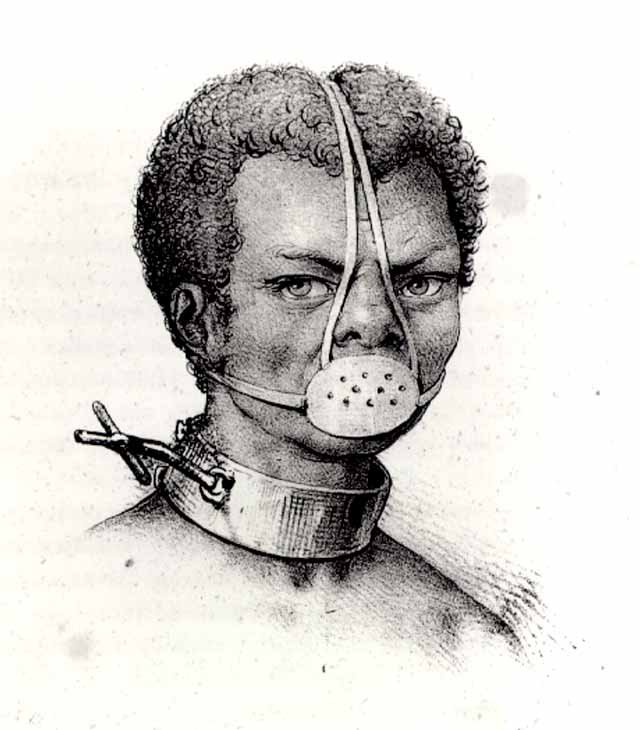
Anastácia’s mask dominates her iconography. It covers her mouth, sometimes her chin, sometimes part of her face. It recalls punishment devices used against enslaved people throughout different Atlantic contexts. It functions as a mark of discipline: preventing speech, preventing screams, preventing protest, preventing free eating.
In popular accounts, the mask punishes a woman who refused the master’s order. The refusal changes form depending on the version: sexual refusal, moral refusal, assistance in escape, unbroken dignity. But the motif remains constant: Anastácia is punished for a power slavery seeks to destroy.
This image explains her contemporary force. The mask can be read as a visual archive of the denial of Black speech. It points to all forbidden voices: those of enslaved women, deported Africans, descendants silenced in national narratives, marginalized Afro-Brazilian beliefs, and the poor and imprisoned who recognize themselves in her suffering.
Anastácia thus becomes a paradoxical figure of speech. Her image shows her mute, yet her cult gives her a voice. Devotees speak to her, asking for help, protection, healing, and justice. This devotional dialogue transforms imposed silence into spiritual power.
Anastácia belongs to the realm of popular Catholicism. She is prayed to, invoked, and honored, but her sainthood has never received official recognition from the Catholic Church. In this sense, she resembles many popular religious figures across Latin America: locally venerated dead, martyrs of the people, healing figures, characters suspended between history, legend, and faith.
Her cult also extends beyond popular Catholicism. She is venerated by followers of Umbanda and Kardecism. She may even be integrated into the universe of the pretos velhos, those spiritual figures associated with formerly enslaved Black elders in certain Afro-Brazilian traditions.
This circulation between traditions is essential. Religious Brazil functions through crossings, translations, and overlays. Catholic saints may coexist with Afro-Brazilian entities. Popular prayers may merge with healing practices. A figure like Anastácia can become a bridge between historical pain, spiritual intercession, and Black identity.
Anastácia’s popularity also comes from her closeness to ordinary believers. She suffers, she heals, she listens. She belongs to the humiliated. Stories claim she performed healing miracles, including for the children of her oppressors, and that she forgave those who tortured her.
The veneration of Anastácia reached a major turning point in 1968. In Rio de Janeiro, the Black Museum, located in the annex of the Church of Our Lady of the Rosary of Black Men and Saint Benedict, organized an exhibition marking the 80th anniversary of the Lei Áurea, the law that abolished slavery in Brazil in 1888. Among the exhibited works was an engraving depicting a Black woman wearing a punishment mask. The image quickly attracted popular devotion.
This moment proved decisive. Anastácia entered a new phase of visibility. Members of the Brotherhood of Black Men began collecting stories about her during the 1970s. By the 1980s, her cult had expanded beyond a predominantly Black and poor audience, also reaching progressive white middle-class circles.
This expansion must be understood within Brazil’s political context. Between the 1960s and 1980s, new questions emerged around racism, the memory of slavery, Black movements, the place of women, and Afro-Brazilian identities. Anastácia became available for multiple readings: religious, feminine, racial, and political.
In 1984, a canonization attempt financed by Petrobras brought additional attention to the cult. Anastácia was then presented as a symbol of racial harmony. This formulation says much about Brazil: a country that often prefers to imagine its racial history through the language of mixture, peace, and reconciliation, while still carrying deep inequalities inherited from slavery.
Accounts often describe Anastácia as a woman of extraordinary beauty, with piercing blue eyes. This characteristic played an important role in her iconography. She appears this way in statues, prayer cards, and popular representations.
This beauty is not a decorative detail. It structures the violence of the story. In some versions, Anastácia is the product of a rape committed by a white master against an enslaved African woman. Her blue eyes then become the visible proof of colonial sexual violence. In other stories, her beauty provokes the mistress’s jealousy or the master’s desire. In every case, Anastácia’s body becomes a site of conflict.
Slave society produced countless children born from sexual violence, coercive relationships, or profoundly unequal power dynamics. Official narratives often concealed this reality behind the language of racial mixing. Anastácia reminds us of the violent face of that history. In the popular imagination, her blue eyes do not tell a story of harmonious blending; they tell a story of domination.
Anastácia’s image has been adopted by several social movements. She has served as a symbol in causes linked to liberation, rebellion, women’s rights, and the fight against racism. Her image was reportedly used during a 1988 anti-racism march, the centennial year of abolition in Brazil.
This appropriation makes sense. Anastácia gives a feminine face to the memory of slavery. She allows people to think together about racism, misogyny, sexual violence, popular religion, and resistance. She speaks to Black women because she carries a historical experience in which the Black female body was exploited, monitored, sexualized, punished, and sacralized.
In everyday practices, millions of Brazilian women use her image in the form of cards, medallions, prayers, or devotional objects. This domestic presence matters. Anastácia’s memory lives in handbags, bedrooms, altars, wallets, whispered prayers, and requests for healing and protection.
In 1990, a mini-series titled Escrava Anastácia was produced for Brazilian television. Directed by Henrique Martins, written by Paulo César Coutinho, and starring Ângela Correa, it portrays Anastácia as a Nigerian princess captured by slave traders, sold to a cruel master, and punished with the mask after rejecting his sexual advances.
Television played a major role here. It fixed one version of the myth. It gave the broader public a more romanticized, narrative, and identifiable Anastácia. It reinforced the image of the African princess, the noble victim, the woman martyred by a violent master.
But the mini-series also introduced new elements. The image of Anastácia healing the son of her oppressors was an innovation developed by the program itself. This detail matters. It shows how popular culture enriches religious narratives, and how these additions can later become integrated into collective memory.
The power of an image also explains its distortions. In May 2020, during a protest in California against Covid-19 public health measures, a demonstrator held a sign using Anastácia’s image alongside the slogan:
“Muzzles are for dogs and slaves. I am a human being.” “Muzzles are for dogs and slaves. I am a human being.”

The woman later claimed she did not know the meaning of the image. Historians and observers identified Anastácia and condemned the offensive use of a figure tied to slavery in order to compare public health masks to mass oppression.
This controversy reveals a broader phenomenon: images of Black suffering often circulate outside their historical context. They are torn away from their memory and used in struggles that erase the historical violence from which they emerged. Anastácia’s image, diverted into an American public health debate, thus becomes a symptom of ignorance about slavery and of the irresponsible use of Black visual archives.
This type of distortion makes contextualization all the more necessary. Anastácia is not an image available for any comparison whatsoever. She carries the memory of a system of racial, sexual, and social domination. Her mask belongs to the history of slavery, not to the banal repertoire of contemporary protest.


In 2019, Brazilian artist Yhuri Cruz proposed a major reinterpretation: Anastácia Livre, “Free Anastácia.” He reworked the traditional image attributed to Jacques Arago, but removed the torture mask from her mouth. The collar became jewelry. Anastácia appeared with a secret smile. White camellias, symbols of abolitionism and emancipation in Brazil, accompanied her.
This artistic gesture is considerable. For decades, Anastácia had been recognizable through the instruments of her torture. Yhuri Cruz proposed making her recognizable through her freedom. The shift is political: it redirects the gaze from suffering to dignity, from punishment to sovereignty, from the gag to the voice.
This reinterpretation raises an essential question for Afro-descendant memory: how can the victims of slavery be represented without imprisoning them forever within the image of their torment? Memory needs to show violence. But it also needs to imagine the defeated outside the instruments that humiliated them.
Anastácia Livre does not erase history. It shifts the center of gravity. It reminds us that the Black woman behind the mask existed before the punishment, and continues to exist beyond it. It gives a future to an icon long frozen in pain.
Anastácia’s precise historical existence remains disputed. The sources do not allow for the establishment of a complete biography, a certain birth date, an exact place, a stable genealogy, or a definitive archive.
But biographical uncertainty does not erase her memorial truth. Many popular figures emerge this way: from traces, images, collective suffering, transmitted stories, and spiritual and political needs. Anastácia condenses the real experiences lived by countless enslaved women, even if her individual story remains difficult to stabilize.
She became a figure because she makes it possible to name what exceeds a single individual. She represents the gagged Black woman. The captive who heals. Punished beauty. Forbidden speech. The victim transformed into an intercessor. Black memory refusing erasure.
From this perspective, the central question becomes: why did so many people need her?
The answer lies in the history of Brazil. A country built on slavery long lacked spaces to mourn the enslaved, honor Black women, recognize sexual violence, name structural racism, and transform pain into collective strength. Anastácia filled part of that void.
The gagged woman who found her voice
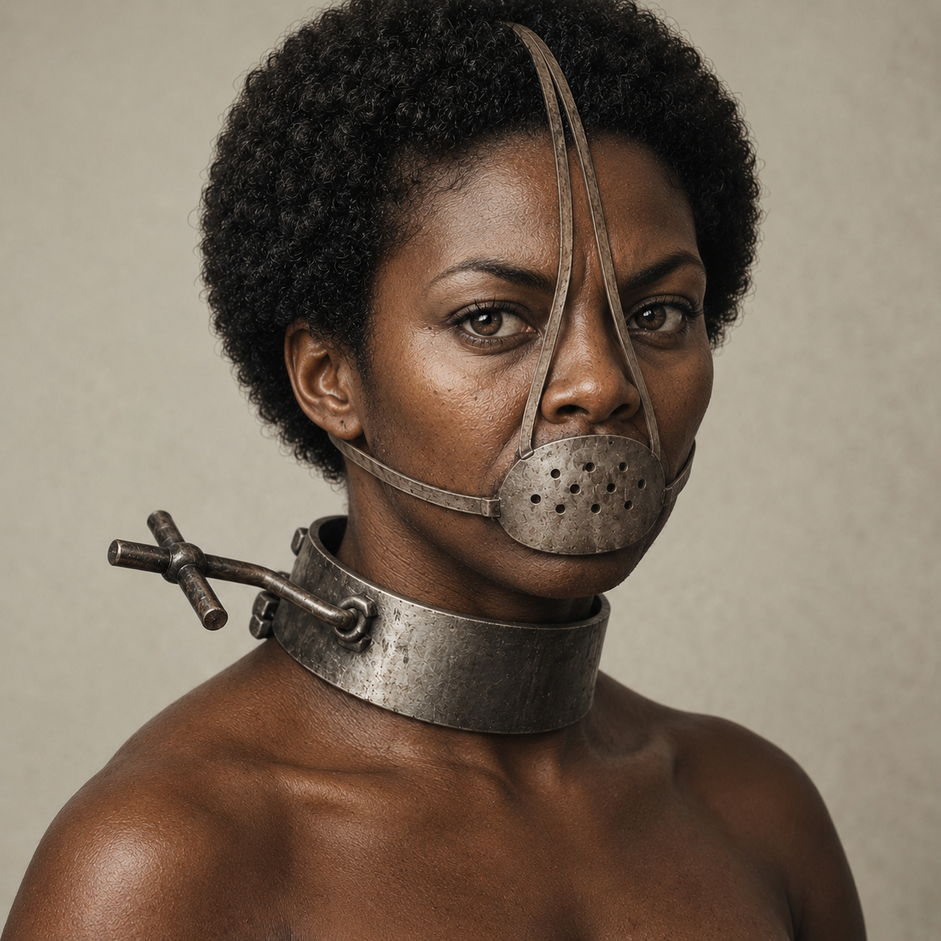
Escrava Anastácia belongs among the great Afro-Atlantic figures of Black memory. She stands between history and legend, between popular Catholicism and Afro-Brazilian religions, between suffering and healing, between the colonial archive and contemporary art. Her mask tells the story of imposed silence. Her cult tells the story of recovered speech.
Through her, Brazil confronts a deep part of itself: the violence of slavery, the domination of Black women, the hypocrisy of racial harmony, the power of popular devotions, and the ability of Afro-descendant communities to transform images of torment into symbols of dignity.
Anastácia remains a controversial, debated, and constantly reinterpreted figure. Yet her image continues to act. She inspires prayers, marches, artworks, debates, refusals, and acts of reclamation. She reminds us that Black memory lives through the icons people choose to carry. For generations, Anastácia was depicted with her mouth sealed by iron. Today, her image speaks.
Notes and references
- Escrava Anastacia, wikipedia.org.
- Kelly Hayes and Jerome Handler, “Escrava Anastácia: The Iconographic History of a Brazilian Popular Saint,” African Diaspora, vol. 2, no. 1, 2009, pp. 25–51.
- John Burdick, Blessed Anastácia: Women, Race, and Popular Christianity in Brazil, Routledge, 1998.
- Marc Hertzman and Giovana Xavier, “Let’s Build a Monument to Anastácia,” Public Seminar, July 30, 2020.
- Edilson Pereira, “From slavery to freedom: the image of Anastácia between contemporary art, politics, and religion,” Horizontes Antropológicos, vol. 29, no. 67, 2023.

