

Goddess of war and epidemics, Sekhmet is one of the most feared deities of ancient Egypt.
Sekhmet
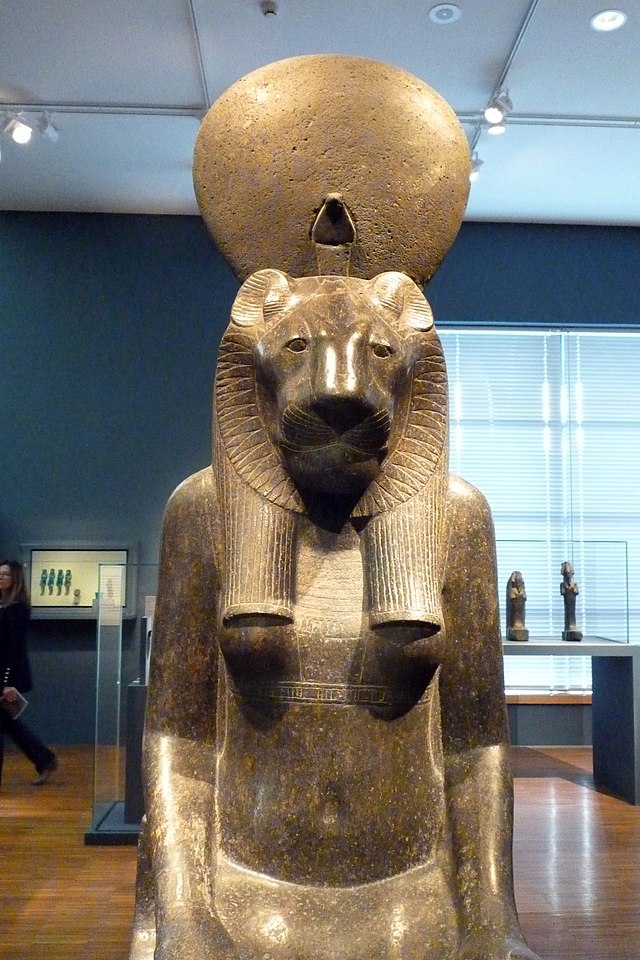
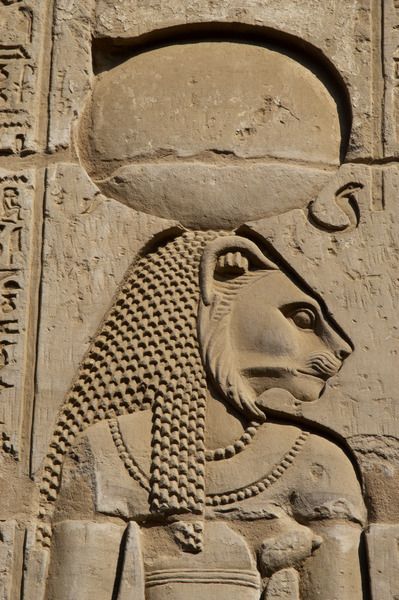
Sekhmet is one of the most important ancient Egyptian deities. Egyptian texts and art attest to her presence as early as the Old Kingdom period, in the third millennium BCE. From that time on, she was considered to be closely associated with the pharaoh. She is thus depicted nursing the young king Niuserre or described as having ‘conceived’ the pharaoh Unas. Sekhmet is represented in Egyptian art as a woman with a lioness head. Her head was sometimes adorned with a solar disk and a uraeus, a cobra symbolizing the defense against the enemies of royal power.
A connection with foreign lands
Sekhmet appears to have a particular link with regions west of the Nile Valley. She was thus described as the goddess of the Western Desert and the one who commands the Tjehenou. The Tjehenou are the populations referred to as ‘Libyans’ most anciently attested in Egyptian documents. They are depicted with a dark skin similar to that of ancient Egyptians. Later still, in a funerary text called the Book of Gates, Horus protects the Egyptians and Nubio-Sudanese. Sekhmet, for her part, is described as protecting the Asians and the Tjemehou, the ‘Libyans’ with lighter skin who succeeded the Tjehenou in the Western Desert.
War and epidemics
Sekhmet was associated with war and epidemics. Her aspect was dual. She was considered one of the main protectors of royal power. She was invoked to defend the pharaoh against his enemies. From a cosmic point of view, she was considered a protector of the sun during its daily journey in the sky and under the earth. In his boat, the sun god Ra had to confront his underground enemy Apophis. If the latter prevailed, the sun would not reappear. The balance of the world would then be threatened. To maintain it, deities accompanied Ra in his boat. One of these deities was Sekhmet.
Her other main function concerned diseases. The ancient Egyptians considered Sekhmet responsible for various ailments and epidemics, particularly those accompanying the return of the flood each year. Sekhmet was therefore extremely feared by the ancient Egyptians, who sought to appease her through a number of rituals. In this respect, Sekhmet was considered potentially an anti-ma’at entity threatening the balance of the world. The link the Egyptians made between Sekhmet and medicine was very close. The priests of Sekhmet were considered the foremost physicians of the land. Their compatriots saw them as the only ones capable of calming the fury of the deity, which manifested itself in illness.
The name Sekhmet reflects well this fear directed toward her. It means ‘the powerful one’.
Myths
Sekhmet was considered the Eye of Ra, or by a play on words, the action of Ra. The most famous myth in which she appears is that of the destruction of Humanity. In it, Ra, king of Egypt, discovers a plot launched by some of his subjects to overthrow him. To punish them, he sends his eye in the form of Sekhmet to punish the rebels. But she soon escapes Ra’s control and continues her massacre despite his will. Ra manages to stop her by pouring in her path beer dyed red in place of the blood she expected to find. Drunk, Sekhmet stops her massacre. The land is saved, but Ra, deeply disappointed by the behavior of humans, decides to leave the earthly world and withdraw to the sky, leaving his Prime Minister Thoth in his place.
The myth has several meanings and functions. It illustrates the cycle of the sun in the sky. It is also likely a reference to a ritual involving bloody animal sacrifices. The meat that was then consumed, if spoiled, could cause diseases or epidemics. These, as we have seen, were considered to result from the anger of Sekhmet. To avoid this, the priests of Sekhmet drained the sacrificial animals of their blood in a sanitary practice foreshadowing, or perhaps even inspiring, that of Jewish kosher and Muslim halal.
Sekhmet also appears in the myth of the Distant Goddess. In it, as in the myth of the Destruction of Humanity, Ra had sent his eye which had not returned. This eye could be embodied by Sekhmet or by other lioness goddesses. Ra then sent other deities to bring back the eye, which they succeeded in doing. However, when it returned, the eye realized it had been replaced by Ra. To appease it, he placed it on his forehead in the form of the uraeus. Like the myth of the Destruction of Humanity where Sekhmet is drowned and appeased in a pool of beer, the myth of the distant goddess is likely a reference to the return of the Nile flood. Essential for the country’s agriculture, the possibility that it might not return each year was greatly feared by the ancient Egyptians.
Sekhmet and the modern Black world
Sekhmet has a number of parallels in the modern African Black world.
Sekhmet has much in common with a West African deity called Sakpata among the Ewe, the Adja and the Fon of Togo, Benin and Ghana. During epidemics caused by Sakpata, for example, blood was not to be spilled on the ground, otherwise his anger would intensify and the epidemic would spread. In the same way, a Fon tale recounts how Sakpata was prevented by the supreme being from continuing his many massacres.
There is an equivalent of Sakpata among populations neighboring the Fon, the Yoruba. Sakpata is there called Shankpannan. In the 1980s, Anthony Buckley recorded the following statements from a Yoruba traditionalist from Nigeria named Fatoogun:
Yes, Shankpannan does both good and evil. Every spirit can help people in its own way. Shankpannan is also the owner of the sun and we all know that the sun does us good. He is also responsible for the movements of the sun in the sky like a canoe.
(…)
When Shankpannan arrives in the world, he is accompanied by Eburu, also called woroko (a type of spirits). These are things that cause the bad wind. When this bad wind blows on anyone, they will turn into smallpox. Shankpannan uses a type of arrow known as Ofa Shankpannan. When he shoots an arrow into the air, smallpox will strike the person, tree or animal—whatever the wind of the arrow touches. Woroko comes out of the arrow in the form of a wind.
(…)
These passages suggest an interesting parallel with Sekhmet, her ambivalence, the fact that she is associated with the sun, that she protects it, and above all that she is responsible for its movements in a boat in the sky, exactly like Sekhmet in Ra’s boat.
Furthermore, it is interesting to note that Shankpannan, like Sekhmet, shoots arrows to strike their victims with disease. Among the Yoruba, spirits emerge from the arrow. In ancient Egypt, the word used for the arrows of Sekhmet is the same as that for her demons.
The word Sekhmet, as mentioned, means the powerful one. sḫm means ‘powerful’ and the suffix -t marks the feminine in ancient Egyptian. In Black Africa, the word sḫm has parallels in languages spoken by Black populations such as Kikongo sik-am-a ‘to be solid’ or Swahili and Kinyarwanda sukuma ‘to push, to incite, to give courage’.
From a constructive linguistic perspective, in Swahili, the future pan-African language, sukuma could be used to signify proper or figurative references to Sekhmet and what she embodies. Sekhmet was a female warrior entity, and the word msukumi (wa kike) ‘she who pushes, who encourages’ could be used to designate women who, like Sekhmet, are combative or warrior-like.
As for the deity Sekhmet in its earliest sense, msukumizi could serve to designate her with the meaning of one who blames, who causes disease. In the same way, kisukumi refers to a woman suffering from a sore on her intimate parts that can cost the lives of several of her successive husbands, which could correspond to the epidemic nature of the afflictions caused by Sekhmet, with the added feminine character.


