

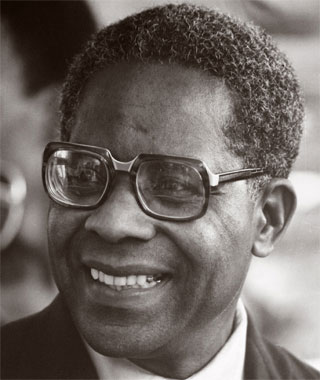
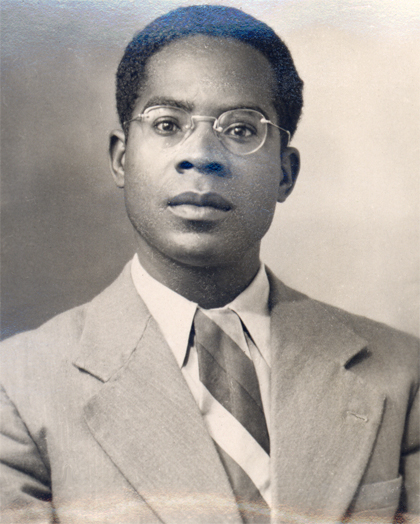
Speech delivered by Aimé Césaire in Dakar, on April 6, 1966, as part of the “Colloquium on Art in the Life of the People,” which marked the opening of the First World Festival of Negro Arts (March 30–April 21, 1966).
Speech by Aimé Césaire at the First World Festival of Negro Arts
Mr. President,
Ladies and Gentlemen,
First of all, I would like to share with you the hesitations I had about speaking at this colloquium. I am in no way a man of science, in no way an expert, and I am aware that in such an assembly, I have far more to learn than to teach.
Therefore, I ask you to see this intervention only as the expression of my desire to tell you how deeply interested I have been in your work and to submit, as a contribution, a few reflections born from my experience as a man of culture, as a poet, as a West Indian man in relation to mother Africa.
The theme of this colloquium is formulated as follows: “Function and meaning of Negro-African art in the life of the people and by the people.”
I believe that to answer this particular question, the simplest way is first to pose a more general question and attempt to answer it. That question would be: “Function and meaning of art in the modern world.”

In other words, before speaking about African art and its meaning for modern Africa, it seems better to speak about art in general and its function in the world at large. Why, in the world as it is, has it seemed essential to the organizers of this colloquium, and why does it seem essential to us men of culture, to emphasize the function of art? After all, art is not the whole of culture; it is only one aspect of it. So why privilege this aspect over others?
I would answer that it is a sign of the times, and that if we have deliberately chosen to privilege art, it is because we believe that never before has the world needed art so much.
Whether one likes it or not, there currently exists a dominant and sprawling civilization: the Euro-American civilization, the industrial civilization that covers the world with its network and now reaches—even to the most remote parts of the globe, since it is clear that we have entered the era of a finite world.
There is no need to recall the merits of this European civilization. They are numerous and striking. But to understand the role of art, our need for art and poetry, it is rather its negative side that must be recalled.
The man of European civilization is a man who developed a system of thought that allowed him to conquer and dominate nature. But a strange misfortune befell this conqueror: he ended up being defeated by his own power. He became the prisoner and victim of the concepts and categories he had invented to grasp the world.
What is it about? It is about the substitution, for the dialectical totality that is the world, the substitution for the concrete and heterogeneous world—therefore rich and varied—of a veritable algebra of homogenized and dissociated abstractions representing a summary of the world, convenient no doubt but corresponding to an impoverishment and a substitute for the world. The consequences, you know them: the emergence of a mechanized world, a world of efficiency, but also a world where man himself becomes a thing, a world where time is no longer time, but a kind of space filled with quantitatively measurable things.

In short, we are faced with a progressive devaluation of the world which quite naturally leads to the emergence of an inhuman universe, along whose trajectory lie contempt, war, and the exploitation of man by man.
It is this invasion of the world and of man by things, this process of reification of the world established by European culture within society, that explains why the need for art and poetry today is truly a vital need, in the sense that one says art is vital for man.
Just as man needs oxygen to survive, he needs art and poetry. He knows, indeed, contrary to conceptual thought, contrary to ideology, that art and poetry restore the dialectic between man and the world. Through art, the reified world once again becomes the human world, the world of living realities, the world of communication and participation. From a collection of things, poetry becomes youth. It is that force which restores to the world its original vitality, which gives back to each thing its aura of wonder by placing it once again within the original totality.
Thus, to save poetry, to save art, is ultimately to save modern man by personalizing and revitalizing nature.
If proof were needed, I would say that one need only observe that never has the poetic need been felt so strongly, never has man clung so desperately to poetry as to a last lifeline as in the aftermath of those periods full of sound and fury called war—whether that war be hot or cold—precisely in the aftermath of those times when non-communication and reification have reached a properly intolerable degree. And here, I think of European surrealism which followed the First World War, and since I speak in the name of the poets of Africa and of French-speaking Africa, allow me to evoke here the entire poetic movement known as Négritude.

My dear friends, I must tell you right away that no word irritates me more than the word “Négritude” — I do not like that word at all, but since it has been used and since it has been so widely attacked, I truly believe that it would be a lack of courage to appear to abandon this notion. I do not like the word Négritude at all, and I must tell you that it always irritates me when, in international conferences where there are English- and French-speakers, this notion is introduced, which appears to me as a notion of division. Négritude is what it is; it has its qualities, it has its faults, but at the moment when it is vilified, when it is distorted, I would nevertheless like us to reflect on what the situation of the Negroes, the situation of the Negro world, was at the moment when this notion was born, almost spontaneously, so much did it respond to a need. Of course, at the present time, young people can do something else, but believe me, they would not be able to do something else today if, at a certain moment, between 1930 and 1940, there had not been men who took the risk of establishing this movement known as Négritude. This movement of Négritude, so attacked and so disfigured, one must not forget the role it played in the awakening of the Negro world, in the awakening of Africa. When I read a sentence like the one that Saint-John Perse pronounced when he received the Nobel Prize, when he wrote this:
“When mythology collapses, it is in poetry that the divine finds refuge. Perhaps even its relay and even within the social order and immediate human sphere, when the bread-bearer of the ancient procession yields her bread to the torchbearers, it is in poetic imagination that the high passion of peoples in search of clarity is still kindled.”
If Négritude has served Africa well, it is precisely because, in the expanse of abomination and darkness, its poets have been, despite their flaws, bearers of light.
This notion of Négritude has been questioned as to whether it was not a form of racism. I believe the texts are there. One need only read them, and any reader in good faith will realize that while Négritude is a particular rooting, it is also a transcendence and a flowering into the universal.
To return to my point, I would say, with regard to Négritude, that from the perspective of reification, racism and colonialism sought to transform the Negro into a thing. The Black man was no longer perceived by the white man except through the lens of distortion, of stereotypes, for it is always from stereotypes that prejudices live. And that is racism. Racism is non-communication. It is the objectification of the other, of the Negro or of the Jew; the substitution of the other by a caricature of the other, a caricature to which one gives absolute value. The emergence of Négritude literature and Négritude poetry produced such a shock precisely because they disrupted the image that the white man had of the Black man, because they inscribed him—with his qualities, with his faults, therefore with his full humanity—into the world of abstractions and stereotypes that the white man had until then constructed about him in a unilateral way.

And that is indeed, I believe, the service that Négritude has rendered to the world. In this way, it contributed to the construction of a true humanism, of universal humanism, for there is no humanism unless it is universal, and there is no humanism without dialogue, and there can be no dialogue between a man and a caricature.
By restoring the Black man to his human stature, to his human dimension, for the first time, Négritude literature reestablished the possibility of dialogue between the white man and the Black man, and this is no small merit.
It is quite true that Négritude literature was a literature of combat, a literature of shock, and that is its honor; a war machine against colonialism and racism, and that is its justification. But that is only one aspect of Négritude, its negative aspect. If we hated colonialism so much, if we fought it so fiercely, it is no doubt because we were aware that it mutilated us, that it humiliated us, that it separated us from ourselves, and that this separation was intolerable; but it is also because we knew that it separated us from the world, that it separated us from man, from all men, including the white man—in short, that it separated us from our brother. In other words, the poet of Négritude hates racism and colonialism so deeply only because he feels that these are barriers that prevent communication from being established.
In short, if I had to define the attitude of the poet of Négritude, the poetry of Négritude, I would not allow myself to be misled by its cries, its demands, its curses.
Its cries, its demands, I would define only as a postulation—no doubt irritated, an impatient postulation—but in any case, a postulation of fraternity. And thus I come to the very subject of this colloquium: the meaning and significance of art in Africa today. One can affirm it without fear: never has Africa needed art so much. Never has it needed its art, its own art, so much. This is true, of course, for the general reasons I mentioned earlier, which are valid for the entire world. But to this are added reasons that are specific to Africa. What is the great phenomenon of modern times? It is that Africa has definitively and entirely entered into the orbit and sphere of European civilization. It is enough to say this to understand how deeply Africa is threatened. Threatened because of the impact of industrial civilization. Threatened by the internal dynamism of Europe and America. One might say to me: why speak of threat, since there is no longer a European presence in Africa, since colonialism has disappeared and Africa is independent?
Unfortunately, Africa will not get off so lightly. Of course, colonization, colonialism provided the ideal framework for this impact to operate under optimal conditions of efficiency. But it is not because colonialism has disappeared that the danger of the disintegration of African culture has disappeared. The danger is there, and everything contributes to it, with or without Europeans: political development, expanded schooling, education, urbanization, the integration of the African world into the network of global relations, and so on. In short, at the very moment when Africa is truly being born into the world, it risks, more than ever, dying to itself. This means that one must open oneself to the world with eyes wide open to the danger, and that in any case the shield of an independence that would be only political, a political independence not accompanied and completed by cultural independence, would ultimately be the most illusory of shields and the most deceptive of guarantees.
History is always dangerous. The world of history is the world of risk, but it is up to us at every moment to establish and readjust the hierarchy of dangers. I say that at present the danger for Africa is not the refusal of the outside world, it is not the refusal of openness, it is not chauvinism, it is not Black racism; on the contrary, it is the forgetting of itself, it is acculturation and depersonalization.
To return to my initial point, I would say that the danger for Africa is to enter in turn into reification.
And this time, reification will not operate in relations with the other. In the case of Africa—and this is the height of the tragedy—reification will operate in Africa’s relations with itself. If one is not careful, Africa risks seeing itself only through the eyes of others and casting upon itself a petrifying gaze.
I would not want it to be thought that this is an arbitrary view. As proof, I need only point to the discussion that took place yesterday at the Arts Commission among eminent specialists from Europe and America: Mr. Goldwater, Mr. Laude, Michel Leiris. During these discussions, Mr. Goldwater, speaking of the influence of African art on Western art, told us that in reality the word influence was inappropriate, that there had not been, strictly speaking, any influence of Negro art on European artists, and that it would be more accurate to say that at a certain moment in the history of Western art, African art, encountered by chance, served as a catalyst for Western art. And that is true. Mr. Laude clarified this point and showed in particular that Picasso made use of Negro art only to solve his own problems—Picasso’s problems—and that if Picasso challenged Western art, he did so from within and not outside of Western art. The question I ask is this: is this true for the majority of contemporary African artists? When, educated in Europe and trained in European schools, they challenge—and it is their right—when they challenge traditional African art, do they challenge it from within Africanness or from outside Africanness? The answer is unfortunately negative, and Mr. Fagg is right to say that if traditional African art has ceased to be, at present, the catalyst of Western art, it has not yet begun to be the catalyst of contemporary African art.
There, is it not, a remark that goes far and that is indicative of the dangers currently facing the African man, African culture, African art. Mr. Bastide has said it: will there not come a time when there will no longer be African art and when there will be only an art similar to all the other arts of the world, with the sole difference—but an absolutely secondary, insignificant, negligible one—that it will have been made by Africans and not by Europeans or Americans? None of us here, of course, holds the secrets of history, and no one can answer Mr. Bastide’s anguished question.
All we can say, we men of Africa, we men of this colloquium, we men of culture, is that we do not consider it desirable, nor an ideal to be pursued, to substitute African art with an art—some will say laudably universal, others pejoratively cosmopolitan—in any case non-specific, made by Africans.
Here, I hear the objection of André Malraux, who will say—and has said to us: with all due regret, wishes and desires do not count in history. There is an evolution, a necessary evolution.
We have been told: let us try to rediscover the African soul that conceived the masks; through it we will reach the African people. I do not believe this. It is André Malraux who speaks: “What once created the masks, as what once created the cathedrals, is forever lost.” But one can respond to André Malraux this: that the problem is poorly framed, and that it is not a matter of remaking the masks any more than, for Europe, it can be a matter of remaking the cathedrals.
But then, it will be said to me, what must be done to ensure for African art—and not merely the art of Africans—a new survival and vitality in a modern world for which it was not made and whose every element conspires toward its disappearance?
This is for us an essential question. Are this survival and this new vitality possible, or are they even conceivable? In this regard, like Mr. Bastide, I am much less pessimistic than André Malraux. More precisely, I will not say that I am optimistic; I will say that the game is not yet over and that it depends on us—on all of us—whether it is won.
I believe that, when one speaks of the chances of survival of African art, the mistake is to frame the problem in terms of art. It is not in terms of art, but in human terms that the problem of African art must be posed, and it is precisely the consideration of the specific character of African art that leads us to adopt this perspective. Indeed, in African art, what matters is not art—it is first and foremost the artist, therefore the human being. In Africa, art has never been technical know-how, because it has never been a copy of reality, a copy of the object, or a copy of what is conventionally called reality. This is true of the best of modern European art, but it has always been true of African art. In the African case, it is a matter of man recomposing nature according to a deeply felt and lived rhythm, in order to impose upon it a value and a meaning, to animate the object, to give it life, and to make it into a symbol and a metalanguage.
In other words, African art is first in the heart and in the mind and in the belly and in the pulse of the African artist. African art is not a way of doing; it is first a way of being, a way of being more, as the Teilhardian Léopold Sédar Senghor says. If this is true, one understands the double failure we often witness: the failure of African artists who strive to copy European works or to apply European canons, but also the aesthetic failure of African artists who begin to copy “the Negro” by mechanically repeating ancestral motifs, like those “Negro Bosches” of whom Mr. Bastide spoke, who, for a certain time, during a certain period of history, mechanically recopied and reproduced the models handed down by their Ashanti ancestors. It is clear that these attempts can only fail, for they run precisely counter to the very nature of African art. African art is not imitation. It is never imitation, even of itself; it is never reproduction, repetition, or reduplication, but rather inspiration—that is to say, an assault upon the object, an investment of the object by man, who possesses enough inner force to transform it into a form of total communication (and not that impoverished form of communication that language constitutes).

African art, like all great art, one might say—indeed more than any other, and for a very long time if not always—is first within man, within the emotion of man transmitted to things by man and his society.
This is why one cannot separate the problem of the fate of African art from the problem of the fate of the African man, that is to say, ultimately, from the fate of Africa itself.
The African art of tomorrow will be worth what tomorrow’s Africa and tomorrow’s African will be worth. If the African man becomes impoverished, if he withers, if he cuts himself off from his roots, if he deprives himself of his nourishing sap, if he severs himself from his millennial reserves, if he becomes a traveler without baggage, if he sheds his past in order to enter more lightly into the era of mass civilization, if he rids himself of his legends, of his wisdom, of his own culture, or quite simply if he believes that he no longer has any message to deliver to the world, if he has lost his historical confidence or fails to recover it, then nothing will help—despite festivals, despite official encouragement, despite UNESCO, despite all the prizes—quite simply, African art will wither, become impoverished, and disappear.
If, on the contrary, the African man preserves and maintains his vitality, his confidence, his generosity, his humor, his laughter, his dance, if he stands firmly upon his land—not to isolate himself or to sulk, but on the contrary to welcome the world—then African art will continue.
Of course, it will have evolved—and all the better. It will have transformed, but that is a good thing, just as the content of the dreams and imagination of humanity transforms from one era to another. But this very evolution and this transformation will be the sign that African art is alive and very much alive. Thus, it is in our hands—in all our hands, and not only in the hands of men of culture, for that separation is entirely artificial—it is in all our hands that the future of African art lies. That is why, to the African statesmen who tell us: “Gentlemen, African artists, work to save African art,” we reply: Men of Africa, and you first, African politicians—because you are the most responsible—give us good African politics, give us a good Africa, give us an Africa where there are still reasons to hope, means to fulfill oneself, reasons to be proud; restore to Africa its dignity and its health, and African art will be saved.
Notes and references
“Aimé Césaire, pour regarder le siècle en face,” edited by Thebia-Melsan, A., Ed. Maisonneuve et Larose, Paris, 2000, pp. 20–26.


