

Ida Bell Wells-Barnett, known as Ida B. Wells, was an activist known for denouncing the horrors of the lynching of Black people. She was also an American journalist and sociologist who led a crusade in the 1890s against lynching and also fought for women’s suffrage.
THE STORY OF IDA B. WELLS
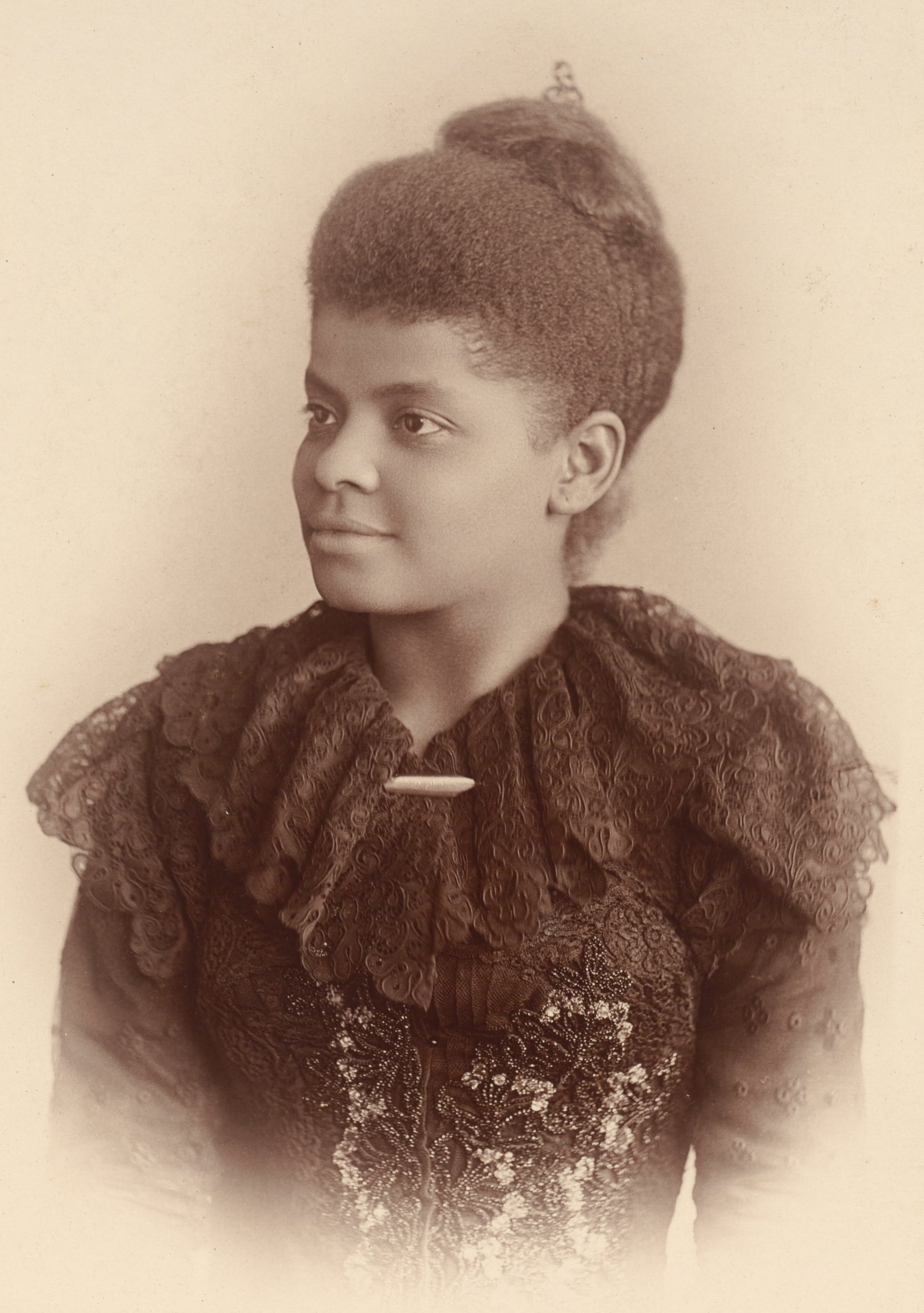
She was born into slavery in Holly Springs in 1862, the eldest daughter of Lizzie and James Wells. A defender of civil rights, Mrs. Wells was involved in the Freedman’s Aid Society and helped to start Rust College. Rust is a historically Black liberal arts college. It is one of the 10 historically Black colleges and universities founded before 1869 and still in operation. Ida B. Wells attended Rust College to receive her early education, but she was forced to drop out.
At the age of 16, Wells lost both of her parents and one of her brothers due to a yellow fever epidemic. She convinced a nearby school principal that she was 18 and obtained a teaching job to take care of her siblings.
In 1882, Wells moved with her sisters to Memphis, Tennessee to live with their aunt. Her brothers found work as apprentice carpenters, and for a time, Wells continued her studies at Fisk University in Nashville.
During a train journey from Memphis to Nashville in May 1884, Wells reached a turning point. She had purchased a first-class ticket, but the train staff forced her to move to the African American car, exactly as it was supposed to be, despite the law stating that Black people could travel in first class. Wells refused on principle before being forcibly removed from the train. While being removed, she bit one of the crew members.
Wells sued the railroad and won a $500 settlement in circuit court. The decision was overturned by the Tennessee Supreme Court.
Following this incident, Wells began writing about issues of race and politics in the South. Using the name “Iola,” Wells had some of her articles published in Black newspapers and periodicals. She later became the owner of two newspapers: The Memphis Free Speech and Headlight and Free Speech.
Working as a journalist and editor, Wells also worked as a teacher in a segregated public school in Memphis. After openly criticizing the condition of segregated schools in the city, she was fired from her job in 1891.
In 1892, Wells turned her attention to anti-lynching after a friend and two of his associates were murdered. Tom Moss, Calvin McDowell, and Will Stewart had opened a grocery store that drew customers away from a white-owned store in the neighborhood. The white store owner and his supporters, such as the sheriff, clashed several times with Moss, McDowell, and Stewart.
One night, they had to defend their store from an attack and ended up shooting several white men. They were arrested and taken to jail. Unfortunately, they did not have the opportunity to defend themselves. A lynch mob took them from their cells and shot them, dragging them to a deserted rail yard north of Memphis.
Wells wrote articles in which she denounced lynching and risked her own life by traveling throughout the South to gather information on other lynchings. One of her editorials pushed some of the city’s white residents to the limit. A mob stormed the office of her newspaper and destroyed all her equipment. Wells was in New York at the time, which likely saved her life.
She remained in the North after her life was threatened and wrote a detailed report on lynching in America for the New York Age. This was a newspaper run by T. Thomas Fortune, a former enslaved man.
She brought her anti-lynching campaign to the White House in 1898 and asked President McKinley to enact reforms.
In 1896, Wells founded several civil rights organizations, including the National Association for the Advancement of Colored People. After brutal attacks against the African American community in Springfield, Illinois in 1908, Wells took action. In 1909, she participated in a conference for an organization that would later become the NAACP. Although she is considered one of the founders of the NAACP, Wells at one point cut ties with the organization.
Wells was an active fighter for women’s suffrage, particularly for Black women. On January 30, 1913, Wells founded the Alpha Suffrage Club in Chicago. The club organized women in the city to elect candidates who would best serve the Black community.
As president of the club, Wells was invited to participate in the 1913 suffrage parade in Washington, DC with dozens of other club members. The work carried out by Wells and the Alpha Suffrage Club played a crucial role in winning women’s suffrage in Illinois on June 25, 1913.
Wells died of kidney disease on March 25, 1931, in Chicago, leaving behind a legacy of social and political activism.


