

In her all-too-short life and even after her death, Saartjie Baartman, who was nicknamed the “Hottentot Venus,” endured the worst. Having left her native Eastern Cape in 1810, her remains would only be returned 192 years later, on March 6, 2002. Thanks to the relentless struggle of her people, she who was sacrificed “in the name of science and progress” now rests in peace.
Saartjie Baartman, sadly known as the “Hottentot Venus,” endured unimaginable trials during her life and even after her death. Originally from the Eastern Cape, she was taken away from her homeland in 1810, and it took nearly two centuries, until March 6, 2002, for her remains to finally be returned to her people. This article pays tribute to her story, marked by exploitation under the guise of science and progress, and celebrates the restoration of her dignity thanks to the perseverance of her community.
From Swatche to the “Hottentot Venus,” a destiny shaped by exploitation
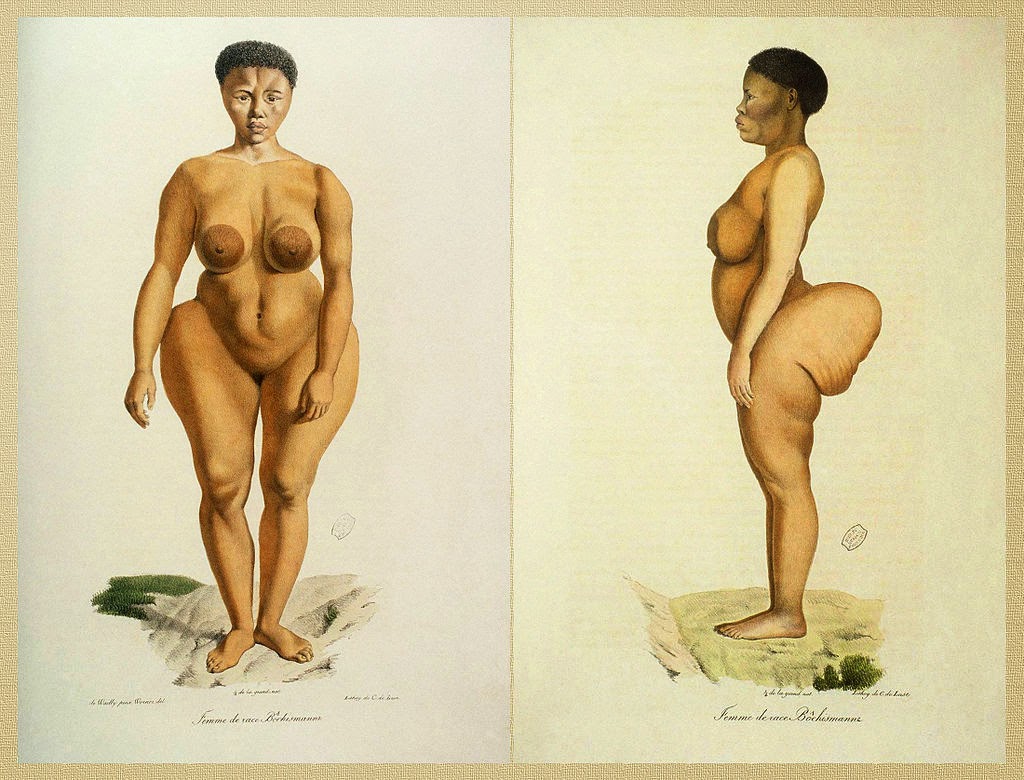
Born around 1789, Saartjie Baartman, whose real name was Swatche, was born in the heart of South Africa, among the ancestral Khoikhoi and Bushman peoples. The reality of slavery quickly imposed itself on her life. Orphaned at a very young age, she was enslaved along with her brothers and sisters by Boer farmers. In line with the colonial practices of the time, her master, the Afrikaner Peter Caesar, gave her a biblical first name, Saartjie, a diminutive of Sarah.
Baartman’s life took a decisive turn in 1810, when she caught the attention of Dunlop, a British military surgeon fascinated by her unique physical characteristics. Saartjie was notably marked by hypertrophy of the hips and buttocks (steatopygia), as well as a prominence of the genital organs (macronymphia), a condition then referred to as the “Hottentot apron.” These exceptional physical attributes became the pretext for her forced displacement to Europe.
During this period, Europe was fascinated by “human zoos,” exhibitions where around 35,000 individuals from the colonies were displayed as living curiosities. Convinced of Saartjie’s lucrative potential, Dunlop persuaded her owners to take her to England, marking the beginning of a series of dehumanizing exhibitions.
Saartjie Baartman’s arrival in Europe: between exploitation and disillusionment
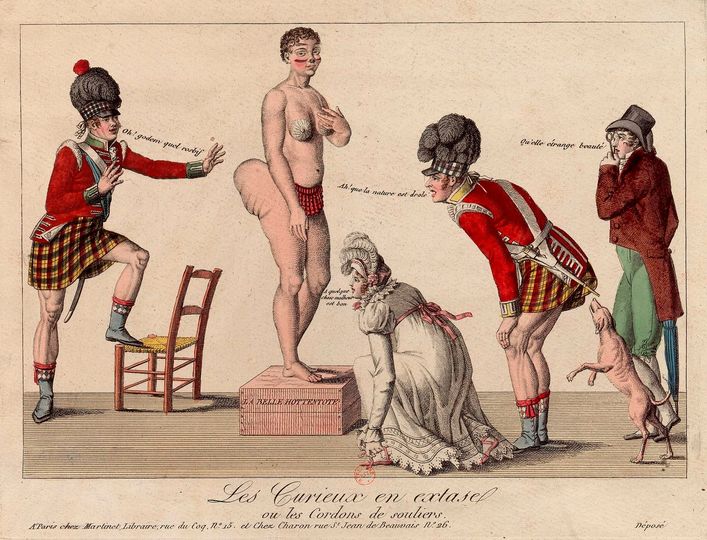
From her arrival in London, Saartjie Baartman’s fate took a tragic turn. Presented against her will as a curiosity in inhumane exhibitions, she found herself confined in a cage, displayed alongside other individuals considered “freaks.” Forced to play the role of “the savage,” Saartjie was made to perform in a revealing bodysuit, executing suggestive dances and compelled to produce grunting sounds. It was during these degrading shows that she was given the nickname “Hottentot Venus,” a stage name that would follow her throughout her life in Europe.
As the years passed, after four years of degrading tours, the hope of returning to her native South Africa faded for Saartjie. Transferred to Paris, her situation worsened further. She was exploited as a paid attraction, reduced to an object of desire at social gatherings, and pushed into prostitution. Isolated and exploited, Saartjie Baartman sank into depression and alcoholism, fighting alone against the devastating consequences of her exploitation.
“The curious race”
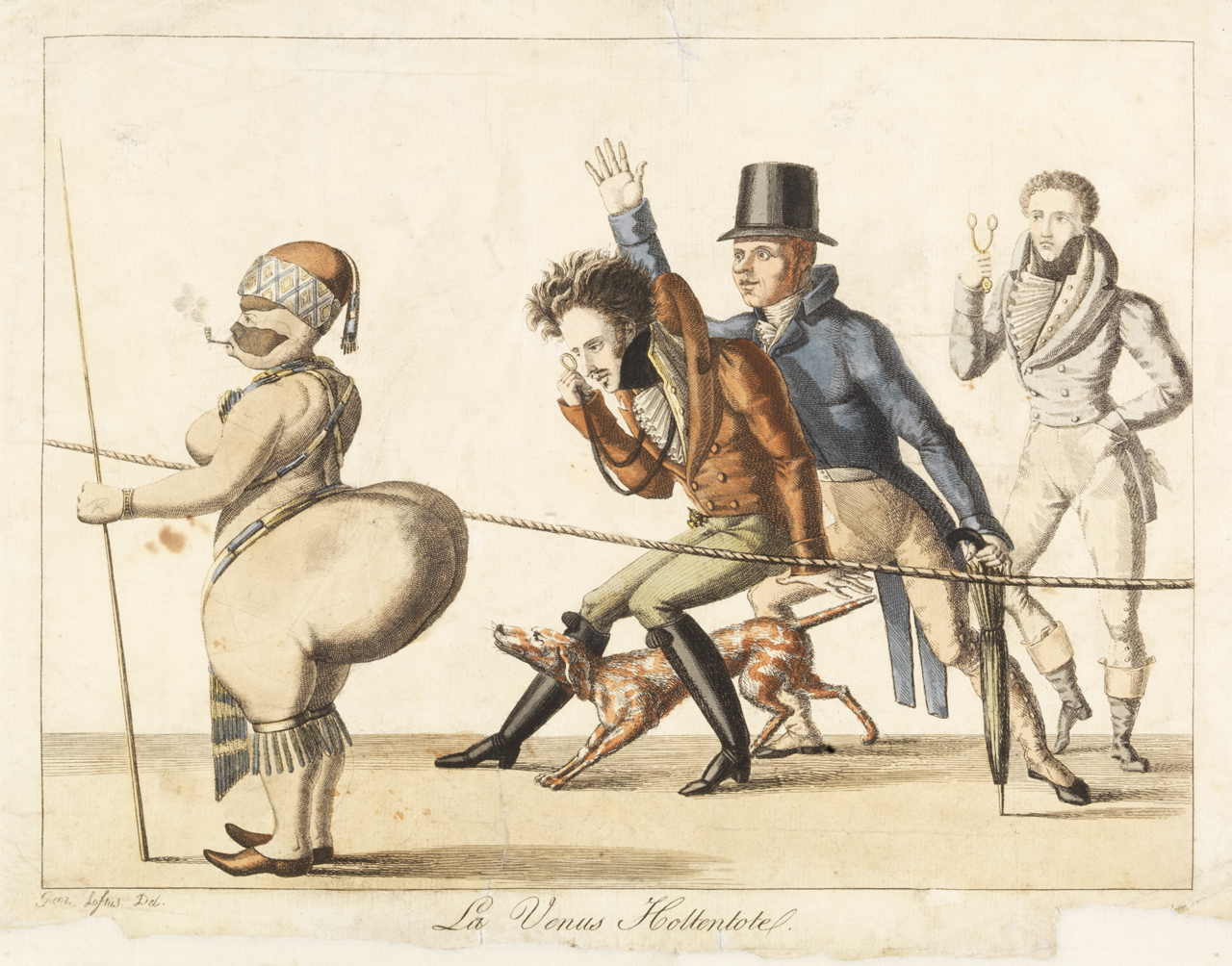
In March 1815, Saartjie Baartman attracted the attention of Étienne Geoffroy Saint-Hilaire, a prominent professor of zoology, fascinated by what he described as the “characteristics of a curious race.” On April 1, 1815, he published a controversial report comparing Saartjie’s physical traits to those of primates, a dehumanizing comparison that fueled the racist theories of the time. Despite her young age, Saartjie spoke several languages, including Dutch, English, and French, demonstrating her intelligence and adaptability.
Before an assembly of scientists, Saartjie was examined like a living specimen, a situation that highlighted the reductive and objectifying взгляд of certain scientists of the time. Georges Cuvier, another renowned scientist, expressed his frustration at Saartjie’s refusal to submit to a full examination.
Tragically, Saartjie Baartman died on December 29, 1815, from pneumonia. Her death marked the end of a life shaped by exploitation and toxic scientific racism.
A desecrated body in the name of science
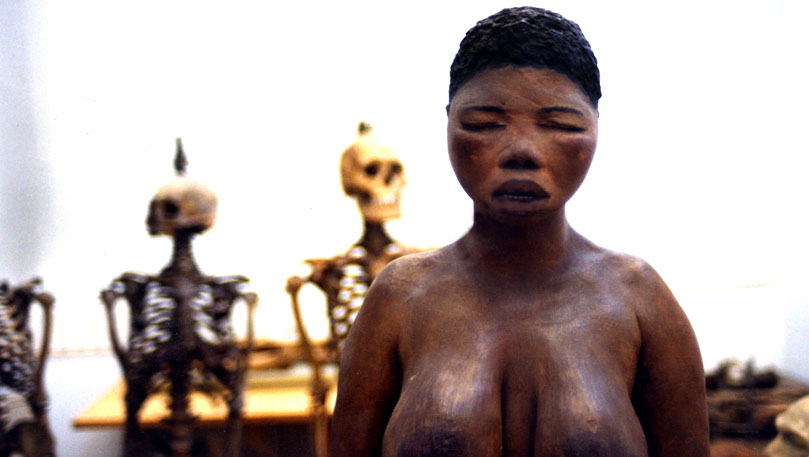
Georges Cuvier would not let Saartjie’s body rest. He managed to obtain permission to perform an autopsy. After casting her body to create a plaster statue, claiming to act “in the name of the progress of human knowledge,” he dissected her remains. In 1817, he presented the results of his work, concluding:
“Today, now that races are distinguished by the skeleton of the head, and that we possess so many bodies of ancient mummified Egyptians, it is easy to ascertain that whatever their complexion may have been, they belonged to the same race of men as us [i.e., Whites, editor’s note]; that they had equally voluminous skulls and brains; that, in a word, they did not constitute an exception to this cruel law which seems to have condemned to eternal inferiority those races with depressed and compressed skulls.”
The post-mortem examination of Saartjie was strongly criticized as an example of the scientific exploitation of non-European bodies, an issue that continues to provoke critical reflection on scientific and ethical practices.
The struggle of her people
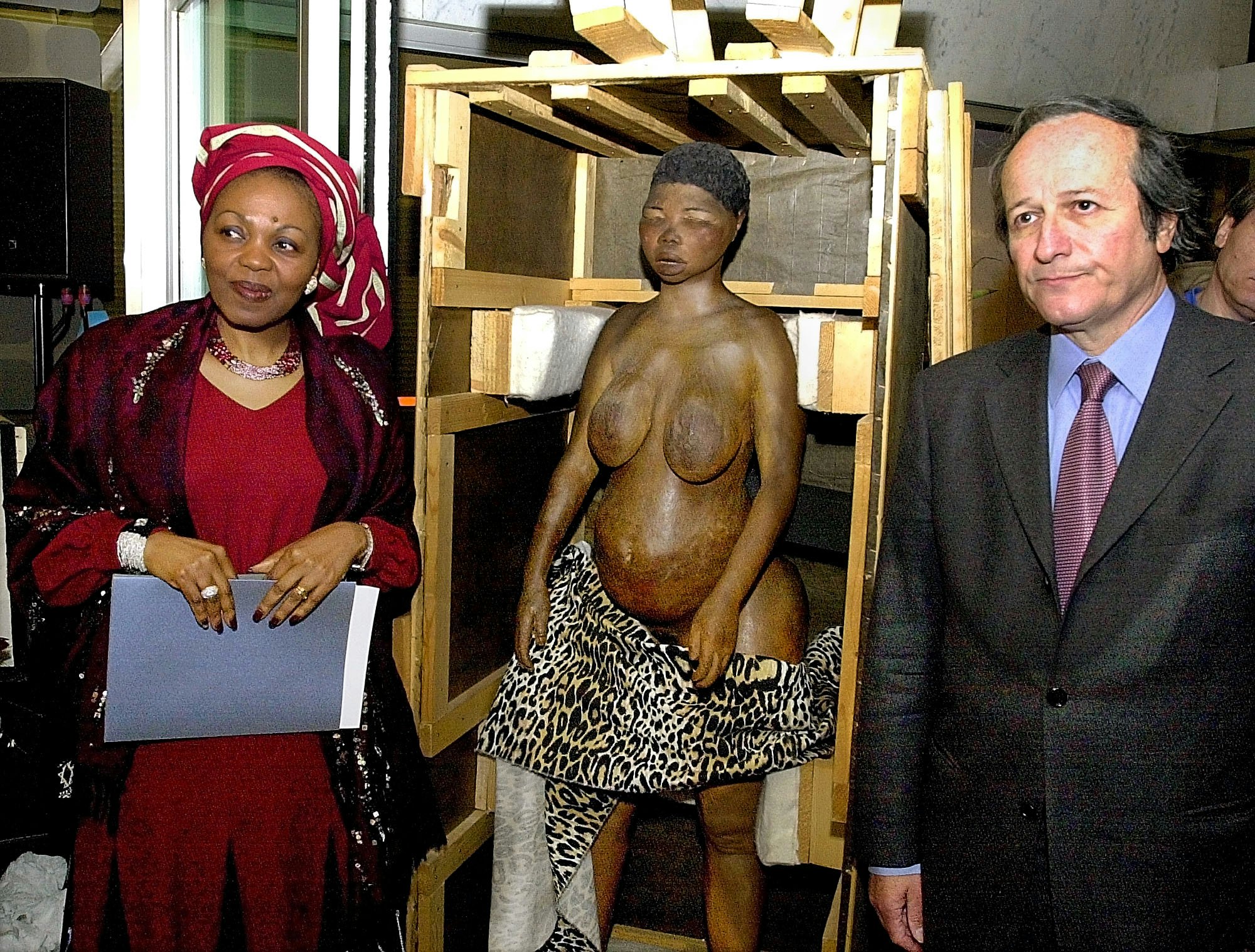
The return of Saartjie Baartman’s remains, also known as the Hottentot Venus, to South Africa represents the culmination of a long struggle led by her people, the Khoikhoi, for her dignity. As early as the 1940s, voices in South Africa called for the restitution of her remains, but it was truly after the end of apartheid that this demand gained momentum, with the involvement of Nelson Mandela.
Faced with resistance from the French scientific community, which invoked national heritage and scientific interest to retain the remains, South African mobilization did not waver. It was only with the intervention of President Jacques Chirac, and the adoption of a special law in 2002, that France finally agreed to return the remains to her country of origin.
On May 3, 2002, in a powerful symbolic gesture, Ambassador Thuthukile Edy Skweyiya accompanied Saartjie Baartman’s return to Cape Town, where she was welcomed by hundreds of South Africans who came to pay tribute. On August 9, on the occasion of Women’s Day in South Africa, a ritual ceremony was held in her native village, marking her burial in the presence of dignitaries, including President Thabo Mbeki. After 192 years of absence, Saartjie Baartman finally rests in peace on her native land, closing a painful chapter of colonial and scientific history.
The legacy of Saartjie Baartman: a symbol of resilience and justice
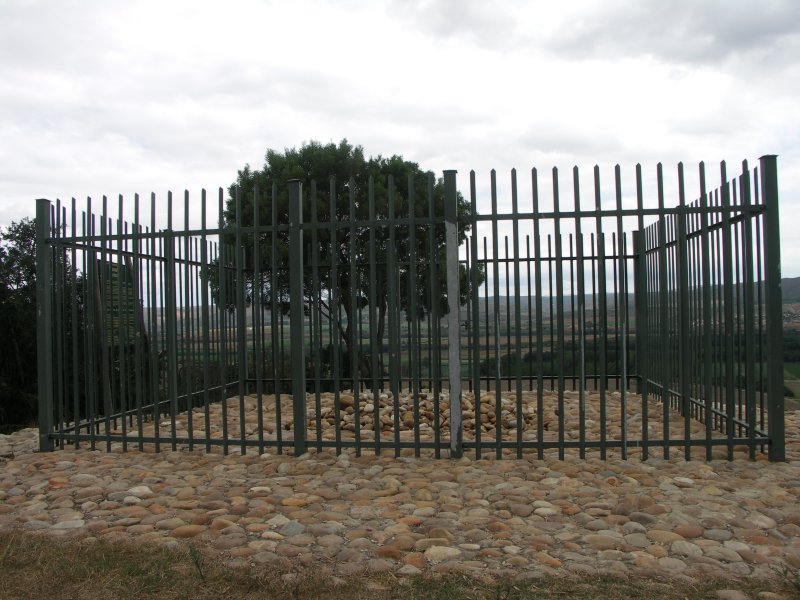
The story of Saartjie Baartman, marked by exploitation and the struggle for dignity, remains a powerful reminder of the shadows of colonialism and racism. Her restitution symbolizes a victory for justice and recognition, raising global awareness of the importance of respecting human dignity. By honoring her memory, we reaffirm our commitment to equality and reconciliation, and we inspire future generations to continue the fight against injustice. Saartjie Baartman will never be forgotten; she embodies a legacy of resilience that continues to resonate across the world.


