

Doctor, intellectual, forgotten pioneer: François Fournier de Pescay was the first Afro-descendant (though not the first African) to practice medicine in Europe. Born between Saint-Domingue and Bordeaux, he embodies the contradictions of a Republic that preached equality while codifying exclusion. From the French Revolution to the Napoleonic Empire, and later in the young Republic of Haiti, his life reveals a disturbing truth: in France, Black merit has never been enough to enter the national memory.
First afro-Doctor in europe: why Is he never mentioned?
He was born on the waves, between two continents, between two worlds, between two truths. François Xavier Fournier de Pescay, child of Saint-Domingue and Bordeaux, appeared in 1771 at the intersection of law and prohibition, noble blood and black skin, privilege and humiliation. Son of a white planter and a free Black woman, he embodies from birth the colonial paradox: a mixed-race child too brilliant to remain invisible, yet too Black to be celebrated.
Surgeon of the Revolution, physician of Napoleon, professor in Haiti, thinker, translator—he was one of the first Afro-descendants to practice medicine in Europe and one of the few to navigate, without ever betraying his origins, between colonial France and the Black Republic of Haiti. Yet his name has remained at the margins of history, where inconvenient lives are quietly shelved.
This article is a restored tribute. It seeks to bring Fournier de Pescay’s figure back into the harsh light he deserves: that of erased greats, of intermediaries between two humanities, of men the Republic forgets when they are too Black for its Pantheon and too brilliant for its silence.
Born between two worlds
François Xavier Fournier de Pescay was born on September 7, 1771, somewhere between Saint-Domingue and Bordeaux, on the deck of a ship transporting him from the colony to the metropolis. This floating birth alone encapsulates the double and fragmented destiny that awaited him. He was the son of a free Black woman, Adélaïde Rappau, and a white planter, François Pescay, member of a noble family from Blaye. A mixed-race child, then (or rather a “bastard of the Empire,” as contemporary terminology put it), born of the impossible union between a descendant of Africans and an heir of slaveholding Enlightenment ideals.
In France under the Ancien Régime, the Code Noir formally prohibited marriage between Whites and Blacks, even free Blacks. This foundational text of French state racism codified a hierarchy of human beings in which “Blackness” meant inferiority, servility, or even animality. Thus, although born of a sincere love, the child Fournier de Pescay was immediately excluded from legal recognition. His arrival was both an intimate transgression and a political provocation.
In this gap of colonial law was born a man who would carry, his entire life, the wound of a Republic not made for people like him.
Disembarking in Bordeaux, the young mixed-race boy entered a schizophrenic city. On one hand, a hub of new ideas, rebellious and intellectual, aflame with Rousseau, Voltaire, and the Rights of Man. On the other, a slaving metropolis, thriving on the African trade, human cargo, and sugar fortunes from Saint-Domingue. Bordeaux conceived of universal equality while drawing wealth from racial exploitation.
It was in this paradox that Fournier de Pescay forged his skills. He trained in medicine in Bordeaux, then in Paris, showing exceptional precocity. In the amphitheaters of the Revolution, he was among the first Afro-descendants to wield the scalpel in metropolitan France. Before the white bodies laid on dissection tables, he—the child born from the black womb of a free mother—dissected the lies of a world that preached universality but practiced exclusion.
He entered medicine as one enters resistance. For a man of color in the 18th century, healing bodies did not erase the wounds of history.
Surgeon of the Republic (between ideals and trenches)
Barely trained, François Fournier de Pescay joined the revolutionary armies in 1792, alongside two of his brothers. He did not fight with a weapon in hand, but with a scalpel, a medical kit, and unwavering faith in progress. He treated, operated, and saved lives in a world where death struck as much from gunpowder as from infection.
He was one of the few men of color to hold such a crucial role in a white army undergoing ideological transformation. The Revolution proclaimed that all men are born free and equal—but on the battlefield, that equality remained one-way. His skill was respected but never celebrated. He was useful, but never fully recognized. Fournier de Pescay embodied the fundamental contradiction of the French Republic: a universalism that selectively grants equality.
For him, every surgical operation was also a political demonstration: a Black man could master science, wear the coat, and treat a white soldier’s wounds. Yet this simple truth was radical in a country that had codified racial inferiority in law and colonies.
In 1806, after several years in Brussels, Pescay was recalled to serve the Empire. He joined the Imperial Guard, the elite corps of Napoleon’s army. This appointment was rare, even exceptional, for a man of his origin. It highlighted a troubling fact: the Empire could recognize talent, but never equality.
Napoleon was not unaware. The man who restored slavery in 1802, crushed Toussaint Louverture’s Black Republic, and placed the colonies under tutelage did not believe in universal brotherhood, but in the utility of men. Pescay became the personal physician of the Prince of Asturias, future Ferdinand VII of Spain, imprisoned at the Château de Valençay. The post was prestigious, diplomatic, almost confidential. It was a mission of trust—but also a golden cage.
He was entrusted with the health of a captive king, but not the recognition of a full citizen. Far from the battlefield, he remained in an elite space without influence, in the shadow of white power. Like the Revolution, the Empire tolerated Black exception as long as it claimed neither visibility nor real equality.
Yet Fournier de Pescay did not bend. He healed, wrote, and thought. And he waited for his moment.
Brussels: knowledge and silence (a discreet rise)
In 1799, tired of military campaigns and the limitations imposed on his career, Fournier de Pescay settled in Brussels, then under French influence. There, he found a more favorable environment for the pursuit of knowledge—not because racism was absent, but because anonymity offered respite. He taught, treated patients, and wrote. Most importantly, he founded the Brussels Medical Society, a leading scientific institution, where he was appointed deputy secretary-general.
This post was not symbolic: it reflected real recognition of his medical skills and scientific rigor. In 1801, he published a pioneering treatise, Historical and Practical Essay on Vaccine Inoculation, advocating vaccination against smallpox. A Black man popularizing modern medicine at the turn of the 19th century—this should have been historic.
But national memory chose to ignore him. He was neither a general in uniform nor a radical salon thinker. He was a man of action, knowledge, and restraint—and that was not enough to enter the heroic narrative of the Republic.
Fournier de Pescay ticked all the boxes of republican greatness: academic excellence, medical devotion, political loyalty, contribution to science. Yet he is never cited in textbooks, never pantheonized, rarely mentioned in accounts of the Revolution or Empire.
Why? Because he did not exist to reassure. His very existence, intelligence, and career exposed the lie of a racially selective universalism. His merit contradicted hierarchies inherited from slavery. He was not the “good Negro” of colonial tales, nor the folklorized exception. He was a Black intellectual in a white Europe, unashamed, unbowed.
This silence around him is not forgetting: it is a choice. An erasure. A political act as cruel as a decree.
Haiti: return to the homeland, conflict with Boyer
In 1823, after a long career serving France, François Fournier de Pescay embarked for Haiti, the Black Republic proclaimed in blood and defiance, where he hoped to serve without justification. He did not return as an exile, but as a builder. He was appointed director of the National Lyceum of Port-au-Prince, then professor of medicine and surgery, and finally inspector-general of the health service.
His goal was clear: to provide Haiti with the foundations of an autonomous intellectual elite, capable of thinking and healing independently. He helped structure educational institutions, drafting regulations for the Academy of Haiti, the embryo of the country’s first university. He introduced not only medicine, but also law, history, and science—a vision faithful to Enlightenment ideals, yet serving a liberated Black people.
Here, Fournier de Pescay was no longer a tolerated pawn of imperial power. He became an architect of intellectual independence, a transmitter of knowledge within a sovereign Black state. At least, that was his belief.
But this land of emancipation had its own contradictions. Under President Jean-Pierre Boyer, Haiti was unified but centralized, ruled authoritatively by a mulatto elite often wary of outside influence, even from their own sons.
Fournier de Pescay quickly clashed with administrative rigidity, power struggles, and factionalism. His educational project, too ambitious and autonomous, disturbed the hierarchy. He criticized abuses, compromises, and bureaucratic regression. Conflict with Boyer became inevitable. The great doctor, who thought he was returning home as a builder, discovered he was seen as an intruder—a free spirit in a system obsessed with control.
Disappointed, isolated, and ill, he left Haiti in 1828. The Black Republic he had hoped to serve no longer knew what to make of him. And France, for its part, had still not erased the stigma of his birth.
An erased end (between pau and oblivion)
Returning to France in 1828, François Fournier de Pescay was no longer the promising young surgeon nor the passionate teacher he had once been. Illness had taken his body as silence had taken his name. He retired first to Paris, then moved to the Midi, settling in Pau, far from centers of power and from the Republic he had tirelessly served.
He died on July 8, 1833, aged 61. Without fanfare, without tribute, without a memorial stone. At the time, the newspapers did not report it. The institutions he had served did not publish eulogies. France, which would later decorate other figures, let his name slip into administrative oblivion. His portrait, however, painted in 1831, was stored in the collections of the Army Health Service—a bitter irony for a man whose work had been precisely to heal, teach, and institute.
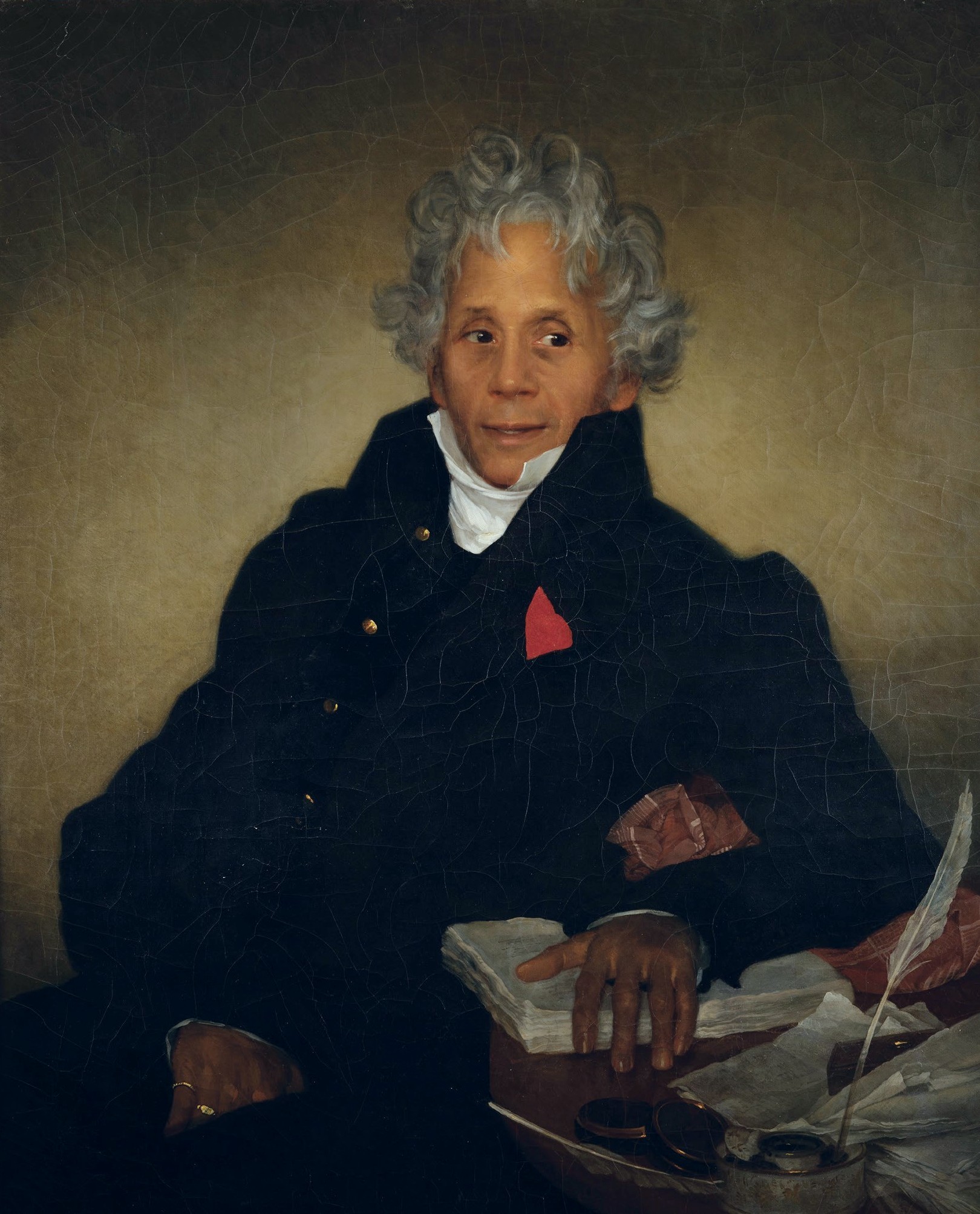
Fournier de Pescay had received the Legion of Honor under Louis XVIII—a rare decoration for a Black man and an ambiguous symbol: his usefulness was recognized, but not his full belonging. His exemplary career was never included in national narratives. No textbooks, no commemorative plaques, no conferences. He is one of those figures whose very existence embarrasses French myths.
Why? Because he was Black, learned, republican, and refused all imposed labels. He was neither the docile exception nor the folklorized hero. He was the Afro-descendant intellectual France produced despite itself—and whom its own universalism never fully welcomed. Too French for Haiti, too Black for the Republic.
Confiscated legacy
At a time when the great principles of the French Revolution are glorified, when Montesquieu, Rousseau, and Voltaire are cited as prophets of universal liberty, François Fournier de Pescay’s life acts as a counterpoint. It reminds us that these very thinkers did not defend the emancipation of Blacks, that the 1789 Declaration of the Rights of Man was never intended to include slaves, and that the Republic long tolerated—even promoted—structural racism.
Fournier de Pescay was a man of reality, not legend. He is living proof that Black excellence existed despite laws, exclusion, and official narratives. He demonstrates that the universalism proclaimed by France was never unconditional. It was often built against those it claimed to liberate.
This is why he unsettles. Because he does not allow history to be half-told.
It is time to bring Pescay out of oblivion—not to celebrate a display hero, but to restore a long-suppressed truth. History cannot be repaired, but its faces can be returned. His deserves to be taught in schools, included in the Republic’s museums, and honored in public spaces.
Why is his name not on hospital facades? Why is he not taught in medical schools? Why has the National Academy of Medicine never honored this pioneer? Why not open the doors of the Pantheon to him, alongside Félix Éboué?
This is not a matter of minority memory. It is a matter of historical coherence. Because the history of France is not only that of those it made citizens—it is also that of those it prevented from becoming so.
Sources
- Wikipedia – François Fournier de Pescay
- Dictionnaire des sciences médicales (1813)
- Beaubrun Ardouin, Études sur l’histoire d’Haïti, 1860
- J.A. Rogers, World’s Great Men of Color, vol. 2
- Bibliothèque interuniversitaire de santé (BIU Santé)
Table of Contents:
- First Afro-Doctor in Europe: Why Is He Never Mentioned?
- Born Between Two Worlds
- Surgeon of the Republic (Between Ideals and Trenches)
- Brussels: Knowledge and Silence (A Discreet Rise)
- Haiti: Return to the Homeland, Conflict with Boyer
- An Erased End (Between Pau and Oblivion)
- Confiscated Legacy
- Sources


