

On March 7, 1965, in Selma, Alabama, a peaceful march organized to defend the voting rights of African Americans was violently repressed by law enforcement. The images of “Bloody Sunday,” broadcast across the country, triggered a shockwave that accelerated the adoption of the Voting Rights Act a few months later. Sixty years after the events, this episode remains one of the most decisive moments in the history of the civil rights movement in the United States.
March 7, 1965: Bloody Sunday, the march that changed America
In the mid-1960s, Selma was one of the places where the contradictions of American democracy appeared most clearly. Located in Dallas County, in the heart of Alabama, the city belongs to the region nicknamed the “Black Belt,” characterized by a large African American population inherited from the history of plantations.
Yet this demographic majority is not reflected in local political life. Since the end of the nineteenth century, the Southern states had gradually put in place a set of laws and practices aimed at preventing African Americans from voting. Poll taxes, arbitrary literacy tests, complex administrative procedures, and systematic intimidation formed the legal and social architecture of this system of exclusion.
In Dallas County, the situation reached a particularly striking level. While the Black population represented about 57% of the inhabitants, barely 130 African Americans were registered on the electoral rolls out of the fifteen thousand of voting age. The right to vote, although guaranteed by the American Constitution, was in practice inaccessible to the vast majority of Black citizens.
This situation was not an administrative accident. It constituted a central pillar of the system of racial segregation established in the Southern states after the end of Reconstruction. By controlling access to the ballot box, local authorities maintained an exclusively white political power and prevented any institutional challenge to the segregationist order.
Faced with this organized exclusion, local activists had been trying for several years to mobilize Selma’s African American population. The Dallas County Voters League, founded in the 1950s, conducted a constant campaign encouraging Black citizens to register to vote despite the obstacles.
For a long time, these efforts remained limited by the violence and intimidation exercised by local authorities. Applicants seeking registration had to present themselves at the county courthouse, where electoral officials had almost total discretionary power to accept or reject applications. Literacy tests were applied arbitrarily and administrative procedures could last hours, even entire days.
Beginning in the early 1960s, the situation in Selma drew the attention of the major organizations of the civil rights movement. The Southern Christian Leadership Conference, led by Martin Luther King Jr., as well as the Student Nonviolent Coordinating Committee, decided to intensify the campaign.
Their strategy was based on a principle already tested in other Southern cities: nonviolent mobilization designed to publicly reveal the injustice of the segregationist system. Marches, rallies, and collective attempts to register were organized in front of the county courthouse.
The reaction of local authorities was swift. Demonstrators were arrested, threatened, and sometimes beaten. Between January and February 1965, more than three thousand people were arrested during the protests organized in Selma.
The event that precipitated the crisis occurred on February 18, 1965, in the nearby town of Marion. That evening, activists organized a peaceful demonstration to protest the arrest of a civil rights activist.
Police intervened brutally to disperse the procession. In the confusion, a young African American activist named Jimmie Lee Jackson tried to protect his mother and grandfather as they sought refuge in a café. A police officer pursued him inside the building and opened fire.
Jackson was gravely wounded. He died eight days later in the Selma hospital. His death caused immense emotion within the African American communities of Alabama.
For the leaders of the civil rights movement, this event revealed the dead end facing the struggle for voter registration. It became necessary to draw the attention of the entire nation to the situation in Selma. The idea of a march linking Selma to Montgomery, the capital of the state of Alabama, gradually took shape.
On Sunday, March 7, 1965, about six hundred demonstrators left Selma to begin the march toward Montgomery. The procession was led by activists John Lewis and Hosea Williams.
The demonstrators advanced in silence along the road leading out of the city. Their objective was to cover the fifty-four miles separating Selma from Montgomery in order to ask the governor of Alabama to guarantee voting rights for African Americans.
At the outskirts of Selma, the marchers had to cross the Edmund Pettus Bridge, a metal bridge spanning the Alabama River. On the other side, a large police force awaited them, composed of state troopers and volunteers mobilized by the county sheriff.
Authorities ordered the demonstrators to disperse. A few seconds later, law enforcement launched the assault.
The demonstrators were beaten with batons, sprayed with tear gas, and chased by mounted police. The violence was extreme. Several dozen people were seriously injured. John Lewis in particular suffered a skull fracture that would permanently mark his memory of the event.
The images of the attack were filmed by television crews and broadcast that same evening across the country. The shock was immediate. The day entered history under the name Bloody Sunday.
The broadcast of the Bloody Sunday images provoked a wave of indignation across the United States. Thousands of citizens, religious leaders, and activists decided to travel to Alabama to support the demonstrators.
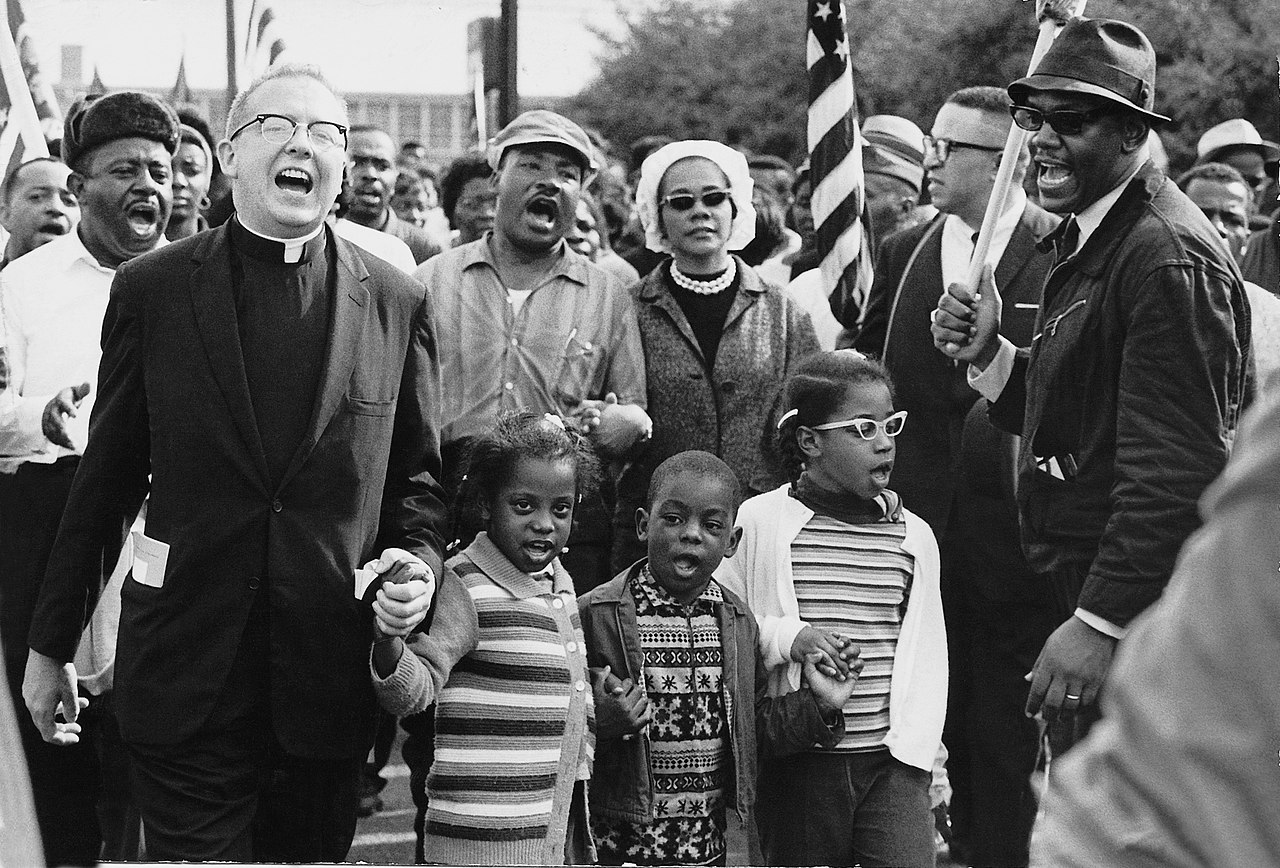
The mobilization quickly went beyond the framework of the civil rights movement. Catholic priests, rabbis, Protestant pastors, and students from across the country participated in the demonstrations.
Political pressure on the federal government became considerable. President Lyndon B. Johnson understood that the Selma crisis could no longer be ignored. The events had exposed to the entire world the brutality of the segregationist system still in force in the Southern United States.
After several days of tension and a favorable judicial decision for the demonstrators, a new march was authorized under federal protection.
On March 21, 1965, thousands of demonstrators left Selma under the protection of the National Guard. Over four days, the marchers covered the 87 kilometers separating them from Montgomery.
Along the route, the number of participants grew. Activists from across the country joined the procession, transforming the march into a national demonstration of solidarity. On March 25, about twenty-five thousand people arrived in front of the Alabama Capitol.
On the steps of the building, Martin Luther King delivered a speech that became one of the major texts in the history of civil rights. In it, he declared that the movement’s victory was inevitable and concluded with a phrase that would become famous: “How long? Not long.”
The events in Selma accelerated a major political decision in Washington. On March 15, 1965, President Johnson delivered a historic speech before Congress in which he announced the introduction of new legislation designed to guarantee voting rights for African Americans.
A few months later, the Voting Rights Act was adopted. This law prohibited the discriminatory practices that had prevented African Americans from voting in the Southern states and authorized federal government intervention to supervise voter registration.
Its effects were rapid. In the years that followed, the number of registered African American voters in the Southern states increased dramatically.
Today, the Selma marches occupy a central place in the memory of the civil rights movement. The route taken by the demonstrators is now protected as a national historic site, and the Edmund Pettus Bridge has become a place of commemoration.
But the importance of Selma extends far beyond the framework of American history. The event reminds us that political rights are never permanently secured. They are the result of struggles that are often long and sometimes violent.
On March 7, 1965, on a bridge in Alabama, ordinary citizens exposed to the entire world the contradictions of a democracy that proclaimed equality while denying voting rights to part of its population.
That day, the history of the United States changed direction.
Notes and references
Branch, Taylor. At Canaan’s Edge: America in the King Years 1965–1968. New York: Simon & Schuster, 2007.
Garrow, David J. Protest at Selma: Martin Luther King Jr. and the Voting Rights Act of 1965. New Haven: Yale University Press, 1978.
May, Gary. Bending Toward Justice: The Voting Rights Act and the Transformation of American Democracy. New York: Basic Books, 2013.
Branch, Taylor. Parting the Waters: America in the King Years 1954–1963. New York: Simon & Schuster, 1988.
Civil Rights Movement Archive. “Selma Voting Rights Campaign.”
United States Congress. Voting Rights Act of 1965. Washington, D.C., August 6, 1965.
National Park Service. Selma to Montgomery National Historic Trail.
Summary
March 7, 1965: Bloody Sunday, the march that changed America
Notes and references


