

American mathematician born in 1918 in West Virginia, Katherine Johnson was one of the central figures of the United States’ space conquest. First employed by the National Advisory Committee for Aeronautics (NACA) and later by NASA, she calculated the trajectories of the first American crewed missions, including John Glenn’s flight in 1962 and the Apollo program missions.
Katherine Johnson (1918–2020)
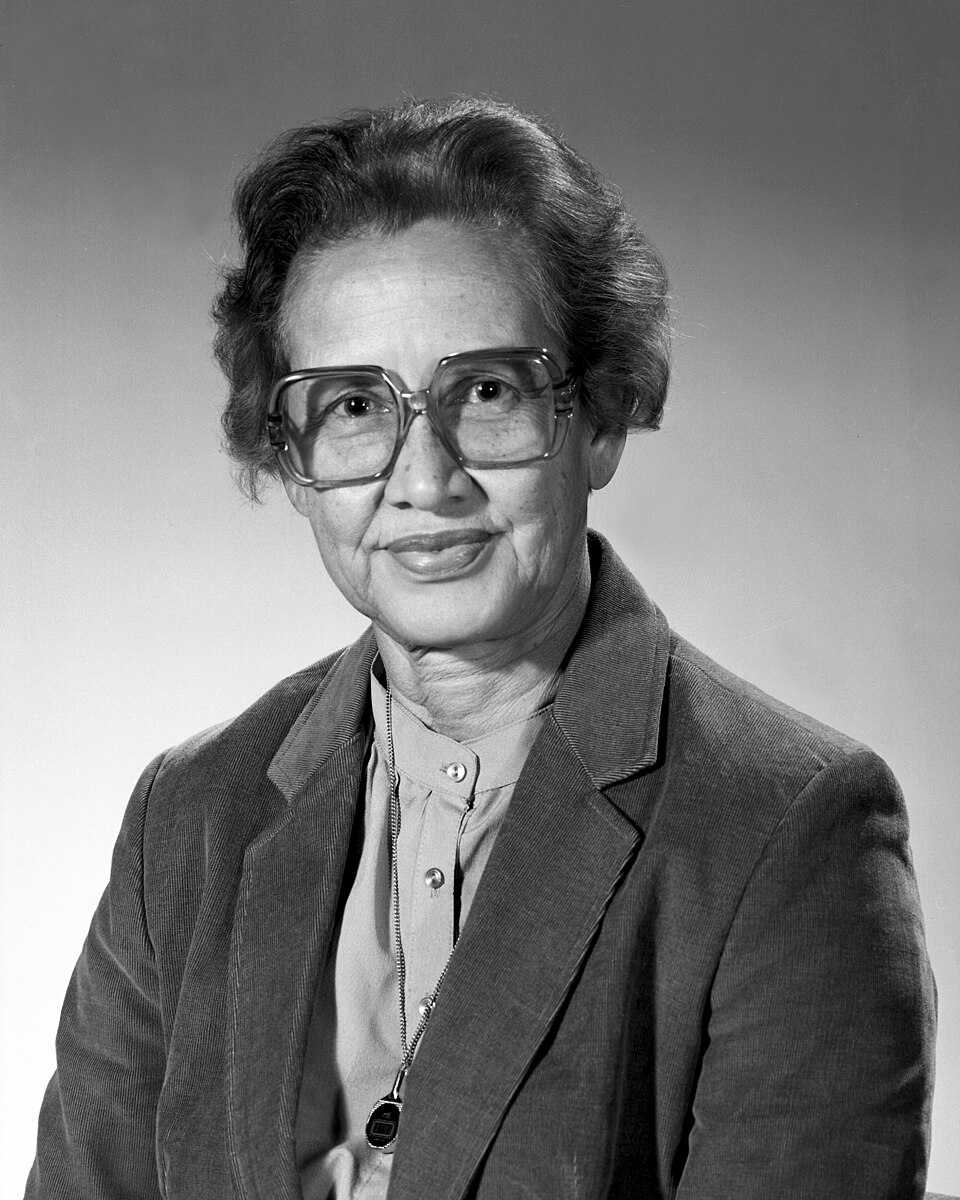
Creola Katherine Coleman was born on August 26, 1918, in White Sulphur Springs, West Virginia. She grew up in a South still deeply marked by racial segregation. Her father was a farmer and laborer, her mother a schoolteacher. Very early on, her mathematical abilities stood out. She entered high school at ten and graduated at fourteen—an exceptional path at a time when secondary education for African Americans often ended after the eighth grade.
She continued her studies at West Virginia State College, a historically Black institution, where she took every mathematics course offered. In 1937, she earned a degree in mathematics and French, with honors. One of her professors, mathematician W. W. Schieffelin Claytor, even created advanced courses specifically for her. In 1939, she became one of the first African American women to enroll in a graduate program at West Virginia University, following the Supreme Court decision Missouri ex rel. Gaines v. Canada (1938), which required states to provide equal access to public higher education.
However, she interrupted her studies to devote herself to her family and taught mathematics in public schools.
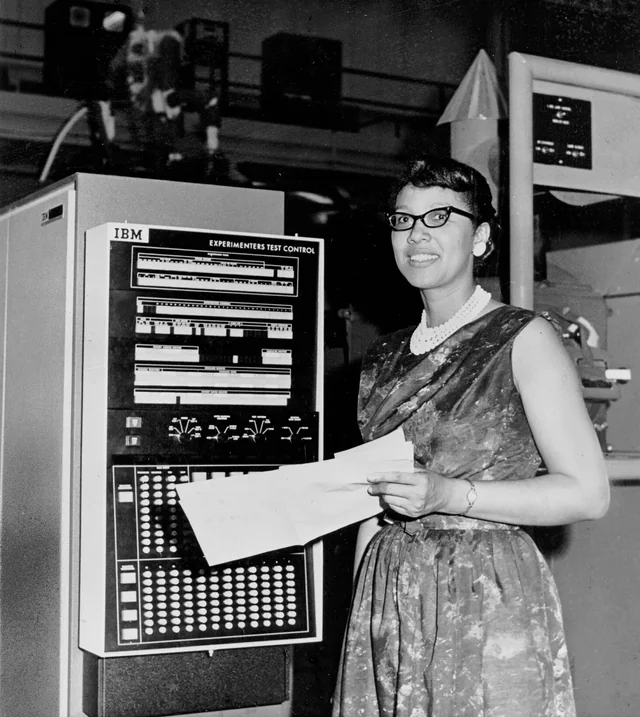
In 1953, Katherine Johnson was recruited by the National Advisory Committee for Aeronautics (NACA), the federal agency responsible for aeronautical research, which became NASA in 1958. She joined the Langley Research Center in Virginia.
Upon her arrival, she was assigned to the “West Area Computing Unit,” a group of African American women mathematicians nicknamed the “human computers.” Their mission was to perform complex calculations by hand for aeronautical engineering. Despite segregation still being enforced in buildings and restrooms, Johnson was quickly assigned to predominantly male technical teams because of her expertise in analytic geometry.
This period marked a turning point: space conquest became a major strategic issue in the context of the Cold War. After the launch of Sputnik 1 in 1957, the United States accelerated its space programs.
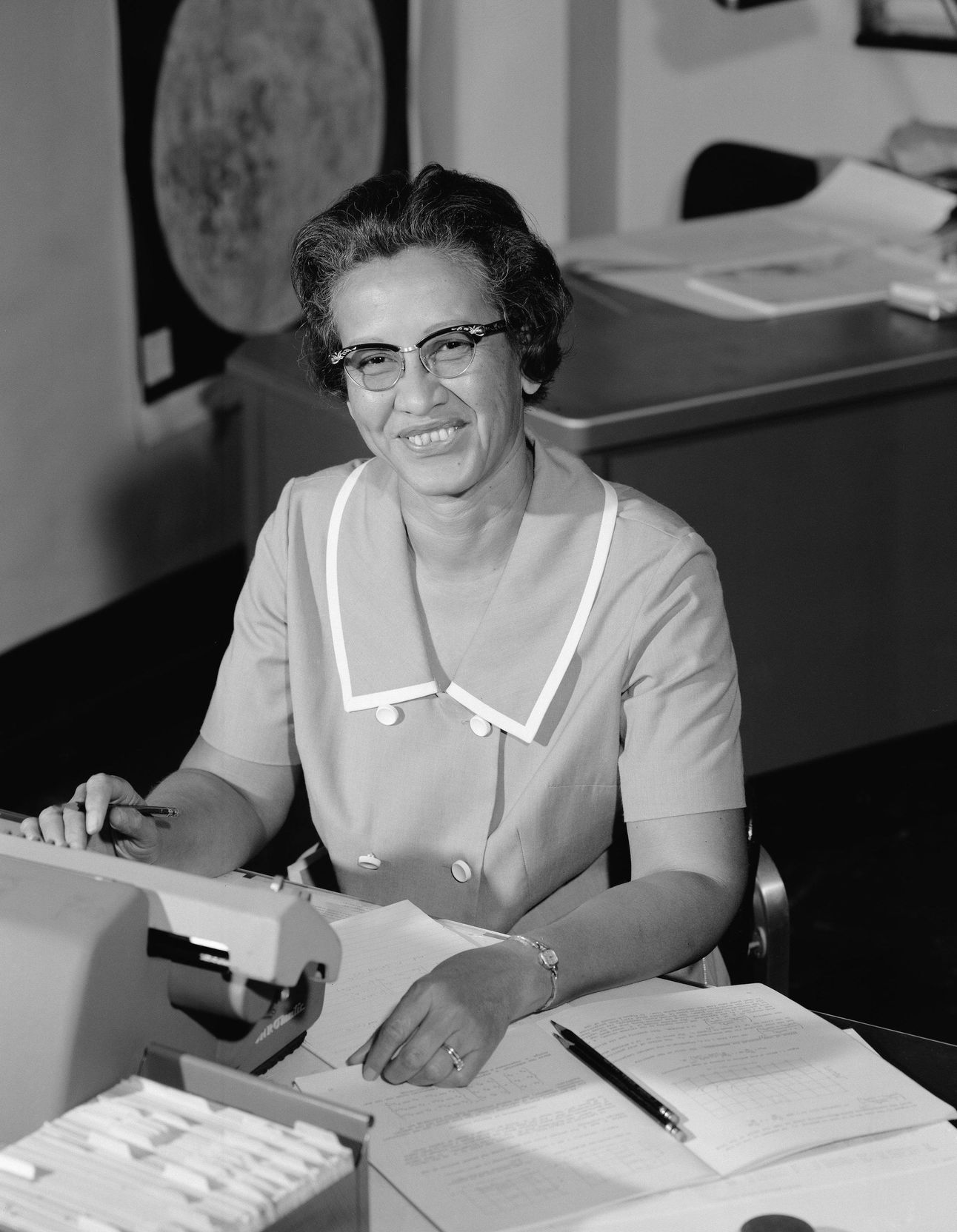
Within NASA, Katherine Johnson worked on trajectory calculations, launch windows, and emergency return procedures for space missions.
In 1961, she contributed to calculating the trajectory of Alan Shepard, the first American sent into space under the Project Mercury. In 1962, during the Mercury-Atlas 6 mission, astronaut John Glenn specifically requested that Katherine Johnson verify the calculations produced by the IBM electronic computer. This manual validation became an emblematic moment in the transition from human computation to digital computing.
Johnson also contributed to calculations for the lunar module of Apollo 11 in 1969, the mission that allowed the United States to land a man on the Moon. In 1970, during Apollo 13, she helped design backup navigation procedures essential for the crew’s safe return after the explosion of an oxygen tank.
She continued her career until 1986, working notably on the Space Shuttle program and on studies related to a potential crewed mission to Mars.
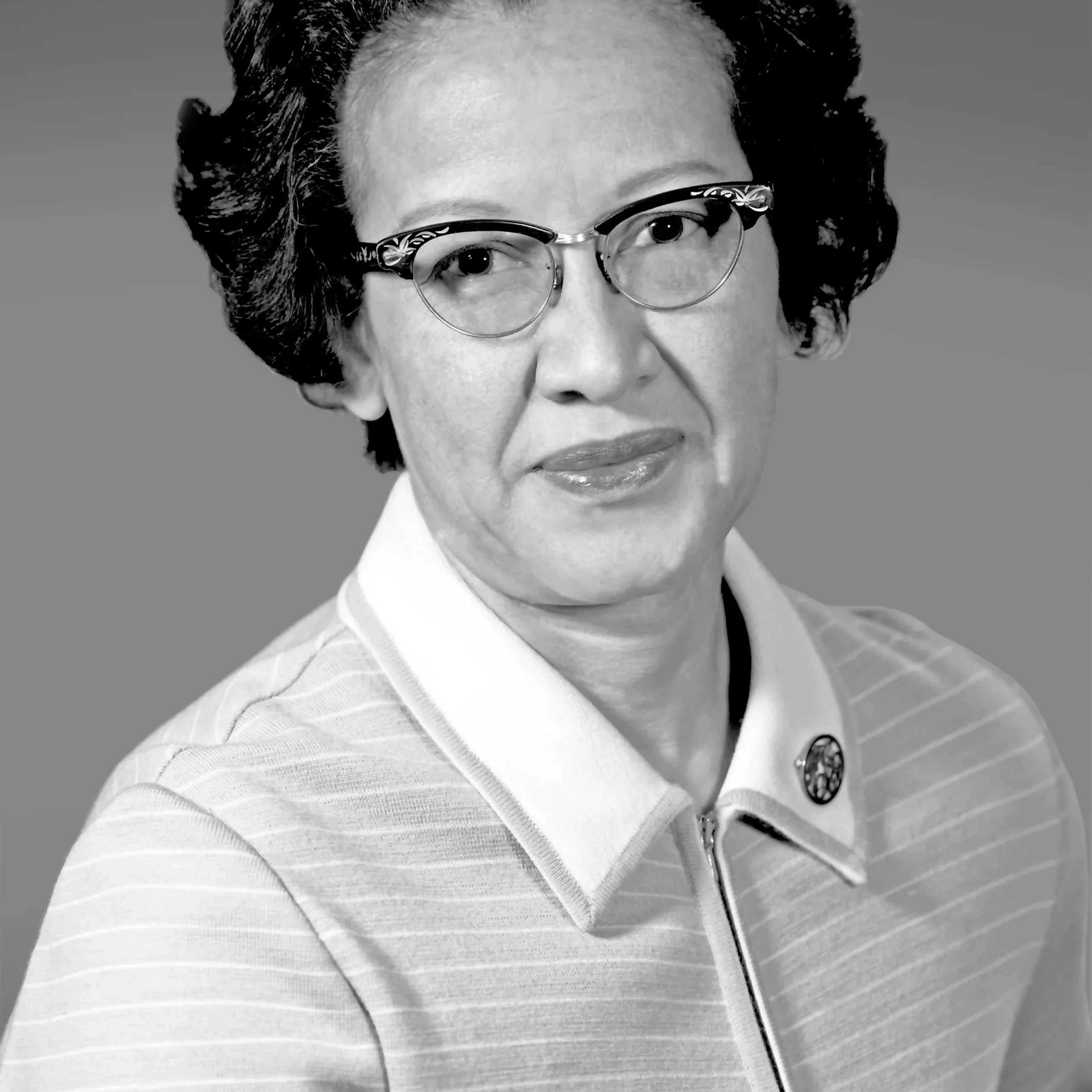
Katherine Johnson’s career unfolded within a dual context of discrimination: racial and gender-based. In 1950s Virginia, segregation laws imposed separate workspaces for African Americans. Women scientists, meanwhile, rarely saw their names appear on technical publications.
Nevertheless, Johnson succeeded in signing several scientific reports and co-authoring technical papers—something rare for a Black woman in America at the time. Her expertise was recognized internally, yet her name remained largely absent from public narratives of the space conquest.
This invisibility reflected a historiography long centered on male astronauts and white engineers, marginalizing the fundamentally important mathematical work carried out by women.
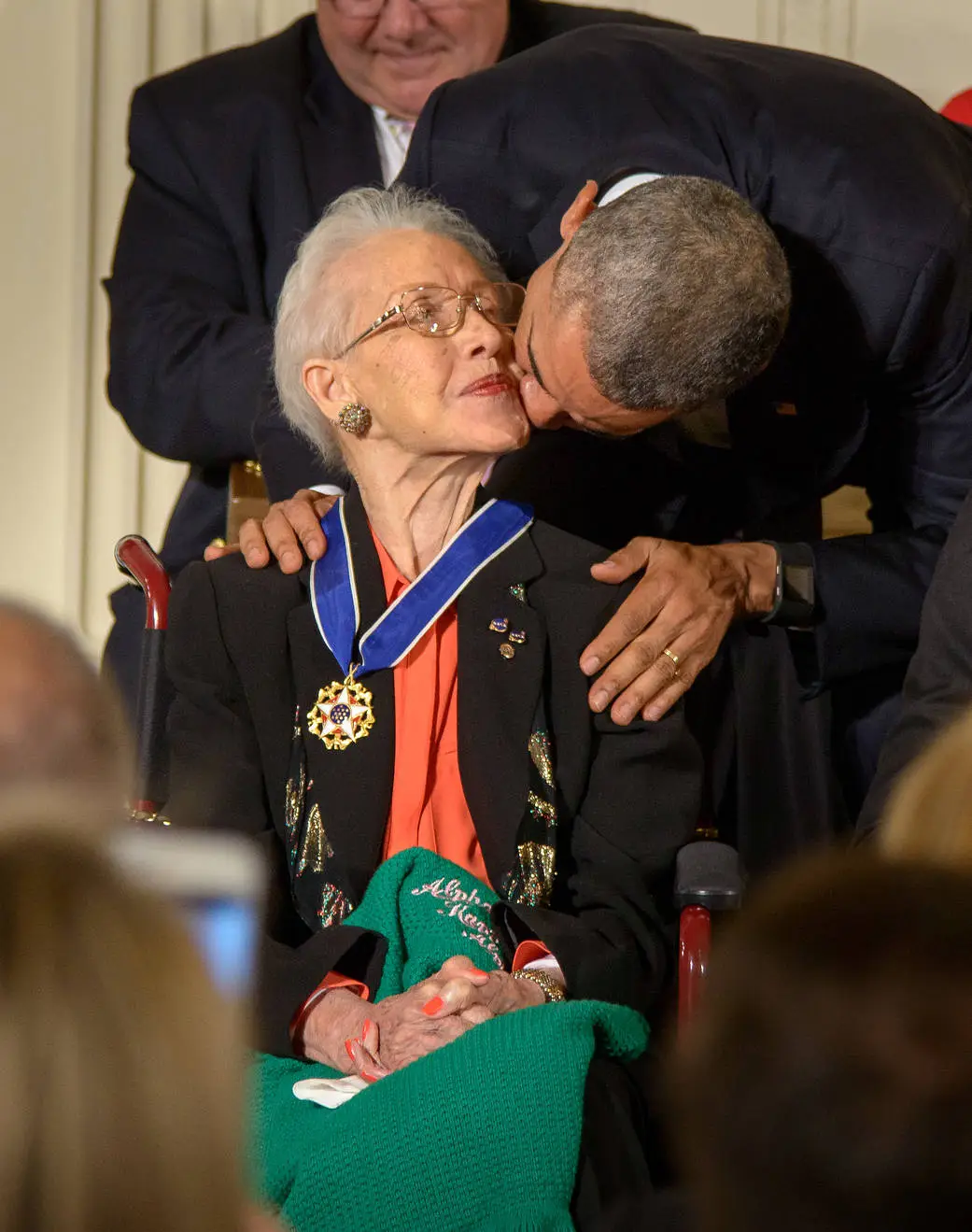
The rediscovery of Katherine Johnson is part of a broader movement reassessing the role of Black women in American science. In 2015, President Barack Obama awarded her the Presidential Medal of Freedom. In 2019, the United States Congress granted her the Congressional Gold Medal.
In 2016, the film Hidden Figures, adapted from Margot Lee Shetterly’s book, highlighted the work of Johnson and her colleagues Dorothy Vaughan and Mary Jackson. The film’s success helped transform her into an international symbol of Black women in STEM (science, technology, engineering, mathematics).
Several NASA facilities now bear her name, including the Katherine G. Johnson Computational Research Facility at Langley.
Katherine Johnson died on February 24, 2020, at the age of 101.
Katherine Johnson, or the silent rewriting of American space history
Katherine Johnson’s importance lies not only in her exemplary biography. She embodies a profound transformation of the American scientific narrative. The space conquest, often presented as the culmination of heroic engineering, in fact relied on mathematical calculations of extreme precision, carried out by largely female teams.
Her journey also demonstrates that segregation did not prevent the emergence of major scientific expertise within African American communities. It invites us to reconsider the history of science as a field shaped by power relations, gender, and race.
Today, Katherine Johnson has become a reference figure in contemporary debates on diversity in scientific disciplines. Her legacy extends beyond NASA: it questions the social conditions under which scientific knowledge was produced in the twentieth century.
Notes and references
Smith, Yvette (November 24, 2015), Katherine Johnson: The Girl Who Loved to Count, NASA.
Loff, Sarah (November 22, 2016), Katherine Johnson Biography, NASA.
Skopinski, T. H.; Johnson, Katherine G. (September 1, 1960), Determination of Azimuth Angle at Burnout for Placing a Satellite Over a Selected Earth Position, NASA Technical Note, Langley Research Center.
Shetterly, Margot Lee (2016), Hidden Figures: The American Dream and the Untold Story of the Black Women Mathematicians Who Helped Win the Space Race, William Morrow.
Fox, Margalit (February 24, 2020), “Katherine Johnson Dies at 101; Mathematician Broke Barriers at NASA,” The New York Times.
Malcom, Shirley (2020), “Katherine Johnson (1918–2020),” Science, vol. 368, no. 6491, p. 591.
Shetterly, Margot Lee (2020), “Obituary: Katherine Johnson (1918–2020),” Nature, vol. 579, p. 341.
Hodges, Jim (August 26, 2008), “She Was a Computer When Computers Wore Skirts,” NASA Langley Research Center.
NASA (2016), Katherine G. Johnson Computational Research Facility Dedication, Langley Research Center.
U.S. Congress (November 8, 2019), Hidden Figures Congressional Gold Medal Act, H.R.1396.
Obama, Barack (November 24, 2015), Official Citation for the Presidential Medal of Freedom, The White House Archives.
Warren, Wini (1999), Black Women Scientists in the United States, Indiana University Press.
Narins, Brigham (2001), Notable Scientists: From 1900 to the Present, Gale Group.
Golemba, Beverly (1994), Human Computers: The Women in Aeronautical Research, NASA Langley Archives (manuscript).
Table of contents
Katherine Johnson (1918–2020)
Katherine Johnson, or the Silent Rewriting of American Space History
Notes and References


