

Amadou Hampâté Bâ (1901–1991) was a Malian writer and ethnologist, and a major defender of African oral traditions. In 1960, at UNESCO, he delivered the famous line: “In Africa, when an old man dies, a library burns,” underscoring the urgency of preserving African memory.
A living library at the heart of twentieth-century Africa
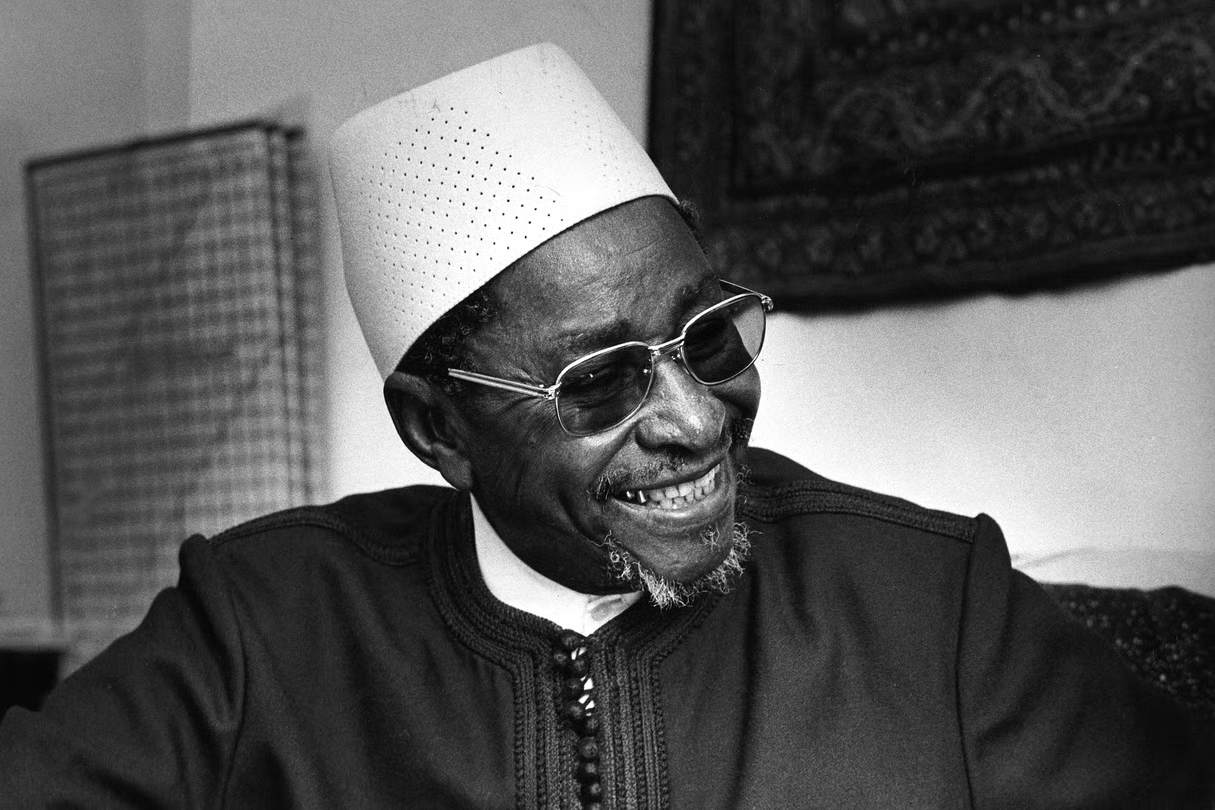
There are figures who transcend their work to become symbols. Amadou Hampâté Bâ belongs to that rare category of intellectuals whose name immediately evokes an idea, almost an image: that of an old man-library, guardian of a threatened memory. Born in 1901 in Bandiagara, in present-day Mali, and deceased in 1991 in Abidjan, he was at once a writer, ethnologist, historian, diplomat, and thinker. But beyond these titles, his major contribution lay in a conviction: traditional Africa possesses an intellectual heritage of considerable richness, and the disappearance of its custodians is equivalent to a cultural fire.
His famous appeal delivered at UNESCO in 1960 (“In Africa, when a traditionalist elder dies, it is an unexplored library that burns”) alone sums up an intellectual and political project. It was not a poetic formula, but a program for safeguarding knowledge, articulated at a pivotal moment in African history—the era of independence.
To understand Amadou Hampâté Bâ therefore requires placing his work within the colonial and postcolonial context, examining his working method, his relationship to orality and writing, and assessing the contemporary relevance of his legacy.
Amadou Hampâté Bâ was born at the turn of the twentieth century in a region marked by the legacy of the Toucouleur Empire and by French colonial presence. Born into a noble Fulani family, he was early initiated into spiritual traditions and Islamic scholarship. He attended the Qur’anic school of Tierno Bokar, a major figure of the Tijaniyya brotherhood, who would leave a lasting mark on his thought.
His path, however, was shaped by colonial constraint. Requisitioned to attend French school, he discovered another system of transmitting knowledge, based on writing, the hierarchization of disciplines, and administrative authority. He later held various posts in the colonial administration in Upper Volta and French Sudan. This experience gave him direct knowledge of power mechanisms and the social transformations brought about by colonization.
This dual heritage (Islamic tradition and colonial administrative training) structured his entire intellectual trajectory. He positioned himself neither in absolute rejection of the West nor in simple assimilation. Rather, he sought to articulate the two worlds.
The decisive turning point came in 1942 when he joined the French Institute of Black Africa (IFAN) in Dakar, under the direction of Théodore Monod. There he undertook a systematic effort to collect oral traditions. Contrary to a view that would oppose orality and scientific rigor, Hampâté Bâ argued that oral tradition could constitute a reliable historical source, provided it was collected methodically.
His major work, L’Empire peul du Macina, was the result of fifteen years of research. In it, he demonstrated that accounts transmitted by griots, scholars, and spiritual masters could be cross-checked, compared, and contextualized, thereby producing coherent historical knowledge.
For him, orality was not an absence of writing, but another form of archiving. It rested on memory, repetition, symbolic codification, and collective responsibility. The disappearance of a holder of tradition therefore amounted to the loss of an entire documentary corpus.
On December 1, 1960, during the General Conference of UNESCO, Amadou Hampâté Bâ delivered a speech that left a lasting impression. He called for the safeguarding of oral traditions to be considered as urgent as the protection of historical monuments.
His intervention took place in a specific context. The year 1960 was that of African independences. The new states sought to assert not only their political sovereignty, but also their cultural sovereignty. Hampâté Bâ understood that independence could not be merely institutional; it had to be epistemological. It meant recognizing the value of African knowledge in a world dominated by Western norms.
His later exchange with an American senator, within UNESCO’s Executive Council, illustrates this stance. In response to accusations of illiteracy, he distinguished between ignorance and the absence of writing, reminding his interlocutors that oral transmission is a sophisticated form of knowledge.
One of Hampâté Bâ’s distinctive qualities lay in his ability to avoid simplistic oppositions. He did not sacralize tradition to the point of turning it into a refuge outside of time. On the contrary, he insisted on the need to translate it, transcribe it, and transmit it in forms adapted to the contemporary world.
His literary work, notably in Kaïdara, Vie et enseignement de Tierno Bokar, and L’Étrange Destin de Wangrin, shows how a narrative rooted in orality can become written literature without losing its symbolic depth. He adopted French as his language of expression, not out of renunciation, but as a vehicle for international dissemination.
This stance distinguished him from certain currents of the Négritude movement. While he shared with Senghor and Césaire the desire to valorize African cultures, he was situated more within a logic of transmission than within an aesthetic of revendication.
His two volumes of memoirs, Amkoullel, l’enfant peul and Oui mon commandant !, published in 1991, constitute an exceptional testimony on colonial Africa. Through his personal narrative, he restored the complexity of West African societies, the diversity of religious figures, the ambivalence of colonial administration, and the tensions of modernization.
These texts are not simple recollections. They articulate autobiography and anthropology. Hampâté Bâ presents himself both as actor and observer of a world in transformation.
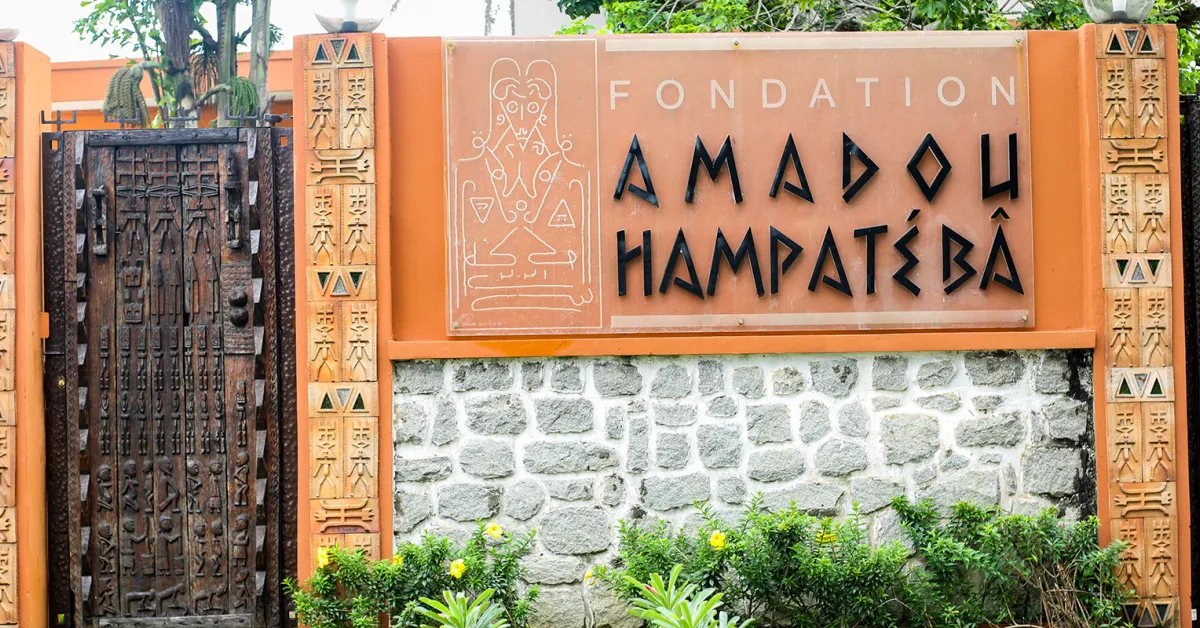
After his death in 1991, his work continued to influence African studies and debates on heritage. The Amadou Hampâté Bâ Foundation, created in Abidjan, works to preserve and promote his archives. A recent project, supported by UNESCO and the National Archives of the Republic of Korea, enabled the digitization of more than 2,100 manuscripts and the cataloging of thousands of documents.
This digitization effort concretely extends his struggle. It aims to preserve not only published texts, but also the notes, correspondence, and archives that testify to a life devoted to transmission.
In a context where debates on the restitution of cultural property, documentary sovereignty, and the decolonization of knowledge occupy a growing place, Hampâté Bâ’s legacy appears particularly relevant. He reminds us that memory is not an added luxury, but a foundation of the sustainable development of societies.
Amadou Hampâté Bâ was far more than a writer or an ethnologist. He embodied a mediation between worlds. Between orality and writing, between Africa and Europe, between tradition and modernity, he sought to build bridges rather than erect borders.
His famous phrase about the “library that burns” was neither nostalgic nor backward-looking. It invited recognition of the value of African knowledge and its inscription into the future. At a time when archives are being digitized and debates on memory are becoming globalized, his work remains an essential reference point for thinking about transmission, cultural dignity, and intellectual responsibility.
Amadou Hampâté Bâ was not merely a witness to his century. He was one of its most lucid interpreters.
Notes and references
Amadou Hampâté Bâ, L’Empire peul du Macina (1818–1853), Dakar, Institut français d’Afrique noire, 1955; new edition, Paris, Karthala, 1984.
Amadou Hampâté Bâ, Vie et enseignement de Tierno Bokar : le sage de Bandiagara, Paris, Seuil, 1980 (1st ed. 1957).
Amadou Hampâté Bâ, Kaïdara : récit initiatique peul, Paris, Julliard, 1969.
Amadou Hampâté Bâ, L’Étrange Destin de Wangrin, Paris, 10/18, 1973; Grand Prix Littéraire d’Afrique Noire, 1974.
Amadou Hampâté Bâ, Amkoullel, l’enfant peul (Mémoires I), Paris, Actes Sud, 1991.
Amadou Hampâté Bâ, Oui mon commandant ! (Mémoires II), Paris, Actes Sud, 1994 (posthumous).
Speech by Amadou Hampâté Bâ at the General Conference of UNESCO, December 1, 1960, INA sound archives.
Moradewun Adejunmobi, “Disruption of Orality in the Writings of Hampâté Bâ,” Research in African Literatures, vol. 31, no. 3, 2000, pp. 27–36.
NOFI IS AN INDEPENDENT MEDIA OUTLET
Each article requires time, research, verification, and writing.
We finance the editorial production ourselves.
Your contribution helps fund:
• the remuneration of writers
• in-depth investigations and feature files
• documentary research
• the technical infrastructure of the media outlet
You can support NOFI with a voluntary donation.
Donations are eligible for a 66% tax reduction of the amount given (within the limits provided by law).
A tax receipt is automatically issued.
In concrete terms:
A donation of €100 effectively costs you only €34 after deduction.
👉 Support the media outlet NOFI


