

On February 4, 1999, in the Bronx, New York, a 23-year-old man named Amadou Diallo was shot dead by American police. In a matter of seconds, forty-one shots were fired by four officers of the New York Police Department. Nineteen bullets hit his body. Amadou Diallo died on the doorstep of the building where he lived. He was unarmed. The object the police mistook for a weapon was a simple wallet. This event, both brutal and banal in its unfolding, quickly became one of the most striking cases in the contemporary history of police violence in the United States.
The murder of Amadou Diallo: an amblematic case of police violence in the United States


Amadou Diallo was born in 1975 in Guinea. From a relatively well-off Fulani family, he grew up across several West African countries before leaving the continent. He lived for a time in Liberia, then Thailand, before settling in New York in 1996. Like many young African migrants of his generation, he hoped to find economic stability and a better future there. In New York, he led a quiet life, worked as a street vendor, and shared an apartment in the Soundview neighborhood of the Bronx with relatives. He had no criminal record, was not involved in any criminal networks, and had never been reported for acts of violence.
On the night of February 3–4, 1999, shortly after midnight, four plainclothes officers from the Street Crime Unit were patrolling the area. This unit, created to combat violent crime, was then known for its aggressive methods and frequent use of targeted stops. The officers claimed they were searching for a suspect matching the description of a serial rapist. They spotted Amadou Diallo in front of his building. According to their account, his behavior seemed suspicious. They said he did not immediately respond to their commands and stepped back toward the building entrance. Startled, Diallo took refuge in the vestibule and pulled an object from his pocket. The officers said they believed it was a firearm.
One shot was fired. Then the situation escalated instantly. All four officers opened fire almost simultaneously. In a matter of seconds, forty-one bullets were fired. Nineteen struck Diallo, including shots to the chest and abdomen. He collapsed and died on the spot. No shots were directed at the officers. No projectile came from the victim. The scene was quickly secured, but images and early reports described a hail of bullets far out of proportion to the actual threat.


The announcement of Amadou Diallo’s death caused an immediate shockwave. In New York and other major U.S. cities, demonstrations were organized. Political leaders, community figures, and civil rights organizations denounced the disproportionate use of force and a clear case of racial profiling. That Diallo was Black, African, and an immigrant became central to the analysis of the case. For many, he embodied a structural reality: that of police fear projected onto Black bodies perceived as dangerous even before any real interaction.
The New York District Attorney decided to charge the four officers with second-degree murder and manslaughter. Due to media pressure and a tense climate, the trial was moved to Albany, far from the Bronx and its residents. The trial opened in January 2000. The debates focused mainly on the officers’ perception of danger, their training, and the doctrine of use of force. The defense emphasized stress, the speed of the situation, and the officers’ sincere belief that they were in mortal danger. The prosecution highlighted the number of shots fired, the absence of a weapon, and the manifestly excessive nature of the response.
On February 25, 2000, after several weeks of hearings, the verdict was delivered. The four officers were acquitted of all charges. The decision sparked another wave of anger and protests. For many observers, this verdict illustrated the extreme difficulty of obtaining criminal convictions against police officers in the United States, even in cases involving manifestly disproportionate lethal force.
Institutionally, however, the Diallo case had consequences. In 2002, the NYPD disbanded the Street Crime Unit. The city of New York reached an out-of-court settlement with the Diallo family, who received three million dollars in compensation, without any official acknowledgment of liability. While this settlement marked an indirect recognition of the harm suffered, it did not address the central question of criminal responsibility.
With hindsight, the murder of Amadou Diallo appears as a milestone in a long history. It preceded other emblematic cases, such as those of Sean Bell, Eric Garner, Michael Brown, or George Floyd. In each case, the same pattern emerges: a routine police encounter, an exaggerated perception of danger, massive use of force, followed by a national debate on systemic racism and justice. In this sense, the Diallo case is not an exception but reflects a structural mechanism.
For historians, this case cannot be understood solely through a judicial lens. It is part of a long history of the Black condition in the United States, marked by slavery, segregation, and the heightened police surveillance of African American and immigrant neighborhoods. It also reveals the specific place of Black Africans in the American imagination at the end of the 20th century: seen simultaneously as foreigners, invisible, and potentially threatening.
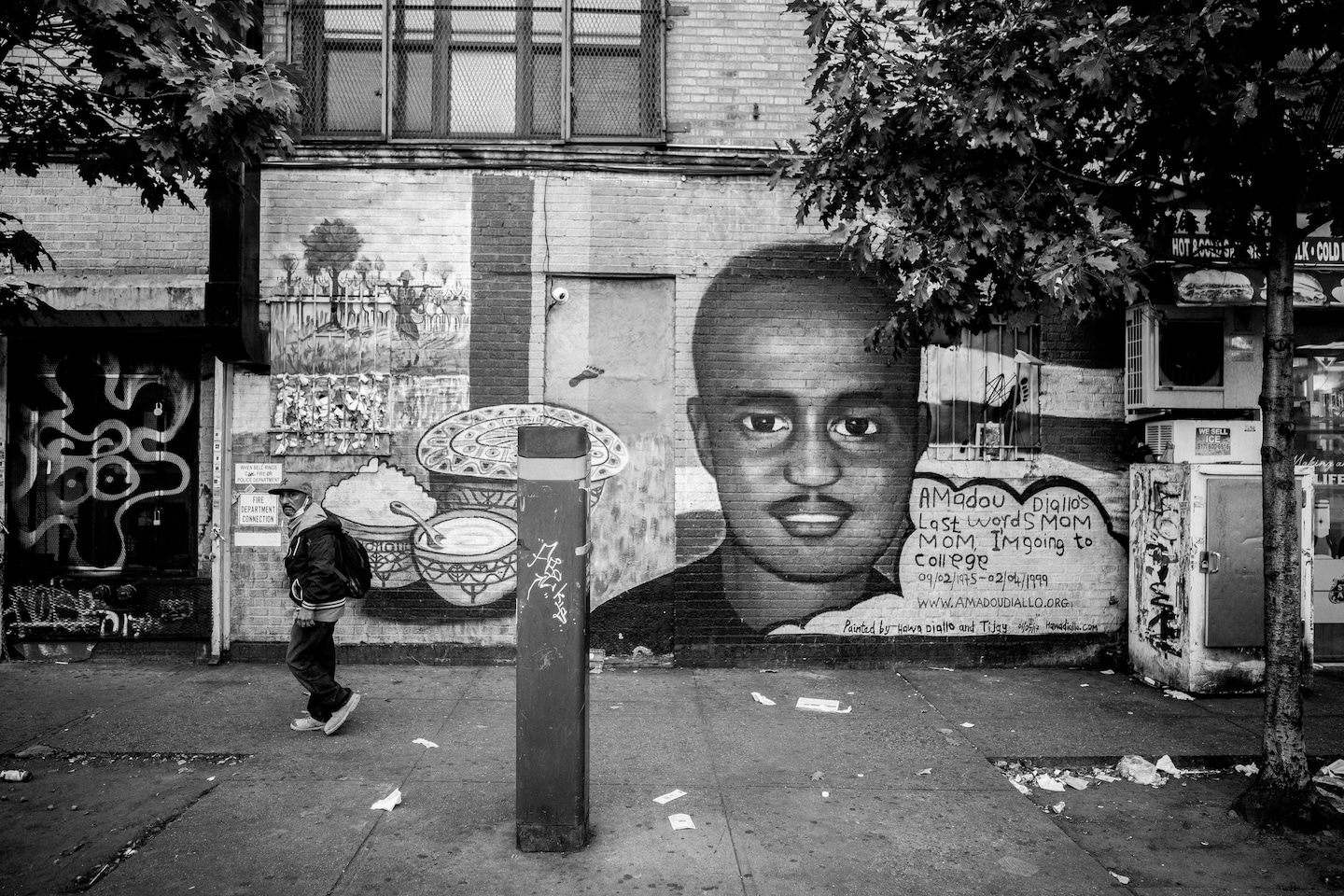
Amadou Diallo was neither an activist, nor a criminal, nor a public figure. He was an ordinary individual whose death acquired historical significance precisely because it summarized an impersonal mechanism. His name became a symbol, not through activism, but because his death made visible a reality many had already lived without full recognition.
Twenty-seven years later, the Diallo case remains a crucial reference in the study of contemporary police violence. It reminds us that history is not limited to major political decisions or armed conflicts, but also unfolds in building lobbies, in a matter of seconds, when institutions meant to protect produce death. Amadou Diallo now belongs to this tragic memory, not as an abstract figure, but as a real man whose life was cut short by fear, doctrine, and a system.
Notes and references
- Michael Cooper, “Officers in Bronx Fire 41 Shots, And an Unarmed Man Is Killed,” The New York Times, February 5, 1999.
- Ginger Thompson and Garry Pierre-Pierre, “Portrait of Slain Immigrant: Big Dreams and a Big Heart,” The New York Times, February 12, 1999.
- Jane Fritsch, “The Diallo Verdict: The Overview; 4 Officers In Diallo Shooting Are Acquitted Of All Charges,” The New York Times, February 26, 2000.
- “The Diallo Case: A Timeline,” The New York Times archives, 1999–2000.
- Shielded from Justice: Police Brutality and Accountability in the United States, Human Rights Watch, 1998.
- United States of America: Police Brutality and Excessive Use of Force, Amnesty International, 1999.

