

A psychiatrist trained at Howard University, Frances Cress Welsing left a lasting mark on certain Afro-American intellectual currents with The Isis Papers (1991), a work as influential as it was contested. By proposing a global psycho-biological explanation of racism, she positioned herself against dominant social sciences. Nofi rigorously analyzes her trajectory, her theses, their reception, and their limits, without hagiography or disqualification, in order to understand what her work reveals about contemporary debates on racial domination.
Frances Cress Welsing: understanding a radical theory of racism

At the turn of the 1990s, a book circulated hand to hand in certain Afro-American bookstores, at activist conferences, and within discussion circles where the goal was less to debate than to understand. The Isis Papers: The Keys to the Colors, published in 1991, did not resemble conventional academic works on racism. It relied neither on dominant critical sociology, nor on Marxist political economy, nor on comparative imperial history. It proposed something else: a global, radical, psychological and biological explanation of worldwide racial domination.
Its author, the American psychiatrist Frances Cress Welsing, did not seek consensus. From the outset, she asserted that racism is neither an accident of history, nor a moral deviation, nor a purely social construction, but a coherent, structured system driven by a fundamental fear: that of the genetic disappearance of populations classified as white. This thesis, directly contested by nearly the entire scientific community, nonetheless found a lasting echo in certain segments of African diasporas.
Why? How can one explain that a work largely disqualified on scientific grounds could become an intellectual and symbolic reference for thousands of readers? What does this reception say about the era in which it emerged, and about the limits of dominant explanatory frameworks of racism?
Writing about Frances Cress Welsing requires a strict method. It is neither a matter of celebrating nor denouncing. It is a matter of understanding: understanding a trajectory, a body of thought, a reception, and the debates it opened—sometimes despite itself.
Frances Luella Cress was born in Chicago on March 18, 1935, into a well-educated, middle-class Afro-American family. Her father was a physician, her mother a teacher. This detail is not anecdotal: it situates Welsing from the outset within an African American tradition in which education is conceived as a bulwark against social and racial marginalization. Contrary to a widespread assumption, her thinking did not arise from scholastic or intellectual marginality, but from early immersion in institutions of knowledge.
She pursued her studies at Antioch College, an institution known for its progressivism, before entering the Howard University College of Medicine, one of the major historically Black institutions in the United States. She earned her medical degree in 1962. In the years that followed, she settled in Washington, D.C., where she practiced primarily in hospitals, particularly pediatric ones.
This context is decisive. Washington, D.C. in the 1960s–1970s was not only a political capital; it was also an urban space marked by profound racial inequalities, residential segregation, and symbolic and material violence inflicted upon Black populations. It was also a site of dense Black intellectual life, where activists, academics, physicians, psychologists, pastors, and Afrocentric thinkers intersected.
As a practitioner, Welsing observed the trajectories of Black children and families confronted with poverty, mass incarceration, addiction, academic failure, and structural violence. She was not satisfied with fragmented explanations. Very early on, she sought a global interpretive framework.
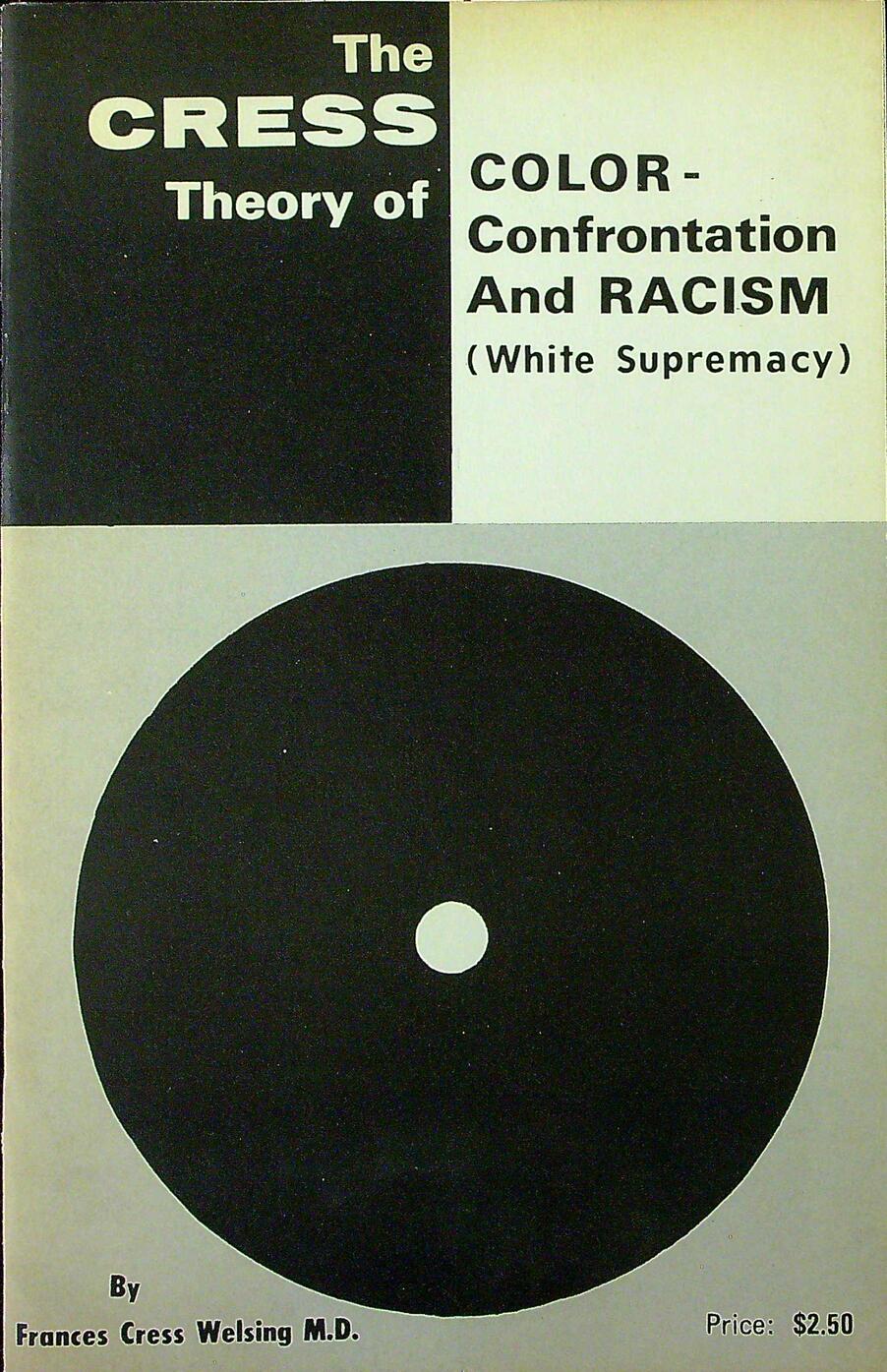
In 1970, Frances Cress Welsing wrote a text entitled The Cress Theory of Color-Confrontation and Racism (White Supremacy), which she self-published before it was reprinted, in 1974, in The Black Scholar. This text constitutes the foundation of her entire subsequent work.
Her definition of racism is unambiguous:
racism (which she systematically associates with white supremacy) is a global system of power, consciously and unconsciously structured, that permeates all spheres of human activity (economy, politics, culture, sexuality, war) with the ultimate aim of ensuring the genetic survival of white populations.
Here, Welsing makes a clear break with dominant approaches. Where social sciences analyze racism as a historical, economic, and political construction, she offers a psycho-biological reading. She mobilizes psychoanalysis to argue that individuals classified as white internalize, unconsciously, an anxiety linked to their minority status on a global scale and to what she perceives as genetic recessivity associated with light pigmentation.
It is essential to underscore a methodological point: Welsing does not present her theory as a metaphor. She conceives it as a real causal explanation, intended to account for the coherence and persistence of racism across time and space.
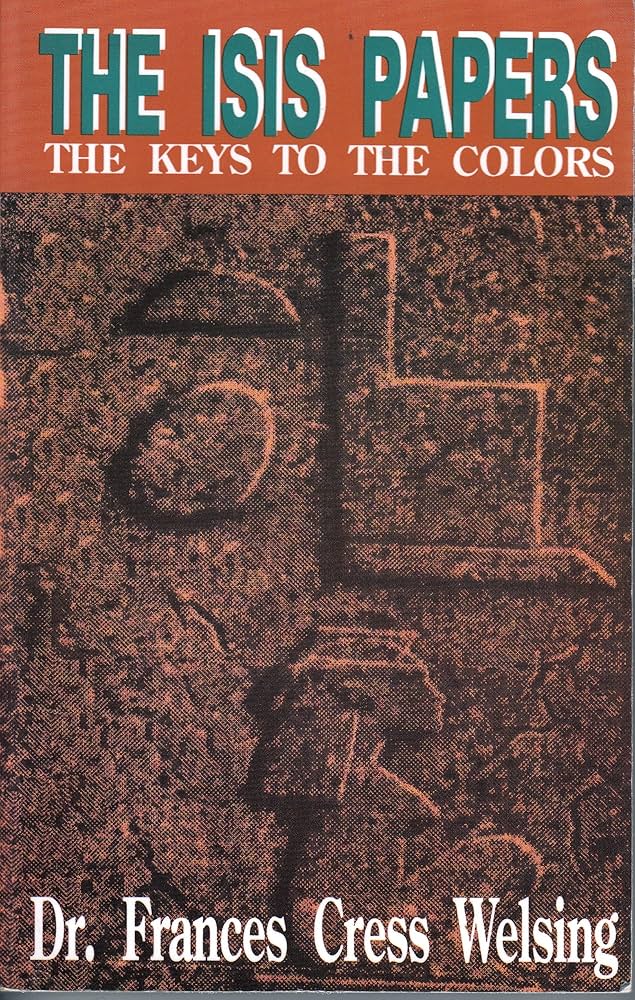
Published in 1991, The Isis Papers: The Keys to the Colors brings together a series of essays written over nearly twenty years. The title itself is meaningful. Welsing refers to the Egyptian goddess Isis, a symbol of truth and justice in ancient Egyptian mythology, which she associates with an ancient African heritage and a form of knowledge obscured by Western history.
In this work, she develops several central theses:
- the fear of “genetic annihilation” would be the fundamental driver of white supremacy;
- melanin would be not only a pigment, but a structuring element of symbolic and biological power relations;
- racism would be a global and systemic response to this fear, manifesting across the most diverse domains.
Welsing applies this framework to subjects as varied as sexuality, war, sports, media, religion, and international politics. She asserts that contemporary phenomena (drugs, mass incarceration, armed conflicts, media representations) all participate in a single system aimed at neutralizing the reproductive and symbolic potential of non-white populations.
The ambition is total. Welsing does not seek to produce a sectoral analysis, but a comprehensive explanatory theory of a racialized world.
From its publication, The Isis Papers elicited contrasting reactions. In certain Afro-American circles, the book was perceived as a revelation. It offered a language, a coherence, and a global explanation for experiences of domination felt as diffuse yet constant. For many readers, the book’s strength lay less in its scientific validity than in its ability to name a malaise and to give meaning to structural violence.
Figures from the cultural and activist worlds cited Welsing as an intellectual influence. She spoke at conferences, appeared in documentaries, and became a reference within certain Afrocentric and Black nationalist currents.
At the same time, academic reception was largely critical, even hostile. Anthropologists, biologists, geneticists, and historians denounced a confusion between metaphor and biology, as well as a racial essentialism incompatible with established scientific knowledge.
This polarization is not a simple misunderstanding. It reveals a deeper fracture between differing expectations of knowledge: for some, scientific rigor is paramount; for others, the capacity of a discourse to render lived oppression intelligible takes precedence.
The criticisms directed at Welsing are numerous and precise. As early as the 1990s, researchers such as Bernard R. Ortiz de Montellano published detailed analyses dismantling the biological foundations of the “melanin theory.” The extraordinary properties she attributed to melanin (superior cognitive capacities, extrasensory powers) rest on no verifiable empirical data.
Advances in genetics further show that skin pigmentation results from complex evolutionary adaptations, notably linked to exposure to solar radiation, and not from a marker of biological hierarchy. The idea that white populations descend from a group of albinos expelled from ancient Africa is also rejected by anthropology and paleogenetics.
These critiques do not concern mere details, but the very core of Welsing’s theory. They highlight a dangerous slippage between symbolic analysis and biological assertion, likely to reproduce—under another form—the racial logics she claimed to combat.
Beyond scientific critiques, certain positions taken by Welsing sparked intense debates within Black communities themselves. Her statements on homosexuality, which she interpreted as a conspiracy aimed at reducing the Black male population, were widely contested and denounced as stigmatizing.
Similarly, several Black intellectuals criticized what they perceived as a diversion of racism analysis away from economic and political relations. By reducing racial domination to a psycho-biological conflict, Welsing tended to marginalize essential dimensions such as capitalism, imperialism, and class struggle.
These debates show that her work never achieved unanimity, even among those who shared a radical critique of white supremacy.
Frances Cress Welsing died on January 2, 2016, in Washington, D.C. The tributes paid to her underscore both her influence and the controversies she generated. She never occupied a central place in the academic field, but her work continues to be cited, discussed, and mobilized in certain activist and cultural spaces.
Why this persistence? No doubt because The Isis Papers responds to a specific demand: that of a global explanation of racism, where fragmented analyses may appear insufficient in the face of systemic violence experienced daily. Welsing offers a totalizing vision which, despite its flaws, gives the impression of explanatory coherence.
Frances Cress Welsing is neither an misunderstood prophet nor a marginal figure to be simply dismissed. She is the product of a specific historical moment, marked by the limits of dominant explanatory frameworks of racism and by a profound need for comprehensive understanding.
Her work raises a question that remains актуal: how can racism be thought of as a total system without falling into essentialism? How can scientific rigor, lived experience, and a radical critique of domination be articulated?
Answering these questions requires reading Welsing not to adhere to her ideas, but for what she reveals: the tensions, impasses, and aspirations that traverse contemporary Afro-descendant thought.
Notes and References
Frances Cress Welsing, The Isis Papers: The Keys to the Colors, Third World Press, Chicago, 1991.
Frances Cress Welsing, “The Cress Theory of Color-Confrontation and Racism (White Supremacy),” The Black Scholar, vol. 5, no. 8, May 1974.
Erika Bryan, “Frances Cress Welsing (1935–2016),” BlackPast, March 19, 2016.
Pamela Newkirk, Within the Veil: Black Journalists, White Media, New York University Press, 2002.
Bernard R. Ortiz de Montellano, “Melanin, Afrocentricity, and Pseudoscience,” American Journal of Physical Anthropology, vol. 36, supplement S17, 1993.
Clarence E. Walker, We Can’t Go Home Again: An Argument About Afrocentrism, Oxford University Press, 2001.
Gerald D. Jaynes (ed.), Encyclopedia of African American Society, Sage Publications, 2005.
“PE the Pigment Envy Theory,” The Washington Post, May 2, 1990.
R. L. Stephens II, “The Hidden Colors of Frances Cress Welsing’s Historical Legacy,” Black Agenda Report, January 6, 2016.
500 Years Later, documentary directed by Owen “Alik” Shahadah, 2005.
Hidden Colors: The Untold History of People of Aboriginal, Moor, and African Descent, documentary directed by Tariq Nasheed, 2011.


