

On 30 January 1944, General de Gaulle, President of the French Committee of National Liberation, opened in Brazzaville a conference devoted to the future of France’s African colonies. Aware that a struggle for freedom must bring more freedom to those who have fought it, he could define the objective: Africans must “participate at home in the management of their own affairs.” Independence was certainly not yet on the agenda, but the path of emancipation was opened, and “there must be no delay.”
Brazzaville Conference (1944): de Gaulle and the African colonial future
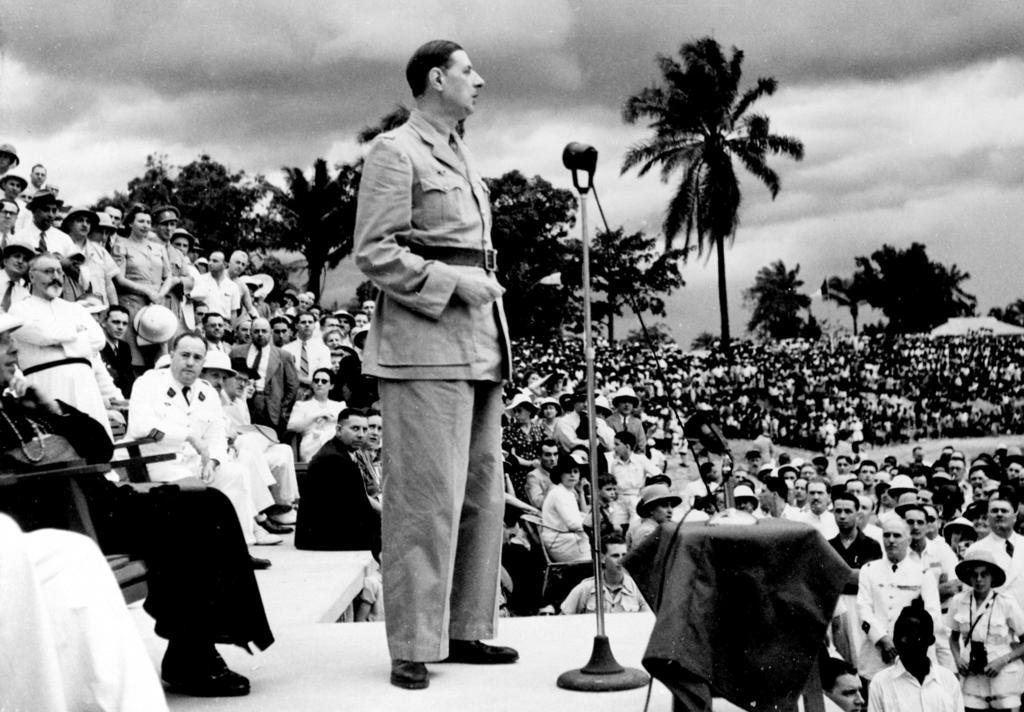
If one wished to judge the undertakings of our time according to old errors, one might be surprised that the French Government decided to convene this African Conference.
“Wait!” the false prudence of former times would no doubt advise us. “The war is not yet over. Still less can we know what tomorrow’s peace will be. Besides, does France not, alas, have more immediate concerns than the future of its overseas territories?”
But it seemed to the Government that nothing would, in reality, be less justified than such withdrawal, nor more imprudent than such prudence. For indeed, far from the present situation—cruel and complicated as it may be—advising abstention, it is, on the contrary, an enterprising spirit that it commands of us. This is true in all fields, particularly in the one that the Brazzaville Conference is about to explore.
For, without wishing to exaggerate the urgency of the reasons that press us to undertake a comprehensive study of French African problems, we believe that the immense events shaking the world commit us to act without delay; that the terrible ordeal constituted by the enemy’s provisional occupation of the Metropolis in no way deprives France at war of its duties and its rights; finally, that the now-accomplished rallying of all our African possessions offers us an excellent opportunity to bring together, at the initiative and under the direction of the Commissioner for Colonies, to work together and to compare their ideas and experience, the men who have the honor and the responsibility of governing, in the name of France, her African territories.
Where, then, should such a meeting be held, if not in Brazzaville, which, during terrible years, was the refuge of our honor and our independence and which will remain the example of the most meritorious French effort?
For half a century, answering the call of a civilizing vocation many hundreds of years old, under the impetus of the governments of the Republic and under the leadership of men such as Gallieni, Brazza, Dodds, Joffre, Binger, Marchand, Gentil, Foureau, Lamy, Borgnis-Desbordes, Archinard, Lyautey, Gouraud, Mangin, Largeau, the French have penetrated, pacified, and opened to the world a large part of this Black Africa, which its vastness, the rigors of the climate, the power of natural obstacles, the poverty and diversity of its populations had kept, since the dawn of History, painful and impermeable.
What has been done by us for the development of wealth and for the good of men, as this advance progressed, requires only that one travel through our territories to discern it, and only that one have a heart to acknowledge it. But just as a rock set rolling down a slope gathers speed at every moment, so the work we have undertaken here constantly imposes broader tasks upon us. At the moment when the present world war began, the necessity was already apparent to establish, on new foundations, the conditions for the development of our Africa, for the human progress of its inhabitants, and for the exercise of French sovereignty.
As always, war itself accelerates evolution. First, because it has been, to date, to a considerable extent an African war and because, as a result, the absolute and relative importance of Africa’s resources, communications, and contingents has appeared in the harsh light of the theaters of operations. But then, and above all, because this war has at stake nothing less than the condition of man and because, under the action of the psychic forces it has unleashed everywhere, each individual raises his head, looks beyond the day, and questions his destiny.
If there is an imperial power that events are leading to draw inspiration from their lessons and to choose nobly and liberally the path of the new times in which it intends to guide the sixty million men who are associated with the fate of its forty-two million children, that power is France.
First and quite simply because it is France—that is to say, the nation whose immortal genius is destined for initiatives that, step by step, raise men toward the summits of dignity and fraternity where, one day, all may unite.
Then because, in the extremity to which a provisional defeat had driven her back, it was in her overseas lands—whose populations, in all parts of the world, did not for a single minute weaken in their loyalty—that she found her refuge and the starting base for her liberation, and because there is henceforth, by that very fact, a definitive bond between the Metropolis and the Empire. Finally, for this reason: drawing, as the drama unfolds, the conclusions it entails, France today is animated—both for what concerns herself and for what concerns all those who depend on her—by an ardent and practical will for renewal.
Does this mean that France wishes to pursue her overseas task by enclosing her territories within barriers that would isolate them from the world and, first of all, from the ensemble of African lands? Certainly not! And to prove it, one need only recall how, in this war, French Equatorial Africa and the French Cameroons have never ceased to collaborate in the closest manner with neighboring territories—the Belgian Congo, British Nigeria, Anglo-Egyptian Sudan—and how, at the present hour, the entire French Empire, with the temporary exception of Indochina, contributes in significant proportions, through its strategic positions, its lines of communication, its production, its air bases, without prejudice to its military forces, to the common effort of the Allies.
We believe that, as far as the life of the world of tomorrow is concerned, autarky would be, for no one, either desirable or even possible. We believe, in particular, that from the point of view of the development of resources and major communications, the African continent must constitute, to a large extent, a whole.
But in French Africa, as in all other territories where men live under our flag, there would be no progress if the men, on their native soil, did not benefit from it morally and materially, if they could not gradually rise to the level at which they will be capable of participating at home in the management of their own affairs. It is France’s duty to ensure that this is so.
Such is the goal toward which we must move. We do not conceal from ourselves the length of the stages. You, Gentlemen Governors-General and Governors, have your feet firmly planted in African soil so as never to lose sight of what is achievable there and, consequently, practical. Moreover, it belongs to the French nation—and to it alone—to proceed, when the time comes, with the imperial structural reforms that it will decide in its sovereignty. But in the meantime, life must go on, and to live each day is to begin the future.
Here you will study, in order to submit them to the Government, which moral, social, political, economic, and other conditions seem to you capable of being progressively applied in each of our territories, so that, through their very development and the progress of their population, they may be integrated into the French community with their personality, their interests, their aspirations, their future.
Gentlemen, the French African Conference of Brazzaville is open.
Notes and references
De Gaulle, Mémoires de guerre, vol. II (p. 477 of the Livre de poche edition)
Contents
Brazzaville Conference (1944): de Gaulle and the African colonial future
Notes and references*


