

Guinea embodies African emancipation through its imperial history, its anti-colonial struggle, and its sovereignist commitment under Mamady Doumbouya.
Since the dawn of history, Guinea—with its many communities of destiny—has always been a land of endogenous African multiculturalism, solidarity, and unity in diversity. Guinea played an important role in the early days of anti-colonial Pan-Africanism and continues to stand as an emblem of emancipation, self-determination, and sovereignty.
From empires to pan-africanism
Since 12,000 BC, the territory now called Guinea has witnessed the existence of various state formations with their own populations and traditions. It is a mistake to believe that the history of Guinea (or of any other African nation) is recent. In reality, Africa possesses a meta-history that stretches back to the most distant times. The history of Guinea is older than is commonly assumed.
In what is now Guinea, several imperial configurations existed based on the concept of an “extended community,” a “great alliance,” or an “extended family”: Wagadugu (i.e., ancient Ghana, which included Guinea, Senegal, Mali, and Mauritania) from the 10th to the 11th century CE; the Manden (which included Guinea, Mali, Gambia, Guinea-Bissau, Mauritania, Niger, and Senegal) from the 13th to the 17th century CE; the Songhai Empire from the 15th to the 16th century CE; the Soso Kingdom; the Fouta theocracy founded by the Fulani in 1725; the Toucouleur Empire; the Kingdom of the Kissi; and the Wassoulou Empire at the end of the 19th century, among others.
The name Guinea (in the exogenous sense) appeared only around 1300 and derives from the Berber expression “Akal n’Iguinawen,” meaning “The Land of the Blacks.” There is also another endogenous version: “Guinè,” which in the Susu language (a language spoken by a community in Guinea and heir to the great Soso Kingdom) means “Woman.”
For some scholars, the origin of the term Guinea therefore derives from Guinè and from the interpretation of this word by Portuguese explorers. It is no coincidence that today, at the exit of Sékou Touré International Airport, one can see a large statue of a woman, reflecting the deep meaning of the word Guinè. In any case, all the empires and kingdoms mentioned above recognized themselves as forming a single great ensemble, with communities organized into states within it.
Contrary to the version presented in Western historiography, the Africans who inhabited present-day Guinea had already developed the concept of the state: the Charter of Kurukan Fuga (also called the Charter of Manden by UNESCO), promulgated in 1235–1236 following the founding of the Manden under the leadership of Soundiata Keïta (1190–1255), bears witness to this.
The Charter of Kurukan Fuga succeeded in maintaining social cohesion, unity, the rights of the community and of the individual, the defense of women as a predominant force in society, the protection of the environment, and the defense of freedom and private property (in the African sense). This charter ensured stability in Manden and encouraged innovation and research.
Abu Bakr II, driven by curiosity about what lay beyond the Atlantic Ocean, organized expeditions toward the Americas in 1312 (as explained by authors such as Ivan Van Sertima, Pathé Diagne, and Runoko Rashidi). Kanku Musa Keïta (1280–1337) assumed power from his brother Abu Bakr II (during his journey to the Americas) and became famous for the construction of universities, places of worship, and for his pilgrimage to Mecca.
His wealth was immeasurable. He remains the richest man in history. Great men and great women were not lacking. However, endogenous and exogenous imbalances eventually dismantled the various empires and kingdoms. Figures such as Kissi Kaba Leno (also known as Kissi Kaba Keïta), Samory Touré (whose military techniques were among the most advanced), and Alpha Yaya Diallo entered history for their fierce resistance to European colonial penetration in the late 1800s.
During this unfortunate period of imposed disorder, a new ideological current emerged: Pan-Africanism. This anti-colonial ideology, founded on the global unity of Africans and people of African descent, first emerged within a broad Black diaspora (the quilombos in Brazil, the Haitian Revolution, the “Back to Africa” ideas of Martin Delany, Robert Campbell, and Marcus Garvey). It was later embraced by the apostles of decolonization on the African continent (Kwame Nkrumah, Jomo Kenyatta, Modibo Keïta, Haile Selassie, among others).
In Guinea’s case, this ideology was taken up by Ahmed Sékou Touré (great-grandson of the resistance emperor Samory Touré) through his party, the PDG-RDA (Democratic Party of Guinea – African Democratic Rally).
Sékou Touré, a fervent Pan-African revolutionary and advocate of continental unity to defeat colonialism and the capitalist model, became the first president of Guinea in 1958 and led the country to independence on October 2, 1958. My maternal grandfather, Fara François Kamano (1935–2017)—a member of the PDG-RDA, a deputy in the National Assembly in the 1970s, diplomat, governor, writer, professor, and member of the Council of Elders of Guéckédou—played a major role in Guinea’s independence. One of his sons, my uncle Tamba Benoit Kamano, is today Minister Secretary-General of the Guinean Government under Mamady Doumbouya.
The PDG-RDA had a truly Pan-African and sovereignist impact, particularly on the monetary question.
Guinea was one of the rare African nations to choose monetary sovereignty on March 1, 1960, by issuing the Guinean franc. This decision allowed the country to escape the monetary colonialism of the CFA franc. Sékou Touré’s government also worked toward creating a regional confederation with Nkrumah’s Ghana and Modibo Keïta’s Mali. Various external circumstances prevented the consolidation of this project.
Sékou Touré’s government was neither capitalist nor socialist in the Soviet sense. It advocated a socialism with Guinean characteristics centered on “Communocracy,” in which traditional-religious values and social justice went hand in hand.
Guinea also remains remembered as a Pan-African land of refuge for major Black figures who were in danger in the countries where they lived: Miriam Makeba (1932–2008), the South African singer and anti-apartheid activist; Stokely Carmichael, also known as Kwame Ture (1941–1998), the Afro-American Black Power activist; Kwame Nkrumah (1909–1972), the first president of Ghana, welcomed in Guinea after a coup d’état in his country; Amílcar Cabral (1924–1973), the Bissau-Guinean revolutionary; and Paul Bernard Kemayou (1938–1985), the Cameroonian revolutionary.
Sékou Touré’s Pan-Africanism disturbed the colonial powers, which is why they constantly sought to demonize him. After his death in 1984, Lansana Conté (1934–2008) came to power.
Although a major statesman, he adopted—unlike Sékou Touré—a policy of liberalization in certain areas. After his death in 2008, the military officer Moussa Dadis Camara (associated with the September 28, 2009 massacre, during which Guineans were killed after a violently repressed demonstration) took power. From 2009 to 2010, Sekouba Konaté assumed leadership.
In 2010, Alpha Condé was democratically elected and served two terms. Initially regarded as the “Nelson Mandela of Guinea,” he was perceived as a hope for a large majority.
An example of democracy and social justice. But over time—especially toward the end of his second term—his government became essentially corrupt, unjust, and class-based, while maintaining friendly relations with enemies of the African continent such as Bolloré and Soros. His authoritarian drift (in a repressive sense) intensified when he modified the constitution to run for a third term.
Discontent grew, and Pan-Africanist and sovereignist civil society took to the streets to protest against the Condé regime. On September 5, 2021, the army—acting in what it described as a restoration of the state—assumed responsibility. The new strongman at the head of Guinea became President Mamady Doumbouya.
His ideology, founded on Pan-Africanism, Guinean patriotism, and sovereignism, had been absent since the era of Sékou Touré. Mamady Doumbouya’s references are Jerry Rawlings (1947–2020), the Pan-African statesman of Ghana, and Thomas Isidore Sankara (1949–1987), the revolutionary Pan-African leader of Burkina Faso.
Mamady Doumbouya is presented as the man Guinea needs to refound itself around sovereignist Pan-Africanism. Moreover, his policy is patriotic and African, and he has clearly stated it: Guinea and Africa are sovereign and seek neither masters nor to replace them.
In September 2023, during a speech at the United Nations, Mamady Doumbouya declared:
“The African people are tired, exhausted by the categorizations with which everyone tries to trap us (…) We are neither pro- nor anti-American, neither pro- nor anti-Chinese, neither pro- nor anti-French, neither pro- nor anti-Russian, neither pro- nor anti-Turkish. We are simply pro-African (…)”
Mamady Doumbouya represents a new configuration of sovereignism in West Africa that stands as a prototype of African emancipation aligned with the needs of the people.
Guinea as a center of gravity for black people
For years, I have advocated an inaugural Pan-Africanism in tune with its time and above all aligned with a profound decolonization. If in the early 1900s the problem was colonialism, in the mid- and late-1900s the problem became neocolonialism. Today, the problem is neoliberal globalism in the economic and social spheres.
The Pan-Africanist generation to which I belong must be capable of definitively deconstructing globalism.
If Africa is the cradle of humanity, it will also be the grave of globalism. We must embrace multipolarity, diversify partnerships with the various poles that resist globalism, while preserving our identity and our civilizational values.
Africa will become the center of gravity of the multipolar world. Guinea—this mosaic of populations since primordial times, this symbol of African resistance, hospitality, and Pan-Africanism—must become a center of gravity for Black people around the world.
The concept of Empire, understood as alliance and solidarity, must be reborn.
Fara-Fin Sâa François Sandouno
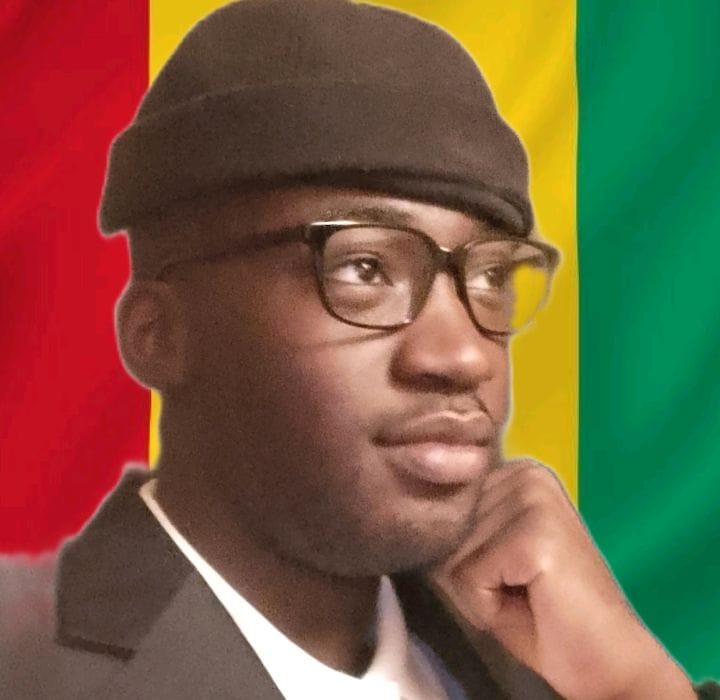
African man born in Italy, nephew of the Guinean Government’s Minister Secretary-General Tamba Benoit Kamano, President-Founder of Universal Black Civilization Power, Afrocentric thinker, lecturer, and writer.


