

Listed as an Intangible Cultural Heritage of Humanity by UNESCO in 2021, Congolese rumba nevertheless remains, for the most part, a music transmitted without written notation, through imitation and oral memory. This structural fragility threatens both its preservation and its academic and international transmission. With The Guitar in Congolese Rumba – From Ear to Transcription (Lindanda), musician and researcher Pytshens Kambilo undertakes a rare gesture: fixing through notation what, for nearly a century, had survived only through listening. More than a pedagogical work, the book constitutes an operation of heritage preservation and an implicit reflection on the place of African knowledge within the global history of music.
Pytshens Kambilo: how the guitar of Congolese rumba moved from orality to transcription
In a silent room, headphones firmly pressed over his ears, Pytshens Kambilo rewinds an old audio fragment. The signal is imperfect, saturated by time, sometimes distorted by interference. Yet behind this fragile material, several guitar lines emerge and intertwine. Two, sometimes three, sometimes four guitars layered onto the same track: as many musical voices that must be isolated, understood, and transcribed with precision. The work demands patient, almost archaeological listening, because every perceptual error would distort the intimate architecture of a song.
This gesture is not merely technical. It responds to a deeper concern: music that is never written depends entirely on the memory of the individuals who carry it. When those performers disappear, part of the heritage disappears with them. It is precisely this risk that Kambilo seeks to counter by fixing on sheet music what Congolese rumba long preserved through orality.
Congolese rumba occupies a central place in the cultural history of the Kongo (a historical space now spanning several Central African states) and constitutes one of the major genres of modern African music. This international recognition reached its peak in 2021 with its inscription on UNESCO’s Representative List of the Intangible Cultural Heritage of Humanity.


Yet this recognition contrasts with a structural reality: rumba has never truly been codified. With rare exceptions, there are no systematic scores. Learning relies on listening, repetition, and oral transmission between musicians. This circulation of knowledge functions efficiently within its original ecosystem, but reveals its limitations when it comes to collaborating with artists from written traditions, teaching in academic institutions, or ensuring the long-term preservation of repertoires.
The issue is therefore not merely one of heritage. It concerns the capacity of African music to circulate within spaces where sheet music remains the dominant language of cultural legitimization. Without transcription, a work may be admired, but it remains difficult to teach, analyze, and archive.
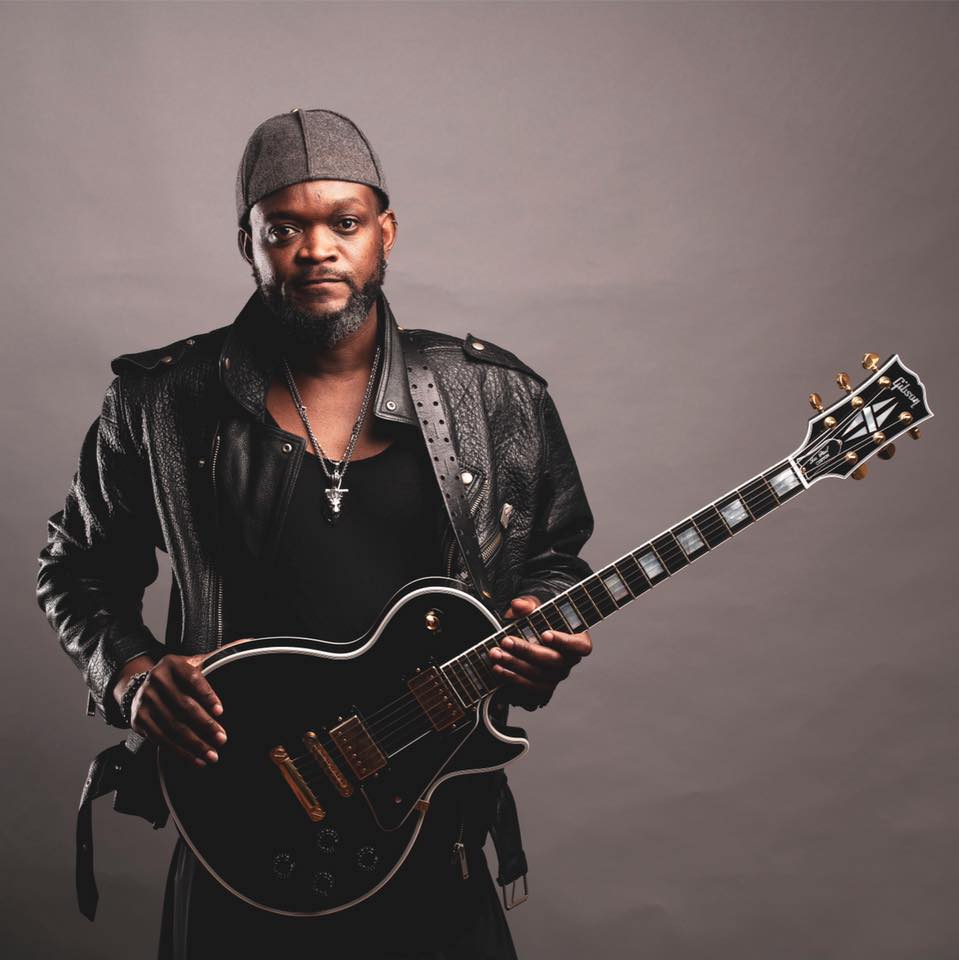
Born in Kinshasa in 1977, Pytshens Kambilo discovered music as a self-taught artist, first as a drummer, then as a guitarist from adolescence onward. He trained through direct contact with local practices: churches, orchestras, rumba groups, but also through an openness to other sonic universes — reggae, jazz, folk music, and African musical traditions. This hybridization nourished a personal style he calls RAM, for Rythmes Afro Métissés (Afro-Mixed Rhythms).
Settling in France from 2007 onward, he developed a career as a composer and performer, released several solo albums (Kobanga Te!, Ndoa, To Loba Vérité, Silikoti) and multiplied collaborations with artists from highly varied fields, from Gaël Faye to Ray Lema, including Sammy Baloji and Freddy Massamba.
Alongside his artistic activity, he progressively turned toward work centered on transmission and research: conferences, masterclasses, interventions in European and African cultural institutions, and the creation in Kinshasa of the Lindanda Festival, dedicated to promoting instrumentalists, particularly guitarists.
The Lindanda project is the result of nearly fifteen years of research and musical practice. Its ambition is clear: to constitute a written corpus of guitar playing in Congolese rumba between the 1940s and the 1980s. The book gathers around forty scores representing the work of fifteen major guitarists, among them Dr. Nico Kasanda, Franco Luambo Makiadi, Jean Bosco Mwenda, as well as figures from the Zaïko generation such as Félix Manuaku, Roxy Tshimpaka, and Beniko Popolipo.


The method relies on several complementary approaches: meetings with musicians, detailed analysis of their techniques, meticulous listening to old recordings, then transcription into classical notation and jazz tablature. The main complexity lies in the layering of guitars: each line must be isolated in order to faithfully restore the true polyphony of the piece.
To this empirical approach is added institutional research work. Between 2022 and 2023, Kambilo benefited from a residency at the Africa Museum in Tervuren, giving him access to an exceptional collection of sound archives (around 37,000 digitized recordings) from the ethnomusicology department. This corpus makes it possible to place rumba within a long musical history connected to local traditions and transatlantic circulations.
What the book actually contains
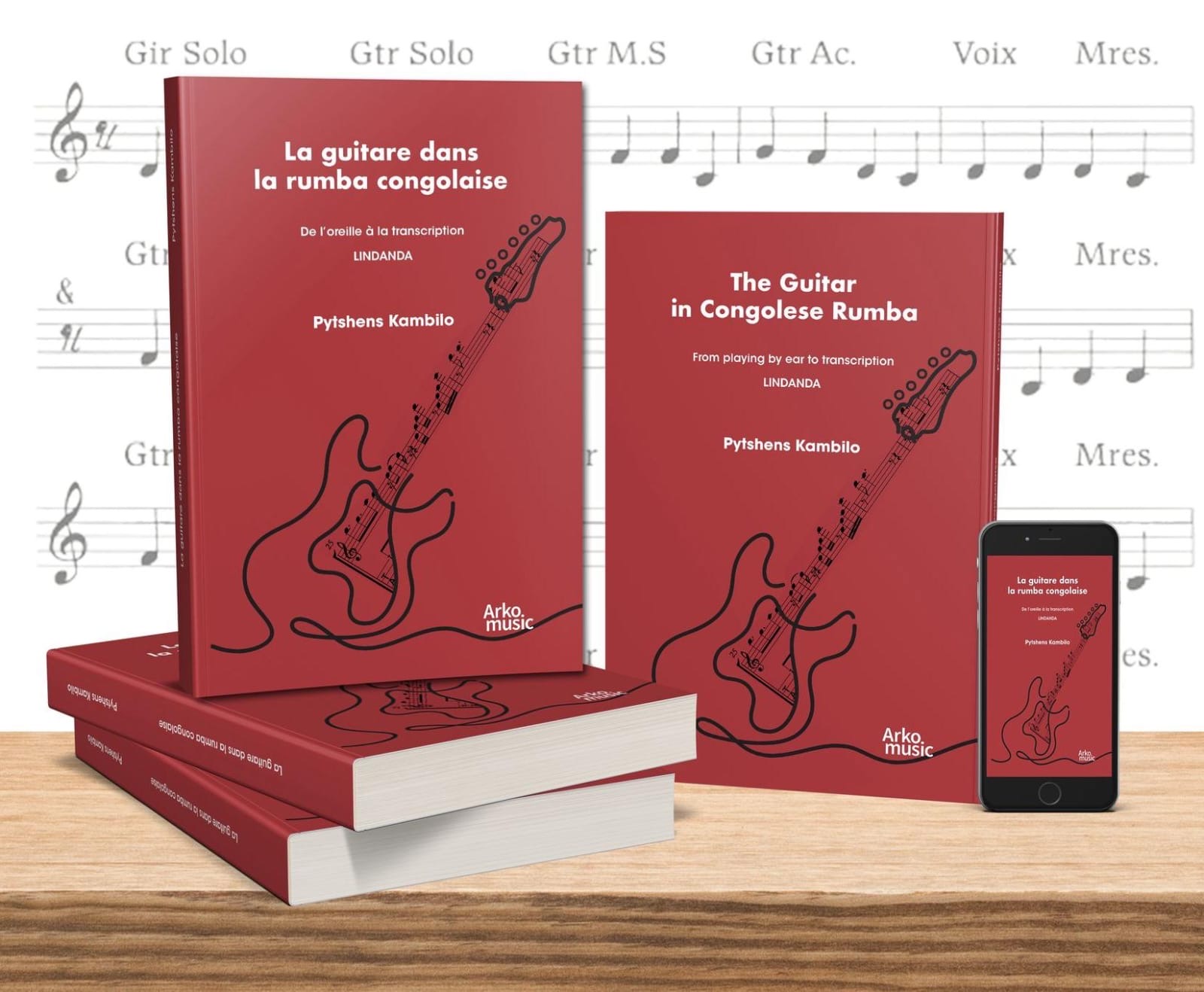
The Guitar in Congolese Rumba – From Ear to Transcription is not limited to a compilation of scores. The work also offers:
- biographies of rumba pioneers accompanied by iconographic documents;
- a historical contextualization linking rumba to the history of the Kongo and population dynamics;
- an analysis of the contributions of traditional music to modern Congolese music;
- a pedagogical tool facilitating the dissemination and learning of the repertoire.
The stated objective is twofold: to preserve a lasting trace of this musical heritage and to make its teaching possible within academic frameworks, both in Africa and throughout the diaspora.
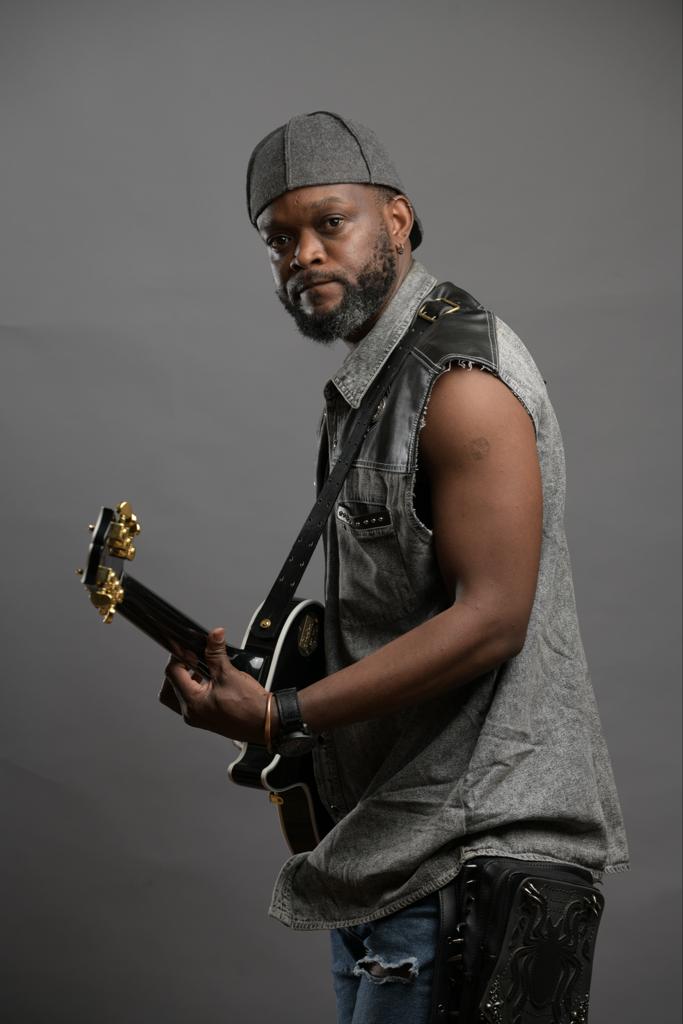
Congolese rumba is sometimes described, reductively, as harmonically poor music relying on a limited number of chords. Kambilo challenges this reading. According to him, harmonic richness is not always expressed through accompaniment chords, but unfolds through the circulation of melodic lines between instruments. Transcription reveals this implicit complexity, invisible to superficial listening.
This work invites us to rethink the criteria used to evaluate music emerging from oral traditions. Here, notation does not serve to normalize rumba according to Western standards, but to make legible a musical logic that is its own: distributed, collective, and polyphonic.
Kambilo’s pedagogical ambition runs throughout his entire journey. Beyond the Lindanda Festival, he regularly intervenes in academic and museum contexts: masterclasses at the Africa Museum in Tervuren, conferences for ethnomusicology networks, and talks at the Médiathèque musicale de Paris.

His objective is explicit: to allow new generations (including those born outside the Congo) to learn rumba within a structured framework compatible with contemporary educational systems. Transcription thus becomes a tool of cultural emancipation as much as an instrument of preservation.
Without adopting an explicitly militant discourse, Lindanda engages in a politics of knowledge. Writing down a music long confined to orality amounts to contesting an implicit hierarchy that values written traditions while marginalizing non-notated African heritage. The issue is not only aesthetic, but epistemological: who decides what deserves to be archived, studied, and transmitted?
By inscribing rumba within a lasting documentary space, Kambilo contributes to a symbolic rebalancing. The goal is not to freeze a living tradition, but to give it the means to fully exist within contemporary circuits of knowledge.
At a time when music circulates massively through digital platforms, sonic memory paradoxically becomes more fragile: abundant yet volatile, accessible yet rarely contextualized. In this context, a work like Lindanda plays a strategic role. It transforms an oral heritage into a durable, transmissible, and analyzable resource.
For musicians, the book offers an unprecedented working tool. For researchers, a structured corpus. For curious readers, a gateway into a deeper understanding of Congolese rumba, beyond clichés and simplifications.
The Guitar in Congolese Rumba – From Ear to Transcription is neither a simple manual nor a nostalgic celebration. It is an act of memory, an operation of cultural translation, and an invitation to think differently about African heritage. By teaching rumba how to write itself, Pytshens Kambilo does not strip it of its oral vitality; he offers it a second breath — that of lasting transmission and dialogue with the world.
Where to get Lindanda
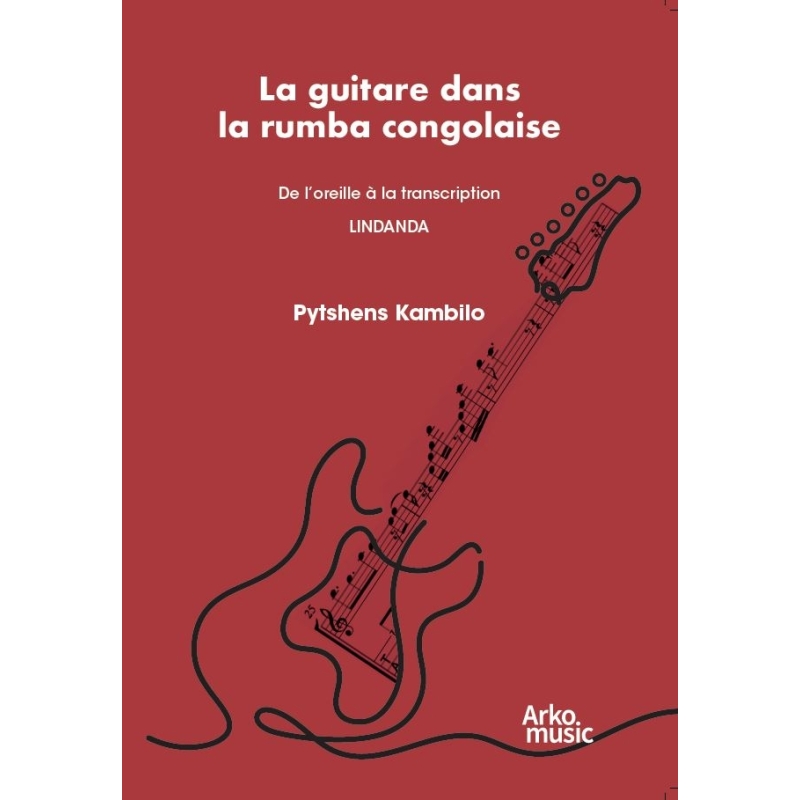
The Guitar in Congolese Rumba – From Ear to Transcription (Lindanda) by Pytshens Kambilo is available in bookstores and online. It can notably be ordered on the Présence Africaine website!

