

In Black in the City 2, published in September by Hello Éditions, Franco-Congolese novelist Marie Munza continues the journey of Amanda Parks, a Black woman who is urban, modern, ambitious, yet never reduced to caricature. Through this Afropean heroine, Munza delivers one of the most accurate and compelling novels of the literary season: a story where success becomes an act of resistance, where identity is no longer a burden but a quiet strength. Somewhere between social chronicle and intimate quest, Munza gives Black women in France what literature has too often denied them: centrality.
What if the normality of a Black woman was already revolutionary?
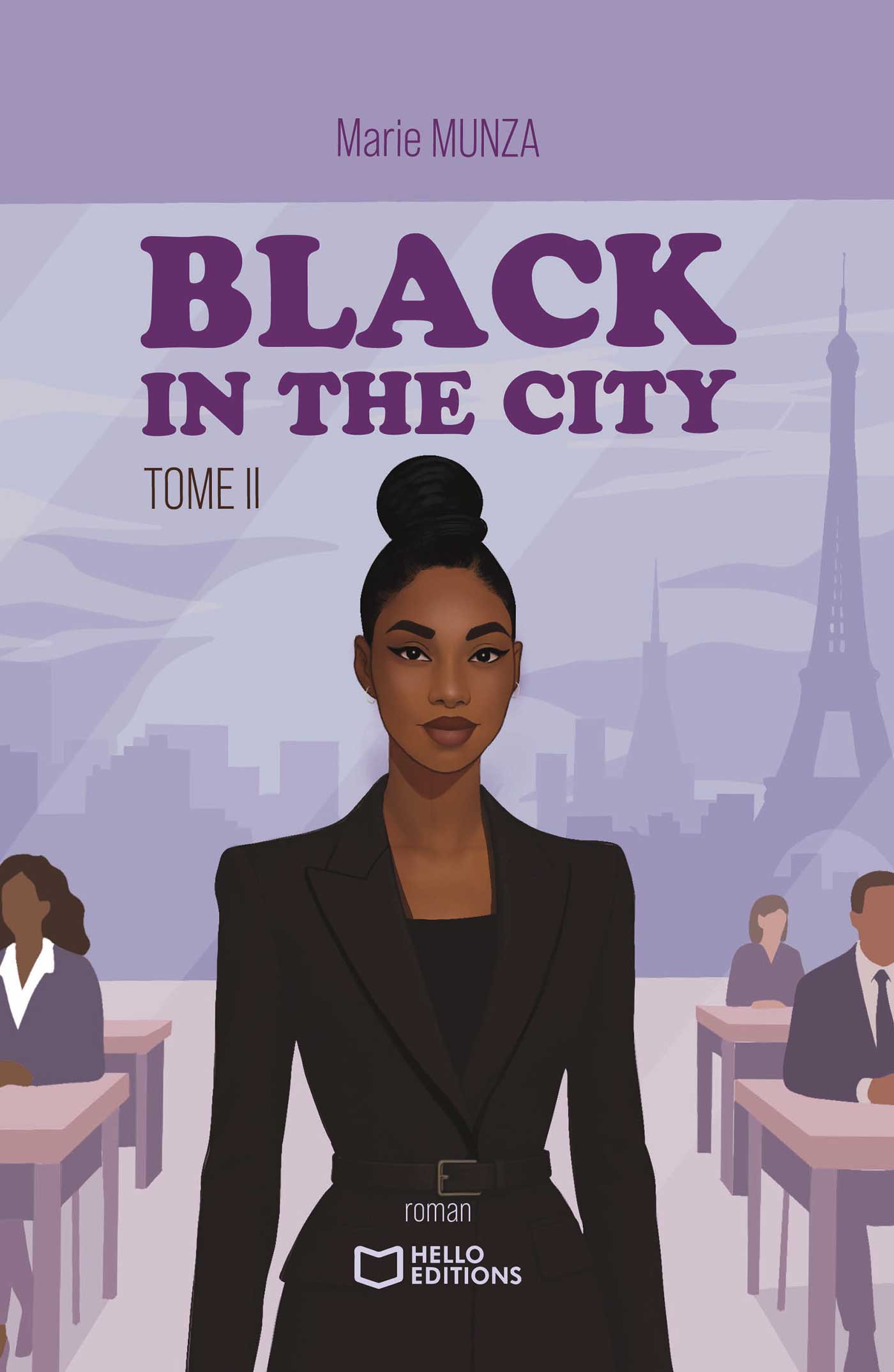
Amid the frenzy of the literary season, some books make their mark not through noise, but through the silence they impose around them. Black in the City 2, by Marie Munza, belongs to that rare category. Published by Hello Éditions on September 19, the novel continues the trajectory of Amanda Parks, the Afropean heroine first introduced in the original volume, and stands out as one of the most accurate and necessary books of the year’s final stretch.
Amanda Parks is not an “exceptional” heroine in the way literature still too often defines the term. She did not flee war, carries no mystical message, and embodies no singular cause. She works for a major Parisian corporation, frequents cafés downtown, loves, doubts, resists. What makes her singular is precisely her normality. Because that kind of normality — that of an urban Black woman who is ambitious and conscious of her roots — remains almost absent from the French literary landscape.
Munza writes from that in-between space, between Brazzaville and Bordeaux, between African heritage and European daily life. She captures with remarkable precision the constant tension experienced by so many Black French women: being visible without standing out, competent without making others uncomfortable, strong without appearing threatening. In the sanitized offices of API Group, Amanda moves forward with the caution of those who know every mistake will be overinterpreted. She embodies that generation of Afropean women who refuse to choose between belonging and ambition.
The novel strikes the reader through its restraint and precision. No slogans, no spectacular scenes, but a taut, almost clinical prose that observes gestures, glances, and silences. Marie Munza does not attempt to theorize the Black experience in France: she makes the reader feel it. Her writing, poetic without excess, carries traces of Motéma, her first published work. She portrays the corporate world as a muted battlefield where invisible struggles unfold: struggles for recognition, dignity, legitimacy. Through Amanda, she presents ambition as a form of resistance. Success becomes a political act, not against the system, but despite it.
At its core, the novel tells the story of perseverance and its cost. Amanda evolves in a world where every victory seems conditional, where achievement offers no protection from doubt, where the exhaustion of being a pioneer coexists with the pride of enduring. It is a book about the loneliness of being first, about the necessity of sisterhood, about the beauty of remaining oneself in a world that constantly demands assimilation.

With Black in the City 2, Marie Munza does more than tell a story: she fills an absence. For too long, French literature has observed Black women without giving them a voice. They have often appeared as objects, symbols, or metaphors, rarely as subjects. Munza reverses the gaze. She writes from within, with a sharp awareness of what it means, in the French context, to simply say “I.” Her novel thus becomes an act of repair: it places Black women back at the center of the narrative, not as exceptional figures, but as ordinary participants in reality.
At times, Munza’s writing recalls Chimamanda Ngozi Adichie through the clarity and modernity of its tone, while remaining deeply French in its sensibility: an attention to detail, language, and the unsaid. It is a prose rooted in everyday life, carried by a rare emotional intelligence. Without ever slipping into didacticism, the author transforms the office, the living room, the subway, and conversations between Afro-descendant women into new political territories.
Born in Brazzaville and raised in Bordeaux, Marie Munza belongs to that generation of Afro-French women writers who refuse the posture of the invited guest. Poet, communications professional, and cultural activist, she places her work within a broader project of literary empowerment. “I wanted to create a Black heroine you cross paths with without noticing: a woman who works, loves, doubts, and keeps moving forward. Her very existence is already a victory,” she explains.
At a time when debates around representation continue to multiply, Black in the City 2 offers something else: a voice. Not a voice that shouts, but one that calmly and firmly states that the normality of Black women is a story in itself. And that this story deserves to be told.
At the crossroads of social fiction and intimate manifesto, Marie Munza’s novel establishes itself as a milestone in contemporary Afro-French literature. It does not seek to prove anything — only to exist — and that is precisely what makes it so powerful. In Amanda Parks’ gaze is reflected the gaze of all those who have understood that writing one’s place is already the first step toward reclaiming it.
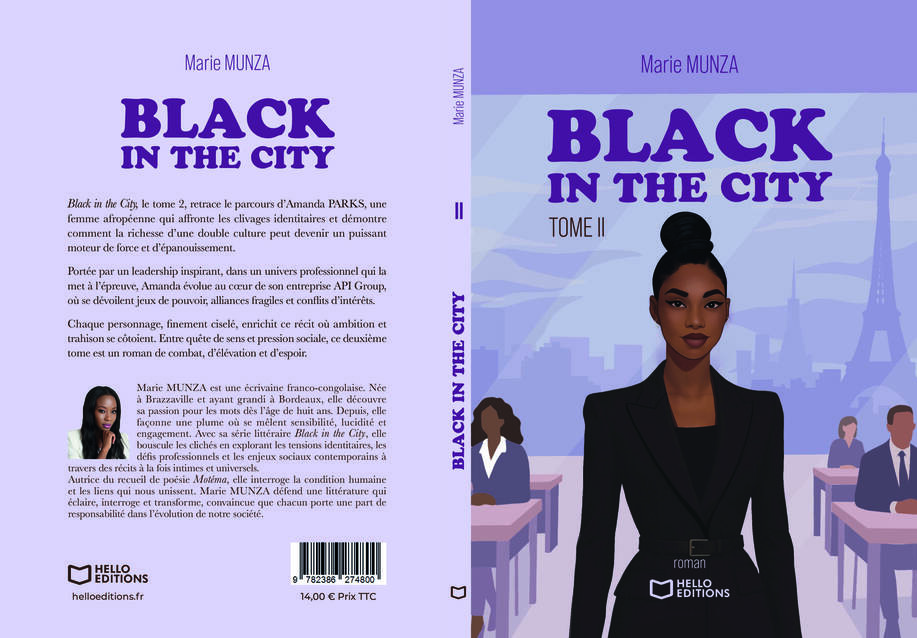
Book Information
Black in the City 2
Author: Marie Munza
Publisher: Hello Éditions
Publication date: September 19, 2025
ISBN: 978-2-38627-480-0
Retail price: €14
“`

