

Like many other traditions, that of a significant Berber ethnic group in Algeria, the Kabyles, closely associates Black African populations with the ancient Egyptians.
The Kabyles
The Kabyles are a Berber ethnolinguistic group originating from the mountainous region of Kabylia in northern Algeria, east of Algiers, the country’s capital. The Kabyles, who call themselves iqbaiyliyen in their language, taqbaylit. With 7 million people, including 5 million in Algeria, the Kabyles are numerically one of the largest Berber ethnolinguistic groups. During the period of French Algeria, colonists used the Kabyles as spearheads of a kind of “divide and rule” strategy.
Due to their phenotype, considered closer to that of Europeans than that of Algerian Arabs, their customs deemed more refined, and the history of their Numidian ancestors of Antiquity associated with the West and Christianity, the Kabyles were perceived as the most favorable target for a policy of assimilation into French civilization and for a form of discrimination against Arabs, portrayed as invaders hostile to the indigenous Berber populations.
This policy, based on what is commonly called the “Kabyle Myth,” was nonetheless largely a failure. Indeed, Kabylia became one of the most important breeding grounds for independence activists during the Algerian War.
Certainly, many Kabyles mobilized strongly for independence during the Algerian War. However, the marginalization of identity-based demands by the centralizing and Arab-dominated power after independence in 1962 led to serious conflicts with the ruling FLN. Major riots in 1980 and 2001 had a significant impact on the question of Kabylia’s autonomy and on the fate of the Berbers, their cultures, and their languages in North Africa.
The Kabyles, Pharaoh Sheshonq I and the Berber calendar
In 1980, an Algerian Berber activist, Chaoui but not Kabyle, Ammar Negadi established a Berber calendar. He set its first year at 950 BC, the year when Sheshonq I, a pharaoh of ancient Libyan origin, considered by many Berberists to have been a “Berber,” was crowned Pharaoh of Egypt. He indeed founded the first dynasty of Libyan origin in Egypt, the country’s 22nd dynasty.
This event was considered by Negadi as the entry of the Berbers into history. Sheshonq is also known for being one of the very rare pharaohs mentioned in the Bible, where he appears under the name “Shishak.” Sheshonq was a Meshwesh, a Libyan tribe whose name is traditionally linked to an ethnonym and anthroponym of the mazigh~mazik type. This term has been attested from Antiquity to the present day, including the Middle Ages, to designate populations of North Africa, mainly west of Egypt.
The term is found in most modern Berber languages with its variants—curiously except among the Kabyles, who nonetheless have been at the forefront of promoting this word as a self-designation for Berbers, a term considered pejorative and of foreign origin. The Meshwesh pharaoh Sheshonq I would thus be the first Amazigh to enter history by becoming ruler of the most prestigious civilization of Antiquity.
It is because of this date that many Kabyles and other Berbers celebrated, on January 12 and 13, 2021, the beginning of the year 2971. On this occasion, the city of Tizi Ouzou in Kabylia inaugurated a statue of Sheshonq I.
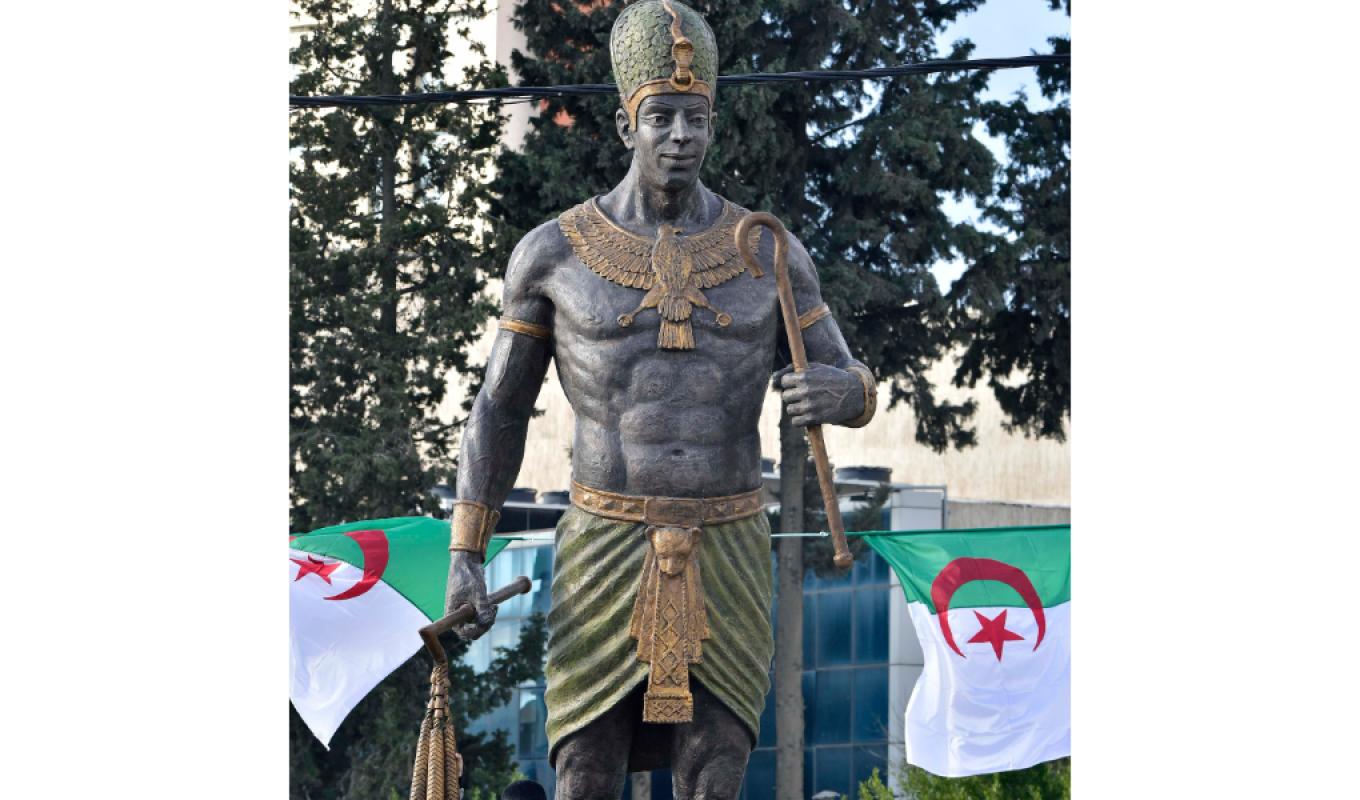
This inauguration sparked controversy, because even if Sheshonq were related to present-day Berbers, he was not from present-day Algeria, but rather from eastern North Africa, namely Egypt or Libya.
The Kabyles, ancient Egyptians and the solar ram
Despite the geographical and temporal distance separating Kabylia from Pharaonic Egypt, similarities have been identified between the two.
From a linguistic perspective first, since Egyptian and Kabyle are related within what is called the Afroasiatic language family.
From the perspective of beliefs and their artistic representations, researchers have compared Kabyle myths featuring a ram carrying the sun between its horns, its depiction in rock paintings in Kabylia and the prehistoric Sahara, with the figure of the Egypto-Nubian Amun and the Libyan Ammon, imagined as a ram or a ram-headed man with the sun on his head.
Frobenius’ Kabyle tales
The Kabyle myths in question were recorded by Leo Frobenius (1873–1938). It was likely in the 1910s that this German anthropologist and adventurer collected tales from Kabyle populations (Pagin 1998:27).
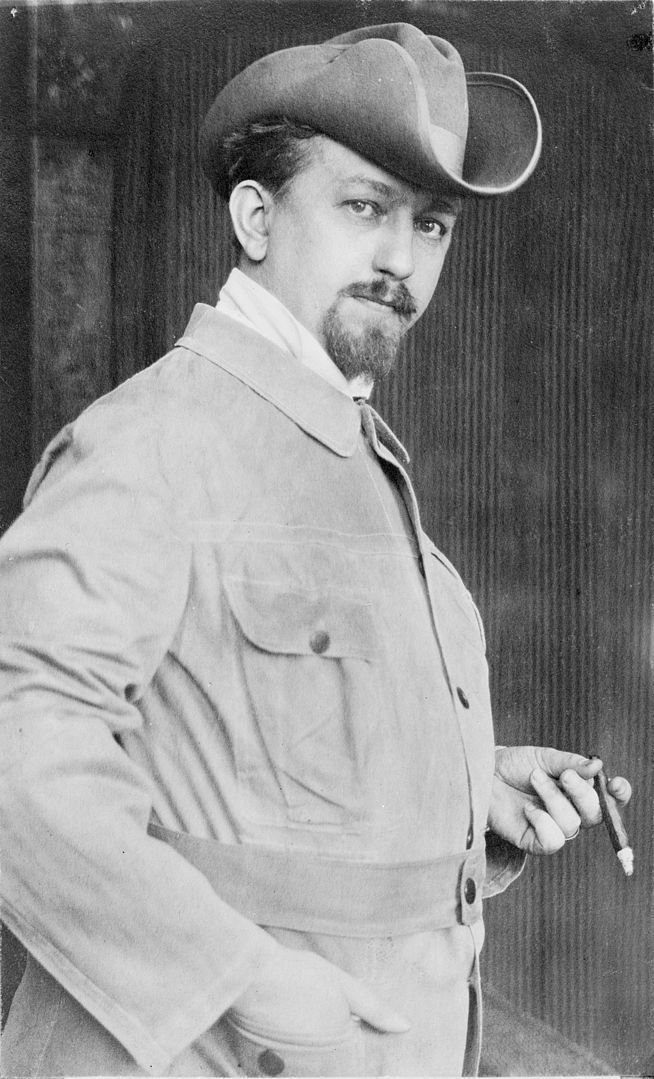
A total of 118 Kabyle folk tales were thus reported in 29 manuscripts written by Frobenius. Among them is Feraon und die Neger (= Pharaoh and the Negroes), first published in German in volume 1 of Volksmärchen der Kabylen (Kabyle folk tales), titled Weisheit (“wisdom”) in 1921. It was not until 1995 that this volume was translated into French by Mokran Fetta under the title Contes Kabyles. Ferraun et les Nègres (sic) was classified by Breteau and Roth as belonging to a legendary time and forming part of a heterogeneous set among the other tales.
The name Feraon (Ferraun)
It features the giant Feraon or Ferraun, which in Arabic means “Pharaoh.” In Kabyle, as in Semitic, Egyptian, and other African languages, words are constructed from a sequence of consonants that provide a general meaning, combined with different vowel patterns that refine that meaning and give grammatical properties.
In Kabyle in particular, and in Berber more generally, there is indeed a root F-R-N associated with the idea of “choosing, sorting, electing,” but no vowel pattern corresponding to Ferraun can, to my knowledge, justify the existence of such a name in Kabyle.
In his Kabyle glossary related to Frobenius’ texts, Lamara Bougchiche (1998:301) also associates Ferraun with the mythical Egyptian “Pharaoh,” who in Berber tales appears “as a wicked character with a voracious appetite.” The identification of Ferraun with Pharaoh is also strongly suggested by his fate in another tale, Feraon and the Angel of Death or the Origin of the Seven Seas, where he is described as an extremely powerful character who believes himself invincible but ultimately dies by drowning. This ending obviously recalls the fate of the Pharaoh in the Old Testament, described as drowning in the Red Sea.
The Kabyle tale “Feraon and the Negroes”
The function of the tale is to explain several characteristics observed by Kabyles among Black people they encounter. The explanation of these characteristics is intertwined with historico-legendary beliefs by the storytellers and their audience. The observed characteristics are that Black people eat a lot of black beans and live in the desert with the sun close to their heads.
The historico-legendary beliefs are that Black people are descendants of Pharaoh. Then comes the narrative itself. It is told in the past tense, while the beliefs and observed characteristics are expressed in the present tense.
In French, the description of observed traits is introduced by logical connectors such as “c’est ainsi” (“thus”) and “c’est pourquoi” (“that is why”), while the belief is introduced by “car” (“because”).
“At that time there lived a man named Feraon (or Ferraün). Feraon ate an akufin full of barley and was not satisfied. […] Feraon then ate beans, black beans. Feraon was fond of black beans. He ate greedily and in great quantity. […] He digested the beans. When he relieved himself, the black beans came out undigested. The black beans became Negroes on earth.
Thus the Negroes were born from Feraon, and to this day they prefer beans to all other food. When they can obtain beans, Negroes set aside all couscous and meat and devour beans.”
“After Feraon had eaten, he became thirsty. […] Feraon went farther with his great thirst and finally arrived at a great river. He bent down and drank, and drank, and drank. Feraon quenched his thirst. The river, however, had not diminished, but flowed on wide and deep. Feraon grew angry at the river, from which he had drunk so much and which nevertheless did not decrease.
Feraon cried: ‘Could the river perhaps be stronger than I am?’ […] I will therefore burn it. For Feraon is stronger than the river.” Feraon made a gigantic fire and brought forests of trees there. […] All the trees were thrown into the fire by Feraon. He threw burning trees into the water until it evaporated and only a little remained, which evaporated in the sun.
Feraon also destroyed the forests, all the thickets and the rivers, because he did not want the river to be stronger than him.
That is why today Negroes live in the desert, where one sometimes has to walk fourteen days to find a spring, and two months to find a village. That is why Negroes live without protection from forests, in the burning sand, and the sun is only an ell […] above their heads. For Negroes are indeed descendants of Feraon.”
This tale thus explains that Feraon gave birth to Black people by defecating undigested black beans that turned into them. This narrative, which describes the creation of Black people from excrement, is a negrophobic fantasy inspired by an observation made by Kabyles: Black people are particularly fond of black beans. Their life in the desert is explained by Feraon’s pride, which led him to burn forests and evaporate a river.
An Abrahamic source behind “Feraon and the Negroes”?
But who is this Feraon? And why does Kabyle tradition consider him the ancestor of Black people? As seen, in Arabic—a language that influenced Kabyle even in the name of the ethnic group (qabila, “tribe”)—Feraoun means “pharaoh.” The word appears to be borrowed from Arabic, with the final -n being an innovation from Syriac pir’un via Arabic.
The similarity between the pride of Pharaoh in biblical and Qur’anic narratives—particularly regarding a great body of water (the river in the tale, the Red Sea in scripture)—supports an Abrahamic source. The Tanakh and the New Testament (Psalms) refer to Egypt as “Ham” or “the land of Ham,” who is considered the ancestor of Black people due to the curse placed upon him by his father Noah. Islamic sources are even more explicit. As David Goldenberg recalls:
“Ka‘b al-Ahbar (d. c. 652), a Yemeni Jew converted to Islam, spoke of the cursed descendants of Ham giving birth to black male and female children [aswadayn] until they multiplied and spread to the shore. Among them were the Nubians [nuba], the Negroes [zanj], the Berbers [brbr], the Sindhis [sind], the Indians [hind] and all Blacks [sudan]: they are the children of Ham. […]”
Goldenberg also cites Wahb ibn Munabbih (d. c. 730):
“God changed the color [of Ham] and that of his descendants in response to the curse [he received] from his father,” and the descendants of Ham are Kush, Canaan, and Fut; the descendants of Fut are the Indians; and the descendants of Kush and Canaan are the various races of Blacks [sudan]: Nubians, Zanj, Qaran, Zaghawa, Copts and Berbers…”
A historical source behind “Feraon and the Negroes”?
Lamara Bougchiche (1998:301) wonders about this character of Feraon in Kabyle literature: “could it be a reminiscence of symbiotic and often conflictual relations between the ancients (Lebou, Temehu, Meshwesh) and the ancient Egyptians?” If so, could it also suggest a migration of the ancestors of Black populations neighboring the Kabyles from Pharaonic Egypt?
We are reminded of the theories of a Pharaonic cradle of sub-Saharan African populations proposed by Cheikh Anta Diop and his disciple Aboubacry Moussa Lam. These theories, which deserve further exploration and argumentation, would thus gain a new supporting element.
In any case, we are faced here with yet another tradition—after those of the Greeks, Latins, Byzantines, Arabs, and Jews—that associates Pharaonic Egypt with Black Africans.
References
Lamara Bougchiche : Glossaire kabyle des termes et énoncés figurant dans les chapitres liminaires et dans l’ensemble mythique de du volume I des Volksmärchen der KabylenCharles H. Breteau & Arlette Roth / L’ensemble mythique recueilli par Léo Frobenius : un essai de validationLeo Frobenius / Contes KabylesDavid M. Goldenberg / The Curse of Ham
Vera Pagin / Leo Frobenius: un ethnologue allemand à réévaluer


