

Dive into an analysis of “The Redemption of Ham,” a painting that questions racial mixing across the centuries, by the artist Modesto Brocos.
The 1895 work, “The Redemption of Ham,” created by the Spanish artist Modesto Brocos, represents a poignant reflection of the racial ideologies prevailing at the end of the 19th century, as well as the controversial notion of “whitening” through racial mixing. This painting, distinguished by its depth and complexity, highlights the concept of industrialized racial mixing, an idea that has profoundly influenced racial policies and perceptions over time.
Born in Spain in 1852, Modesto Brocos settled in Brazil, where he developed a remarkable artistic career marked by a fascination with racial and cultural dynamics. His most famous work, “The Redemption of Ham,” depicts a Brazilian family across three generations, illustrating the ideal of a progressive whitening of descendants through racial mixing. This visual representation is rooted in the context of the time, when the biblical curse of Ham was often invoked to justify slavery and racial discrimination.
The painting, which won a gold medal at the Salão Nacional de Belas Artes in 1895, became a symbol of whitening theory in Brazil, reflecting the social and racial aspirations of the time. By exploring the implications of industrialized racial mixing, Brocos opened a dialogue on the complexities of racial identity and the pursuit of social harmony through cultural assimilation.
Historical context of “The Redemption of Ham”
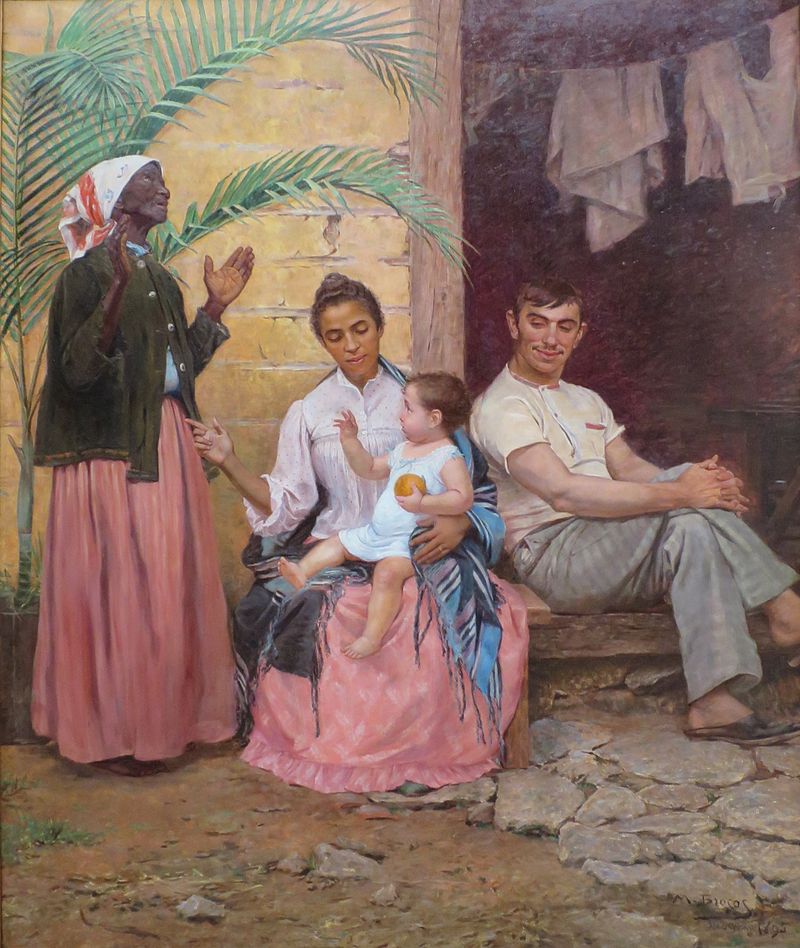
“The Redemption of Ham,” an emblematic work by Modesto Brocos created in 1895, embodies a profound reflection on the predominant racial ideologies of late 19th-century Brazil. This oil painting on canvas features three generations of a Brazilian family, symbolizing the theory of “Blanqueamiento,” or racial whitening through mixing. This concept finds its roots in the interpretation of the biblical episode of the curse of Ham, often invoked to legitimize slavery and racial discrimination.
“Blanqueamiento,” an idea widespread in several Latin American societies, promoted the notion that racial improvement could be achieved through mixing, with the ultimate goal of reaching a lighter-skinned population. This notion, although controversial, reflected an aspiration to transform the demographic composition through interracial unions, in the hope of creating a society with more pronounced European characteristics.
The curse of Ham, for its part, has historically been distorted to justify the oppression of Black populations. According to this erroneous interpretation of the Bible, Ham, the son of Noah, and his descendants were said to have been cursed to serve the descendants of his brothers. This narrative was exploited to support racially discriminatory belief systems and justify slavery.
Racial mixing as a tool of supremacism
Racial mixing, as illustrated by Modesto Brocos in “The Redemption of Ham,” reveals a complex facet of racial history, far removed from any celebration of diversity. This artistic representation highlights a strategy aimed at promoting an idealization of whiteness, underpinning Negrophobic and oppressive policies observed in countries such as Brazil and Cuba. These policies, far from being expressions of unity and interracial love, conceal a darker reality of attempted racial homogenization.
In Brazil, the policy of Branqueamento was implemented in the late 19th and early 20th centuries, following the abolition of slavery and the advent of the First Republic. The government then massively encouraged European immigration, with the explicit goal of “diluting” the Black population. More than one million Europeans arrived in São Paulo between 1890 and 1914, with trips financed by state and federal governments for immigrants from various European countries. This strategy was perceived as a means of “whitening” the population, with demographic statistics used to measure the “success” of this process.
In Cuba, at the beginning of the 20th century, immigration laws were created to invest more than one million dollars in recruiting Europeans, with the aim of “whitening” the state. This policy gained popularity following the high participation of Black people in independence movements, threatening the power of the white elite. Immigration policies favored the arrival of entire families from Europe, although many European immigrants did not remain in Cuba, returning home outside the sugar harvest seasons. Despite the arrival of nearly 780,000 Spaniards between 1902 and 1931, only a third remained. By the 1920s, attempts at blanqueamiento through national policy had largely failed.
These blanqueamiento policies, although presented under a veneer of integration and interracial love, reveal a more complex and often darker reality. They illustrate how racial mixing was instrumentalized not as a means of cultural enrichment, but as a strategy aimed at eroding and replacing Afro-descendant identities within a quest for the idealization of whiteness.
Racial mixing: between personal choice and political instrumentalization

In a profound reflection on racial mixing, Kemi Seba addresses the crucial distinction between interracial unions born of sincere love and the political agenda aimed at promoting mixing as a tool of global uniformization. He expresses unconditional support for mixed couples who genuinely love each other, while firmly criticizing attempts to impose mixing for political purposes, particularly the establishment of a global government. Seba highlights the difference between individual racial mixing and the mechanical blending of populations encouraged by certain elites.
He warns against the widespread idea that racial mixing could eradicate racism, citing the example of Brazil, one of the most mixed countries in the world, where discrimination against darker-skinned individuals nevertheless remains prevalent. Seba calls for awareness and education among younger generations about the realities of the contemporary world, while affirming his personal preference for preserving the cultural identities specific to each people.
This nuanced approach to racial mixing reveals the complexity of issues related to identity and global politics, inviting reflection on the distinction between personal choices of love and political strategies that instrumentalize mixing.
Toward deeper reflection and active engagement
The complexity of the issues related to racial mixing, between personal choice and political instrumentalization, invites us to engage in a deeper reflection on our history, our identity, and our shared future. Faced with the challenges posed by ideologies of “industrialized racial mixing” and policies of uniformization, it is crucial to reclaim our narratives, to value our cultural diversity, and to promote respectful dialogue among peoples.
Pan-Africanism, with its call for vigilance and the valorization of African identity, reminds us of the importance of resisting all forms of forced assimilation and preserving the uniqueness of each culture. It is in this spirit that we invite you to continue this exploration and to actively engage in building a world where diversity is celebrated as an invaluable richness.
To continue enriching your understanding and to participate in these essential discussions, we encourage you to discover more similar content on nofi.media. Together, let us make knowledge and exchange the pillars of a more just, inclusive, and respectful society for all identities.
Join us in this quest for truth and authenticity, and contribute to shaping a future where every voice is heard and every story is valued.


