

On April 25, 2023, the world fell silent for a moment. Harry Belafonte, calypso icon, charismatic actor, and indomitable activist, passed away at 96. But in the silence left by his departure, his voice continues to resonate, deep and clear, like a drum of dignity beating against the walls of time.
Harlem, Jamaica: genesis of a double child
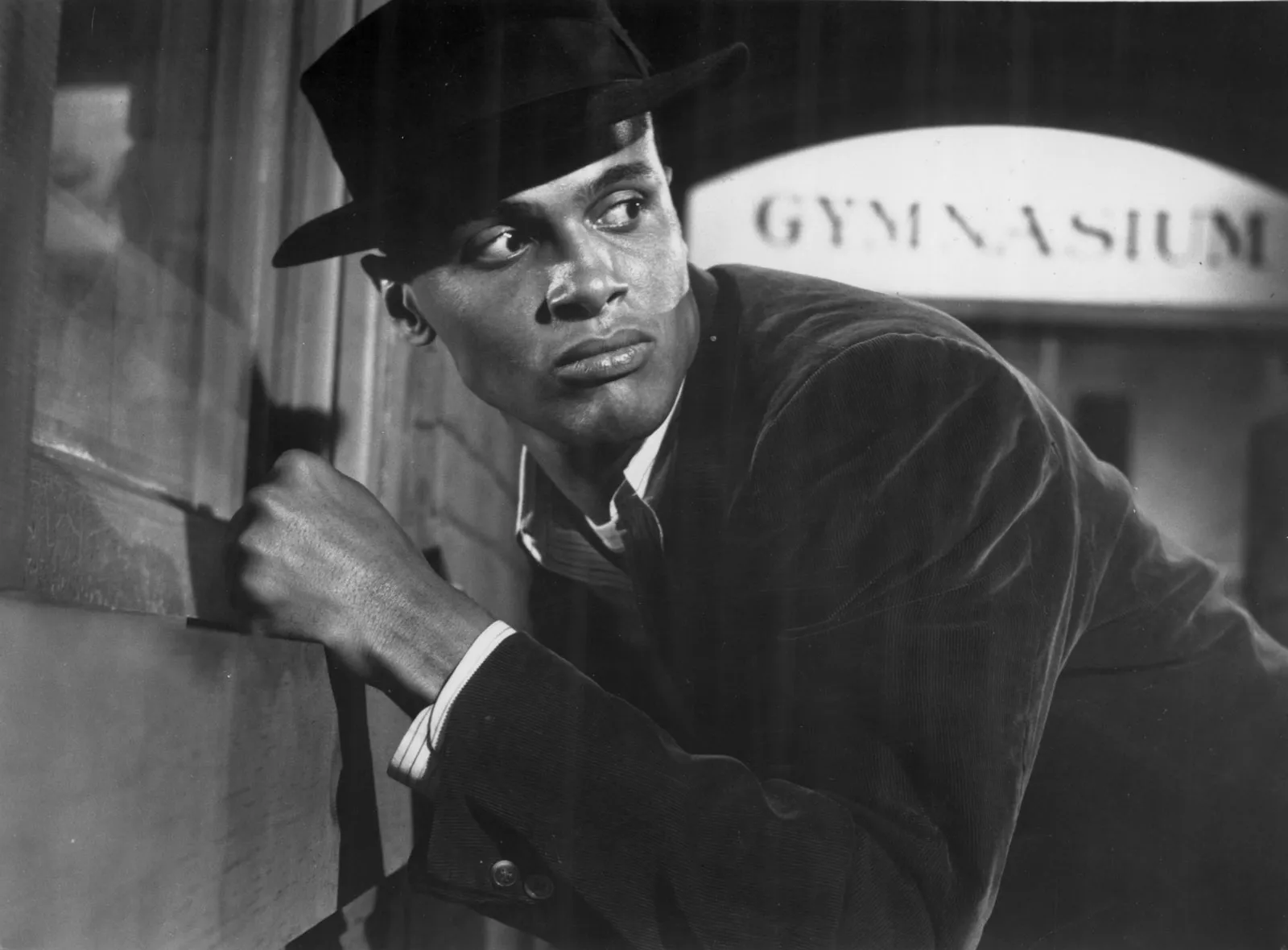
Harry Belafonte was born in the silent tumult of two continents, between the worn sidewalks of Harlem and the red hills of Jamaica. He did not come into the world between two waters; he was born in the current. The son of a Black woman, Melvine Love, a Jamaican domestic worker migrant, and a rarely present seaman father, Harold George Bellanfanti Sr., Harry never had the luxury of a unified childhood. Barely had he learned to walk than he already had to learn to divide himself: between the Americas, between languages, between skins.
In Jamaica, he discovers the rough tenderness of grandmothers, the slow warmth of tropical afternoons, the folk songs filled with salt, pain, and survival. There, he understands what it means to be Black in a world built by the heirs of the whip. In Harlem, he encounters another America: codified racism, structured poverty, white-collar humiliation. But also resilience, struggle, humor, and churches filled with gospel.
These territories do not add up. They clash. And from this constant friction, a consciousness is born. Not yet political, but already poetic. A sense of fracture, of the mask to wear, of the language to twist in order to exist. Belafonte does not become an artist to be loved: he becomes one to survive. The stage is not an aesthetic choice, it is an escape. It is the place where the son of exiles can write his name in a language no one taught him.
From this childhood, he will keep two things: rhythm and rage. Rhythm, in his ability to embody Caribbean cultures with a sincerity that crosses borders. And rage, in his certainty that art is only worthwhile if it serves to denounce. Later, he would say: “My mother taught me never to bend. Never to beg.” This lesson, he received young. And he would make it the backbone of all his work.
In the years to come, this foundational duality (Harlem/Jamaica, rage/rhythm) would run through every calypso note, every civil rights speech, every film in which he would refuse to be stereotyped. Before becoming a global icon, Harry Belafonte was a child of turmoil. And it is in that first storm that he forged the compass that would guide all his insurrections.
Calypso as a soft weapon


When Harry Belafonte first steps onto the stage, it is not with the certainties of an icon. It is with hunger in his stomach. That of the Harlem kid who sells tickets in theaters too white to welcome him, but porous enough to let a little dream slip through. He enrolls at the Actors Studio, meets Marlon Brando, learns to sculpt silences before words. He trains in theater as one arms oneself for a social war. Because for Belafonte, every performance is already a battle to exist fully.
Then comes singing. And with it, a quiet revolution. In 1956, his album Calypso overturns the laws of the market: first million records sold, global success. America, still mired in segregation, discovers with “Day-O (The Banana Boat Song)” a Black voice that does not shout, does not moan, but sings, with elegance, with calm… and with explosive charge. Because it is not just an exotic refrain: it is the song of invisible men, Jamaican night workers, counting the hours before dawn as one counts wounds. “Daylight come and me wan’ go home”; and everything is said.
Belafonte uses calypso as a Trojan horse. Behind the cheerful rhythm, he infuses colonial history, uprooting, the quest for dignity. He knows that in a white America, he cannot impose his message by force; so he slips it into the interstices of melody, saturates it with unsaid meanings. It is a strategy: to seduce in order to shake. To offer universal refrains while telling a Black memory.
He is not just an artist. He is a refined troublemaker. Too elegant to be confined to folklore, too aware to be content with being a mere “entertainer.” His beauty disturbs, because it does not bend. His body language (impeccable suit, dignified posture, direct gaze) contradicts the servant roles Hollywood assigns to Black men. He stands upright, as a permanent reminder that Black charisma is not an accident, but a political construction.
Harry Belafonte becomes one of the first Black artists to impose complexity at the heart of the entertainment industry. He does not use raised fists, but refrains that infiltrate white living rooms. He does not shout his anger, he whispers it in soft harmonies. And perhaps that is more dangerous.
Because what Calypso launched is not a career: it is a slow uprising. A war waged with songs. An insurrection carried by an unalterable smile. And in that war, Belafonte advances masked, but armed to the teeth.
A black actor in a cinema too white
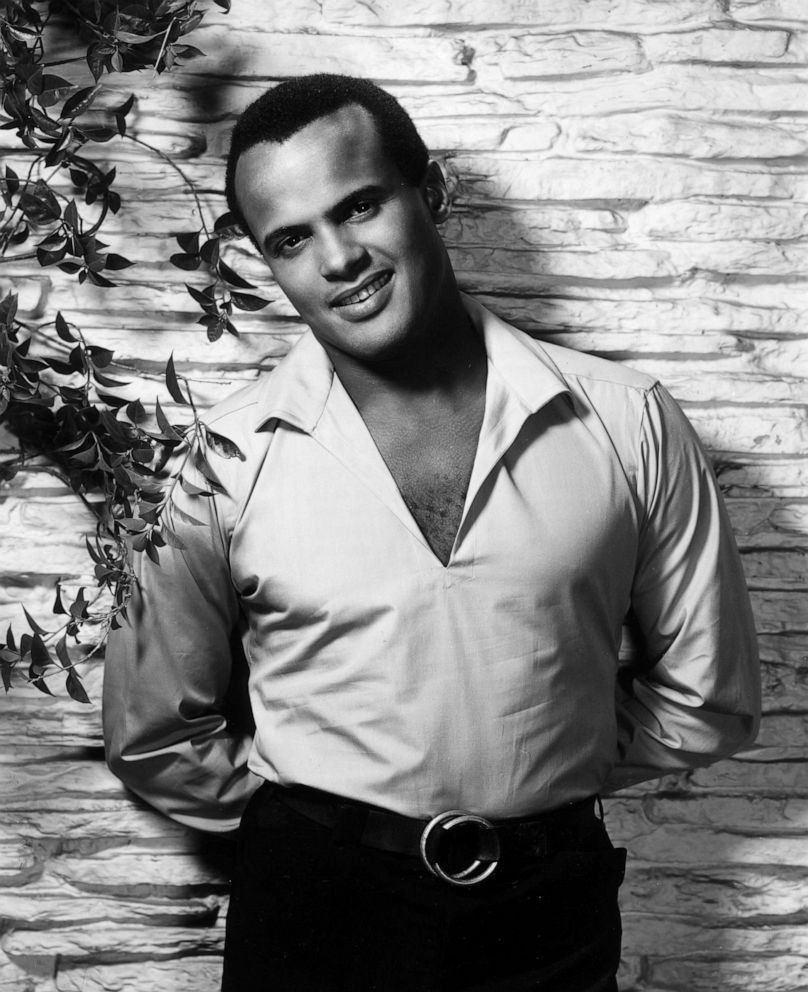
Harry Belafonte does not act. He inhabits. And every character he takes on becomes a declaration of existence. In a Hollywood built to celebrate white America, he enters as a magnificent intruder, never lowering his eyes.
At a time when Black men are only servile shadows or nameless threats, he demands something else: fullness. Nuance. Ambiguity. He does not just want to be seen; he wants to be understood. And he understands that on the big screen, every appearance is either a betrayal or a manifesto.
In 1957, Island in the Sun shakes the American moral order. Belafonte plays a Black man who falls in love with a white woman. The script is a seismograph: it records the racial fractures of an America still frozen in fear of interracial mixing. Threats pour in, hate letters flood. But Belafonte does not back down. He knows that the outrage he provokes is proof that he strikes true.
He continues with Odds Against Tomorrow (1959), a tense, burning noir film in which he plays a musician involved in a heist with a racist accomplice. The character is neither a hero nor a martyr: he is a man. With his anger, contradictions, dignity. A Black man whom the film neither excuses nor reduces. And that is the revolution. Because showing a Black man in doubt, in rage, in redemption is already breaking the image society wants to freeze.
Belafonte quickly understands that cinema is a space of symbolic war. That every shot can suffocate or liberate. So he refuses. He says no. He slams doors. He lets lucrative roles pass to avoid compromising himself. And that refusal, in an industry that survives on the erasure of Black bodies, is a rare form of courage.
He is one of the first to demand respect, not pity. To assert that a Black actor does not just perform to entertain but to redefine the very contours of humanity. Belafonte refuses to be a pawn on a white chessboard. He wants to redraw the table.
And if his time in Hollywood is not long, it is incandescent. Enough to prove that a Black man could love, desire, think, doubt on screen without it being an act of subversion, but a naked truth.
The stage as a platform, life as a struggle
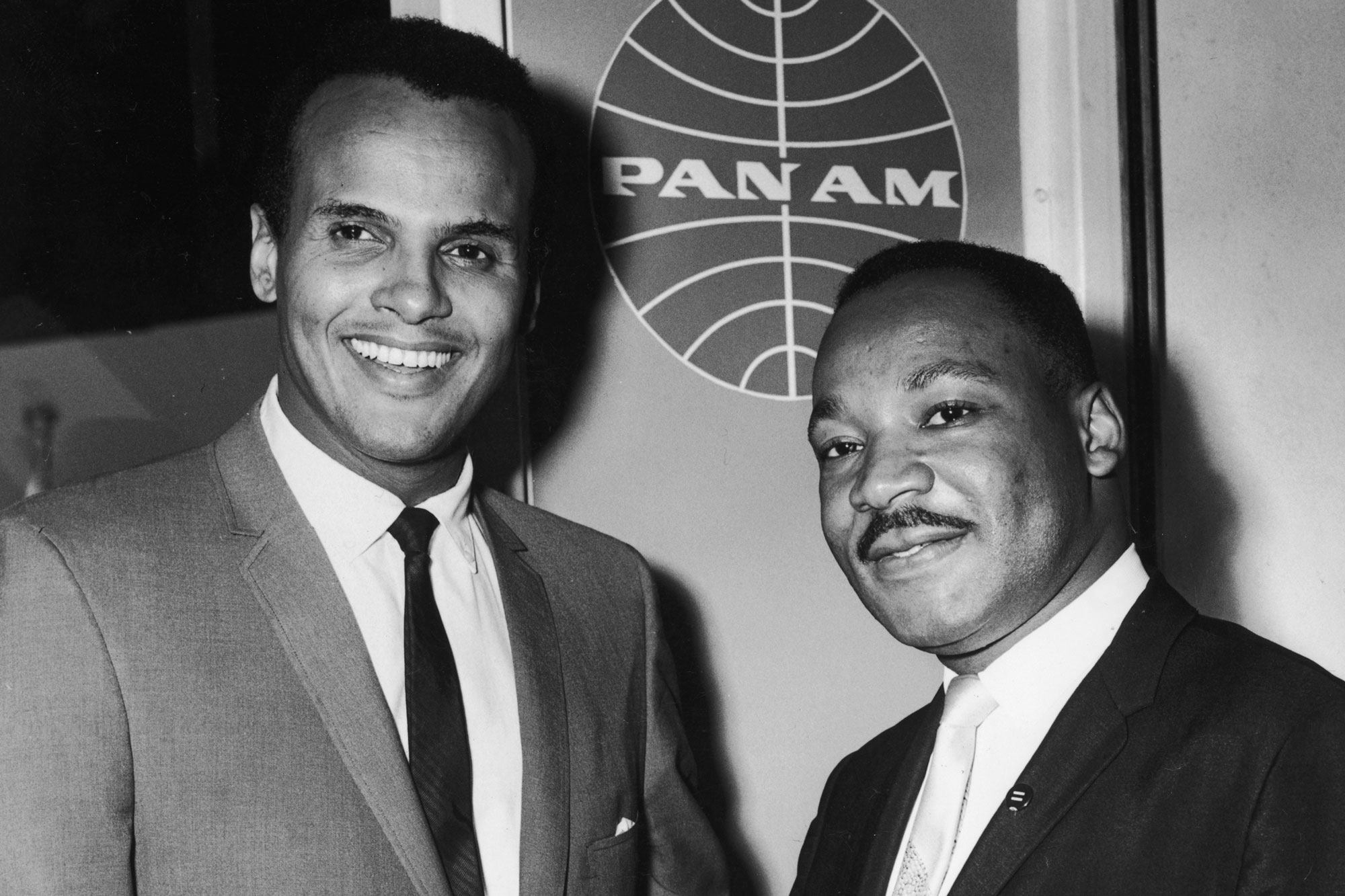
He could have stopped there. Singing. Acting. Shining. Being that “King of Calypso” America liked to applaud quietly. But Harry Belafonte never had the soul of an entertainer. On stage as in the streets, he was never a man of compromise. He was a man of his word. And that word, he put at the service of the struggle.
He made his fame a lever, not a refuge. He financed the March on Washington. He organized, negotiated, coordinated in the shadows, far from cameras, where decisions that change lives are made. He does not just speak for the oppressed, he speaks with them. And sometimes, he falls silent to let them speak. That is his greatness.
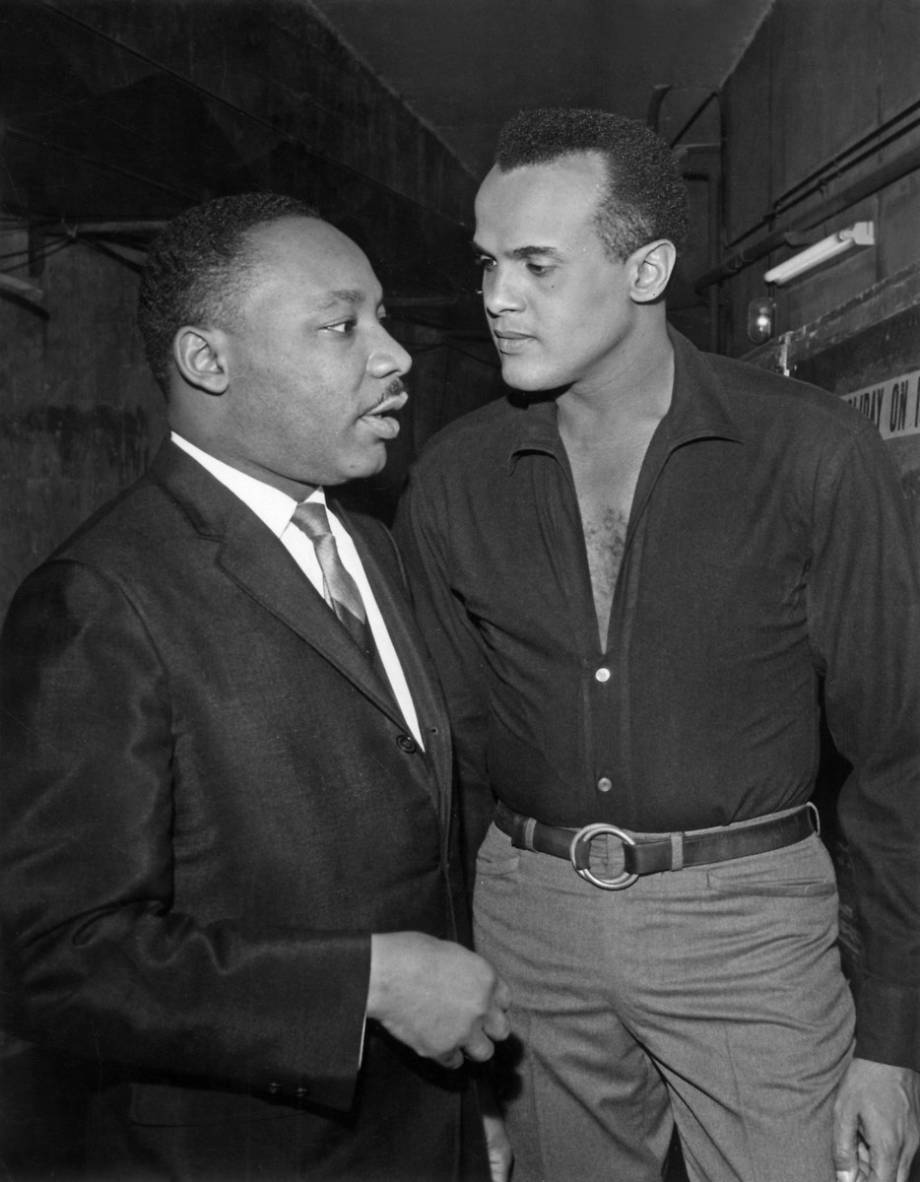
With Martin Luther King Jr., the relationship goes beyond friendship. They listen to each other, support each other, uplift each other. When voices tremble, Belafonte stands firm. He becomes the silent confidant of anxious nights, the relay of urgent messages, the discreet banker of the dream in motion. His home is not a Hollywood residence. It is a headquarters.
And when revolution crosses the Atlantic, he follows. South Africa, Ethiopia, Mozambique. He supports exiles, funds fighters of dignity. His activism becomes pan-African. Global. Tireless. He speaks at the UN, challenges the powerful, refuses honors when they smell of appropriation. He is a living conscience.
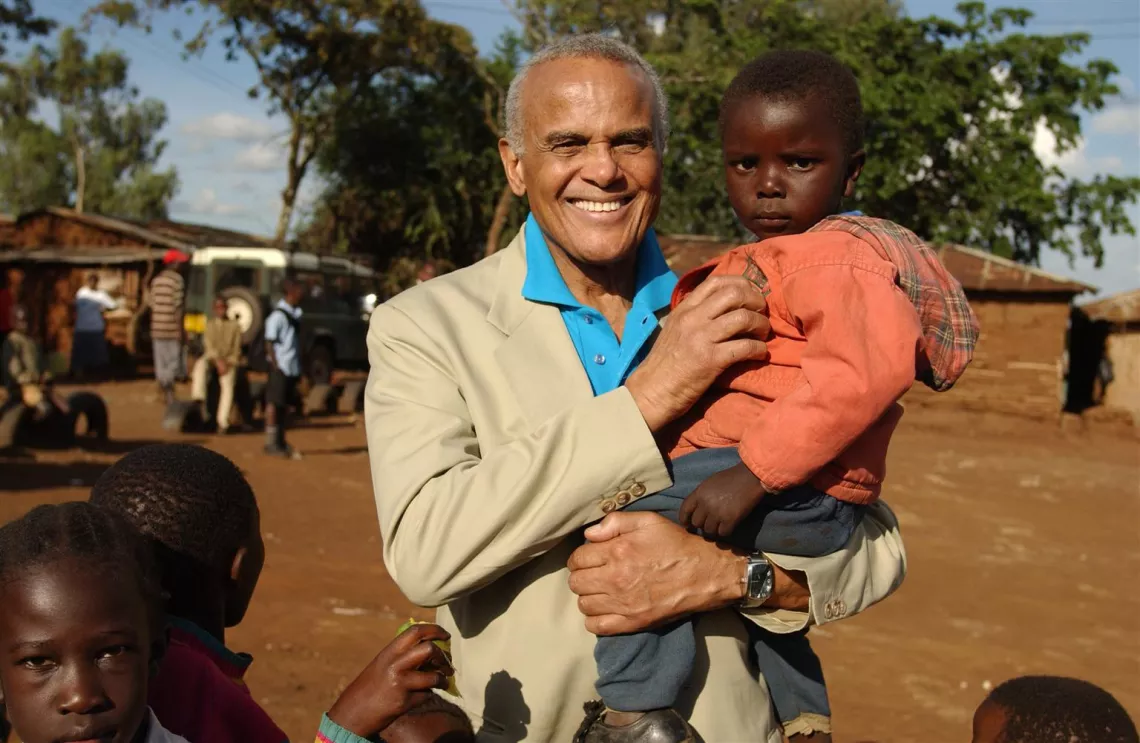
In 1987, UNICEF names him goodwill ambassador. But Belafonte is not a lukewarm symbol for diplomatic posters. He goes to forgotten areas, listens, documents, alerts. He opposes Reagan, criticizes Obama, denounces Clinton. He aligns with no camp if that camp betrays principles.
He speaks for the voiceless, but above all with their voice. He is both griot and strategist. Bearer of stories. Transmitter of heritage. He sings the sufferings and hopes of a people whose history has too often been told by others.
And always, the stage remains his sanctuary. Where his voice resounds like a drum of truth. Where one understands that every song is a political act, every silence a threat, every encore a ritual.
Legacy: a bridge between generations
Harry Belafonte never needed podiums to preach. It was enough for him to tell stories. Not to convince, but to illuminate. He was not one of those who explain by pointing fingers, but one of those who extend a hand—firm, rough, deeply human.
To younger generations, he did not say: “Be like me.” He said: “Be yourselves, but know where you come from.” He did not demand gratitude. He demanded memory. He expected the torch passed on not to light a red carpet, but to set fire to oblivion.
Belafonte became a beacon for today’s artists; those who understand that the microphone is a weapon, that the stage is a symbolic battlefield. He spoke to Beyoncé, Kendrick Lamar, Common, Jay-Z. Not as an idol lecturing, but as a veteran whispering between bursts: “Do not forget why you sing.”
Because he always said it: to be Black, famous, rich… but silent, is still to be captive. And he never accepted chains, even golden ones.
He did not seek to be loved. He wanted to be heard. And he was. Because he had that way of speaking that forced you to listen, even in chaos. A deep voice, burned in the wood of truth, vibrating with ancient angers and future dreams.
On April 25, 2023, Harry Belafonte left the physical world. But one does not speak of the death of such a man as one speaks of others. His disappearance is not an end, it is a sustained note in the long breath of History.
Because how does a legend die, one who turned every act into testimony? How does one bury a man whose voice is etched into the veins of struggle?
He is still there, always, in Baldwin’s silences, Nina Simone’s flashes, Sidney Poitier’s nobility—his soul brother, screen companion, partner in struggle. He is there in every refrain that denounces, every scene that dares, every step that marches for justice.
Belafonte has become a genetic code for conscious artists. He is that underground vibration linking Soweto to Harlem, Kingston to Ferguson. He is beauty in anger, dignity in motion, music in revolt. He is the soft shadow behind the spotlight, the living memory behind the speeches.
And that never dies.
Footnotes
References
Harry Belafonte, My Song: A Memoir – Harry Belafonte with Michael Shnayerson, Alfred A. Knopf, 2011.
Sing Your Song, documentary by Susanne Rostock, 2011 – produced by Belafonte Enterprises.
“King of Calypso and conscience” – The Guardian, April 25, 2023.
“Harry Belafonte, civil rights giant and singer, dies aged 96” – BBC News, April 25, 2023.
“Harry Belafonte, 1927–2023” – New York Times Obituary, April 2023.
UNICEF tribute to Harry Belafonte – unicef.org, April 2023.
“Harry Belafonte: Activism as legacy”, France Culture, 2023.
Speech by Harry Belafonte at the UNICEF summit, 2005.
“Island in the Sun and interracial representation on screen”, The Atlantic, 2018.
“Day-O and the political echoes of Calypso” – NPR Music, 2017.
Table of contents
Harlem, Jamaica: genesis of a double child
Calypso as a soft weapon
A Black actor in a cinema too white
The stage as a platform, life as a struggle
Legacy: a bridge between generations


