

Born free of color in Martinique, Joseph Serrant was a general under Napoleon, an overlooked hero of the Italian and Russian campaigns. Yet his request for an imperial title was rejected because of his origins. The portrait of a Black soldier erased from collective memory.
In Napoleon’s Shadow, a Forgotten Hero
Clermont-Ferrand, 1827. A man dies far from the tropics, far from the battlefields where he once shone. No statue bears his likeness. No fanfare accompanies his funeral. Not even a single line in school textbooks that nonetheless celebrate the heroes of the Empire. And yet this man was a brigadier general under Napoleon Bonaparte. He fought in the Alps, the Balkans, and the Russian steppes. He risked his life for the Republic, the Empire, and France.
His name was Joseph Serrant, born free of color in Saint-Pierre, Martinique, the son of a Black woman and a white planter. A destiny that official history preferred to silence.
Why do we remember Richepanse, the slaveholding general sent to crush the rebels of Guadeloupe, but not Joseph Serrant, his compatriot from Martinique, a valiant officer of the republican armies?
Why are the descendants of Delgrès honored in Basse-Terre, but not those of Serrant in Fort-de-France or Paris?
The answer lies in a single word: color. Not that of the uniform, but that of the skin.
Through Joseph Serrant, another history of France emerges—one marked by the fractures of racism, memory, and citizenship. It is this history that Nofi seeks to illuminate: that of the Black soldiers of the Republic, often glorious, always forgotten.
Birth in a Divided World: Saint-Pierre, 1767
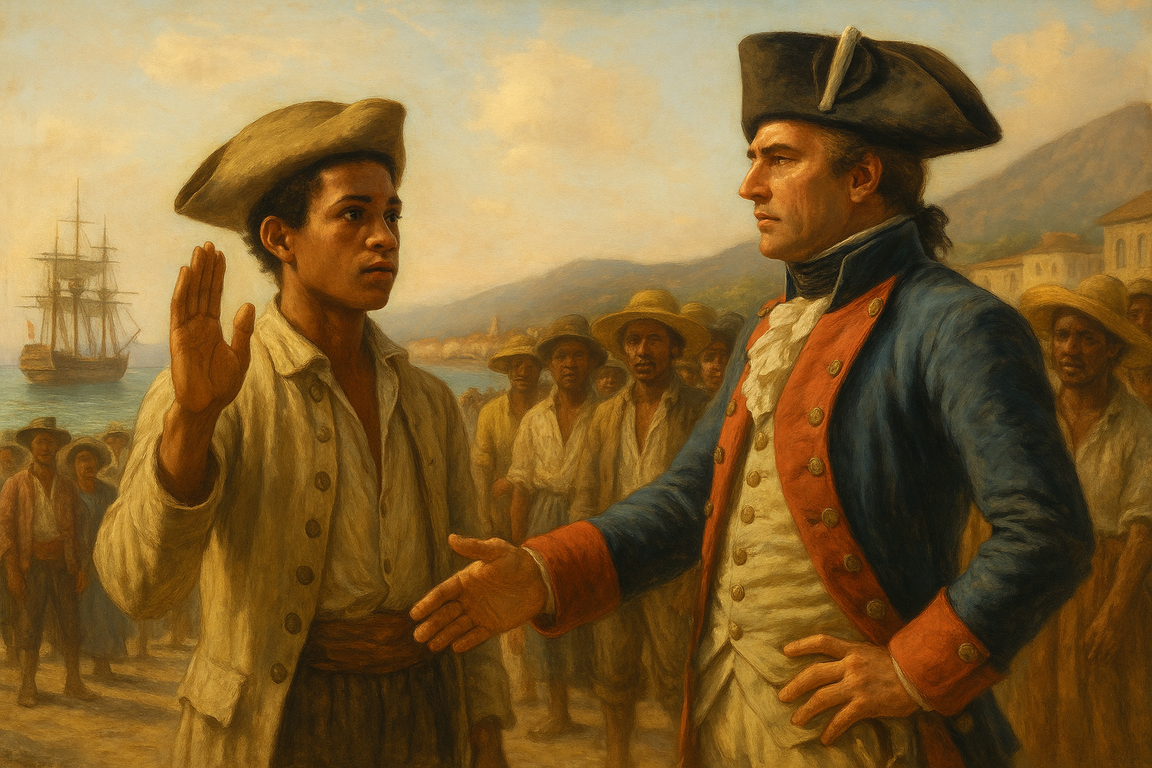
When Joseph Serrant was born on January 10, 1767, in Saint-Pierre, Martinique, the colonial world was in full force. The city, then nicknamed the “Little Paris of the Antilles,” was a jewel of the French Empire, prosperous thanks to sugarcane—and the blood of enslaved people.
Joseph was the son of a white planter, Antoine Serrant, and a freed Black woman, Élisabeth. This made him a free person of color, a separate legal category created to classify human beings according to an invisible yet rigid racial hierarchy. In the slave society, even freedom was not enough to escape domination: free, yes—but never equal.
Free people of color, often educated and sometimes property owners, yet always suspected, lived on a razor’s edge. Too Black to be white. Too free to be dominated. It was within this climate of constant racial tension that Serrant grew up, caught between his father’s relative privileges and the social limits imposed upon his mother.
In 1782, at the age of fifteen, he volunteered for the Régiment de Bouillé—a bold move in an army that was still overwhelmingly white. He fought in the Dominica campaign in 1783, then returned to civilian life as a cobbler. But the call of combat, and above all the call of justice, soon caught up with him.
It was during the revolutionary years that the first great rupture in his destiny would open.
Revolution, exile, and brotherhood with Delgrès
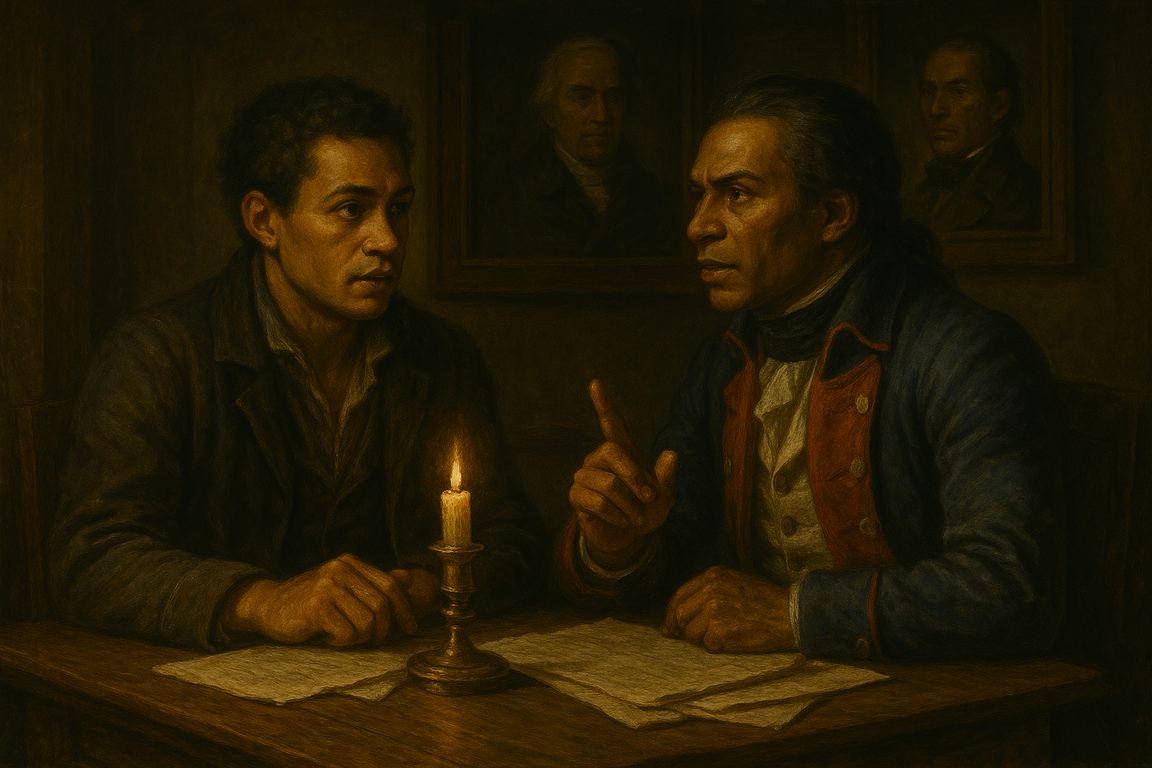
On the eve of the French Revolution, free people of color in the colonies expected far more than a mere change of regime. For them, it represented the promise of equality long denied. In this ferment, Joseph Serrant joined the National Guard and took part in political debates. It was there that he crossed paths with another free man of color from Martinique: Louis Delgrès.
Both men frequented the Club des Dominicains, a political circle in Saint-Pierre where a mixed revolutionary thought was forged—one inspired by the Enlightenment but deeply rooted in colonial suffering. Together, they signed a petition demanding recognition of the rights of free people of color. This courageous act earned them repression. Threatened, they fled to the island of Dominica, then boarded the frigate La Félicité bound for Saint Lucia.
On board, Commander Lacrosse proclaimed the abolition of slavery and the application of the Rights of Man. But this proclamation, hollow and without concrete consequences, already revealed the contradictions of a Republic that struggled to apply its ideals in the colonies.
In Saint Lucia, Delgrès became a lieutenant, Serrant a sub-lieutenant. A military brotherhood was forged in exile, struggle, and the shared conviction that free Black men must be actors of their own history.
This same conviction led Serrant to join the 109th Infantry Regiment under Rochambeau in 1794. He earned his rank of captain there but was captured by the British during the fighting in Martinique. Sent to captivity in Plymouth, he was exchanged the following year.
His return to combat marked a turning point: Joseph Serrant, an experienced and committed soldier, would now fight for a Republic still hesitant to fully recognize its own.
Officer of the republic: from the Antilles to Europe’s battlefields
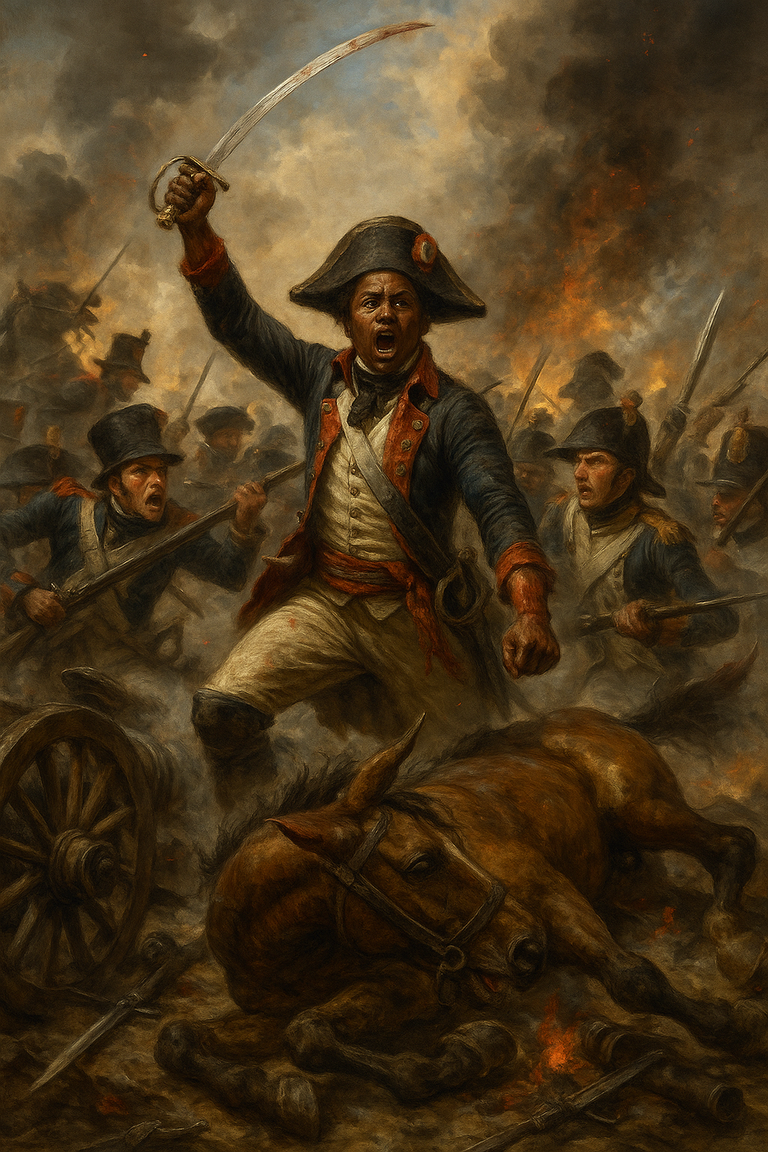
Back in France, Joseph Serrant joined the 106th demi-brigade, then the 13th, before entering the Army of Helvetia with the 87th Line Demi-Brigade. Far from the Antilles, the soldier from Martinique distinguished himself in the Swiss Alps, the Piedmont valleys, and the Italian campaigns. The world became his battlefield.
Under Colonel Armand Philippon, he took part in the campaigns of the Grisons and Valais, then fought in Piedmont. At the Battle of Murazzo on October 31, 1799, he was seriously wounded—proof that he was among those who held the line at the front.
In 1804, he was appointed commander of the fortress of Orbetello on the Tuscan coast. Serrant—Black, senior officer, commander of a strategic bastion—represented a reality rarely acknowledged in French military narratives. At a time when institutional racism operated through unspoken codes, his promotion was itself a political act. He was not a pawn; he was a commander.
Sent to Dalmatia, he captured Curzola and defended Ragusa. His skills as a strategist and leader of men were once again unanimously recognized. On June 21, 1806, he was promoted to battalion commander and awarded the Knight’s Cross of the Legion of Honor. For the Empire, it was a decoration; for him, it was proof—that the son of a mulatto woman could claim his place through excellence in an army that had never planned for him.
At the Battle of Gospić, he was wounded and captured once more. Freed by exchange, he went on to command the 3rd Croatian Chasseur Regiment, then the 8th Light Infantry Regiment within the army of Prince Eugène de Beauharnais.
During the Russian campaign, he protected Murat’s cavalry at the Battle of Ostrovno. Wounded yet again, he was decorated once more and promoted to brigadier general in September 1812.
Prisoner of the Berezina, hero of the retreat


The winter of 1812 was brutal. The Napoleonic armies sank into the Russian steppes, where cold killed more effectively than bullets. General Joseph Serrant commanded an exhausted yet unbroken regiment. He fought at Maloyaroslavets on October 24, a desperate attempt to force a southern passage.
On December 9, 1812, in the frozen hell of Vilnius, he was taken prisoner. The retreat became a catastrophe. But where others succumbed to despair, Serrant escaped—alone, wounded, without an army. He crossed Poland in winter, slipped through enemy lines, and miraculously reached Prince Eugène in Magdeburg.
A Black general escaping Russian prisons, surviving the retreat from Russia, and returning to service as if nothing had happened was enough to disturb a French military imagination still dominated by white aristocratic figures of the Empire.
Back in France, he was placed on convalescence but soon returned to service. In January 1814, he rejoined the 7th Military Division alongside General Dessaix. In Savoy, he led decisive operations: the capture of Annecy on February 24, victory at the Gorges des Usses, the battle of Saint-Julien, and the recapture of Annecy on March 23. His tactical effectiveness was undeniable.
On June 20, 1814, he was placed on inactive status and later received the Knight’s Cross of the Royal and Military Order of Saint Louis. A monarchist decoration for a lifelong republican—the irony was complete.
An end of career under racial surveillance


Despite his extraordinary military career, Joseph Serrant never received the full recognition his rank deserved. The reason was simple and implacable: his skin color.
During the Hundred Days in 1815, he was mobilized once again and assigned to Lyon. But with the Restoration, monarchists purged the army of revolutionary figures. Serrant was placed on inactive status in August 1815, classified as “available” in 1818, and finally forced into retirement in 1825.
More disturbing still, he became the target of a racial investigation. When he requested confirmation of his title as Baron of the Empire from Louis XVIII, the request was rejected following an inquiry into his mixed origins. The king ruled that a “Negro,” even a general, could not claim imperial nobility.
Joseph Serrant died in Clermont-Ferrand on November 7, 1827, in near official indifference. No monument honors him. Yet he was the only Black general in Napoleon’s army—a man who overcame every social, military, and racial barrier to serve France. He was ultimately buried beneath layers of postcolonial silence.
The Martiniquais ghost of the empire
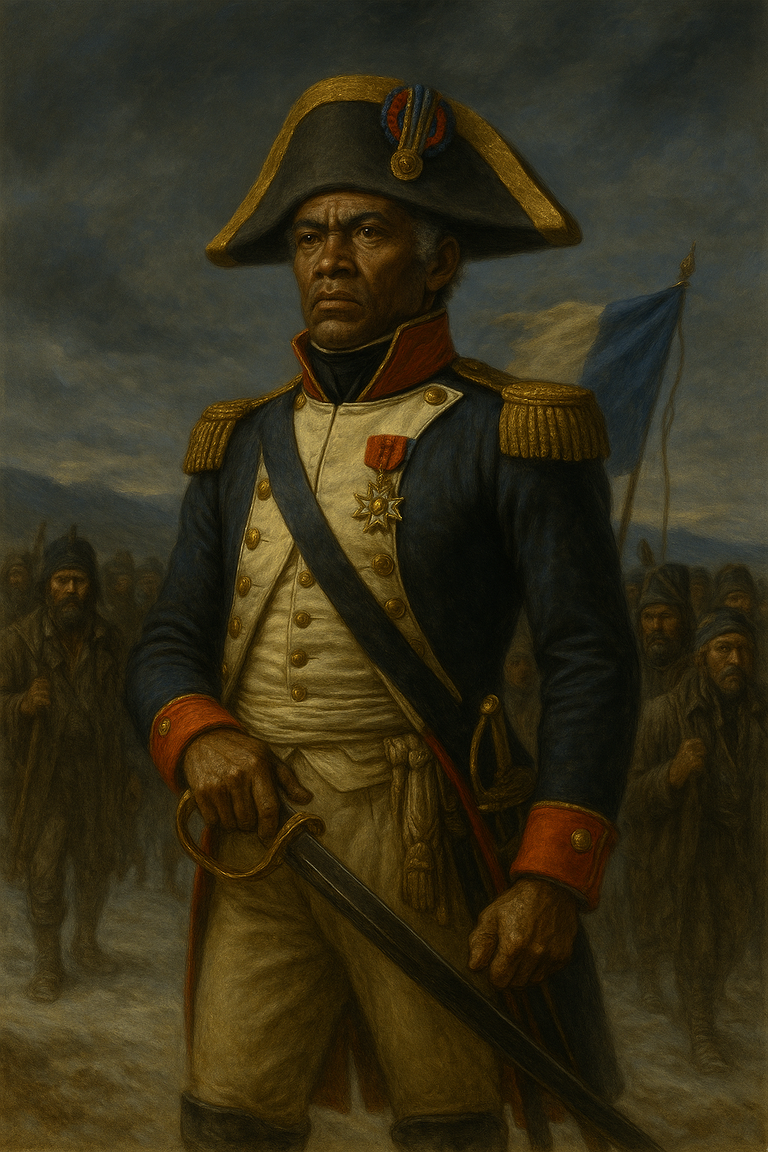
In French history books, Joseph Serrant is absent. Neither school curricula nor military commemorations mention his name. As though the existence of a Black general under Napoleon unsettled a certain national narrative—one that refuses to remember that colonial soldiers shed their blood for a Republic that despised them.
In recent years, however, efforts at rehabilitation have emerged. Raymond Chabaud’s book Le Nègre de Napoléon (2015) shed new light on Serrant’s life and the injustice of his erasure. Caribbean scholars, historians of postcolonial memory, and engaged citizens now demand that Serrant be recognized among the nation’s heroes. Some propose renaming a street in Saint-Pierre or erecting a statue in Martinique.
For Serrant is more than a forgotten general. He is a symbol—of what free Black men could achieve in a hostile white world, of the contradiction between republican ideals and racist realities, and of a combative Afro-descendant memory long erased from France’s national story.
It is time to break the silence. To restore General Joseph Serrant as a figure of emancipation and resistance—a Black star in the troubled constellation of imperial history.
Restoring history to full memory
Joseph Serrant’s story is that of a man of flesh and fire: Martiniquais, Black, free, a soldier, forgotten. But it is also the story of a French society unable to fully remember those who defied its racial expectations. By rising through every rank of the republican and imperial armies to become a brigadier general, Serrant shattered a racial order that revolutionary France claimed to have abolished but continued to enforce.
His life reveals another history of France—one in which the colonies are not margins, but crucibles of courage, loyalty, intelligence, and sacrifice; one in which Black people are not passive beneficiaries of republican benevolence, but actors, combatants, martyrs, and architects of the nation.
To rehabilitate Joseph Serrant is not merely to correct an omission. It is to affirm that Black French history exists—complex, heroic, painful, and worthy.
And if one day, in a school in Fort-de-France or Clermont-Ferrand, a child were to raise their hand and say,
“I want to be like Joseph Serrant,”
then perhaps a new page of French memory could finally be written.
Sources
Service Historique de la Défense (SHD), Vincennes – Military file of Joseph Serrant, SHD ref. 7 Yd 1379
Raymond Chabaud, Le Nègre de Napoléon: Joseph Serrant, seul général noir de l’Empire, Paris, HC Éditions, 2015
Georges Six, Dictionnaire biographique des généraux et amiraux de la Révolution et de l’Empire (1792–1814), Paris, Saffroy, 1934
Abbé Paul Pisani, La Dalmatie de 1797 à 1815 – Épisode des conquêtes napoléoniennes, Picard, 1893
A. Louis Abel, Les libres de couleur en Martinique, vol. II, L’Harmattan, 2012
Frédéric Régent, Esclavage, métissage, liberté, Grasset, 2004
Table of contents
In Napoleon’s shadow, a forgotten hero
Birth in a divided world: Saint-Pierre, 1767
Revolution, exile, and brotherhood with Delgrès
The officer of the Republic: from Caribbean fighting to Europe’s battlefields
Prisoner of the Berezina, hero of the retreat
An end of career under racial surveillance
The Martiniquais ghost of the Empire
Restoring flesh to history, for a full and complete memory
Sources


