

The general public associates his name with a water gun that became iconic in the 1990s. Yet reducing Lonnie Johnson to the Super Soaker alone would be a historical mistake. An aerospace engineer trained at Tuskegee University, former NASA collaborator, and holder of more than one hundred patents, Johnson embodies a tradition too often rendered invisible: that of African-American engineers transforming global science without always being placed at the forefront.
His journey spans segregated Alabama, military laboratories, space missions, and federal courts. It is the story of a man who had to impose his genius in an America where Black inventors remain statistically underrepresented in patent filings and official narratives of innovation.
Lonnie Johnson, Black Engineer and the Silent Energy Revolution
Lonnie Johnson was born on October 6, 1949, in Mobile, Alabama, in a South still deeply marked by racial segregation. His father, a World War II veteran, worked as a driver. His mother was a nursing assistant. In an environment where resources were limited, curiosity became his first laboratory.
From an early age, he dismantled toys to understand their internal mechanisms. He did not simply play with objects: he analyzed them. At Williamson High School, a school reserved for Black students, he built a robot named “Linex” in 1968 and presented it at a science fair in Alabama. He won first prize against better-funded white schools. This victory went beyond simple academic recognition: it demonstrated that a Black student from the segregated South could compete scientifically with dominant institutions.
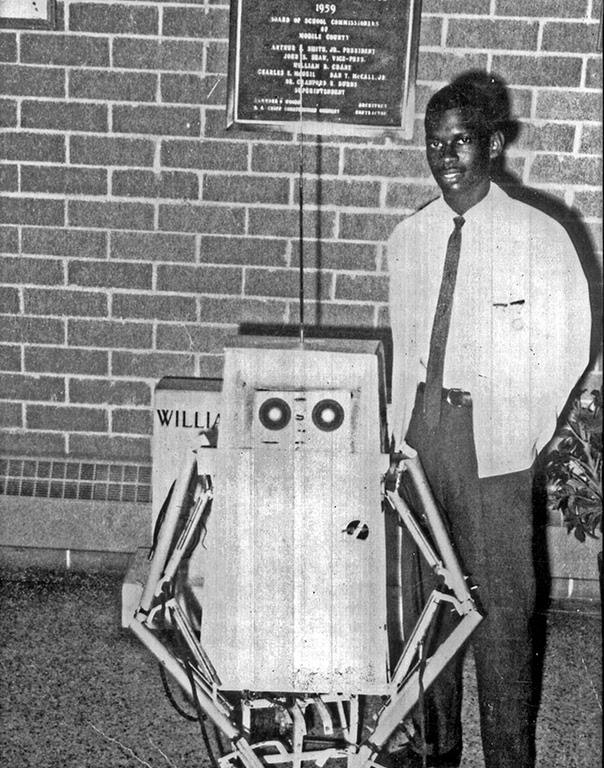
Johnson often cites the influence of George Washington Carver, one of the major Black scientific figures of the twentieth century. Like Carver, he viewed science as a tool of emancipation.
At Tuskegee, the historically Black university founded in the post-slavery era, he earned a degree in mechanical engineering in 1973, followed by a master’s degree in nuclear engineering in 1975. His choice to specialize in nuclear engineering was not insignificant: it placed him in one of the most strategic technological fields of the Cold War.
Before becoming an entrepreneur, Johnson worked for the U.S. Air Force on advanced energy systems. He contributed to projects related to military technologies and power systems. His expertise later led him to the Jet Propulsion Laboratory, a NASA-affiliated center in California.
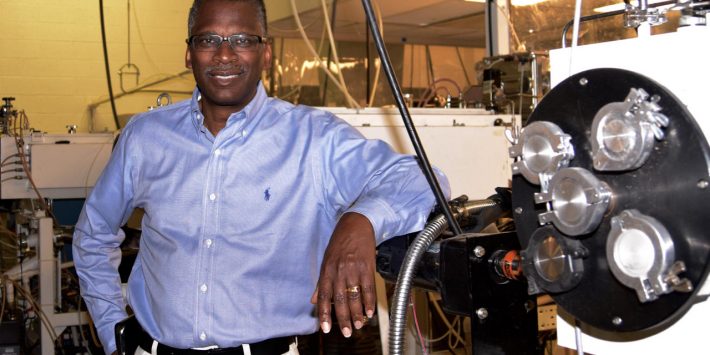
He contributed to the Galileo mission, launched in 1989 to explore Jupiter and its moons. Working on an interplanetary space program meant operating within America’s scientific elite. Yet his name remains largely absent from popular narratives of the space race.
This invisibility is not unique. Many Black engineers participated in major programs without receiving the public recognition granted to their white counterparts.
In the late 1980s, Johnson experimented with a thermal pump system intended for energy applications. While testing a prototype in his bathroom, a stream of water shot across the room with unexpected force. The idea for the Super Soaker was born from that observation.
The toy was commercialized in 1990. By 1991, sales had reached approximately 200 million dollars. The Super Soaker became one of the best-selling toys of the decade and a global cultural symbol.
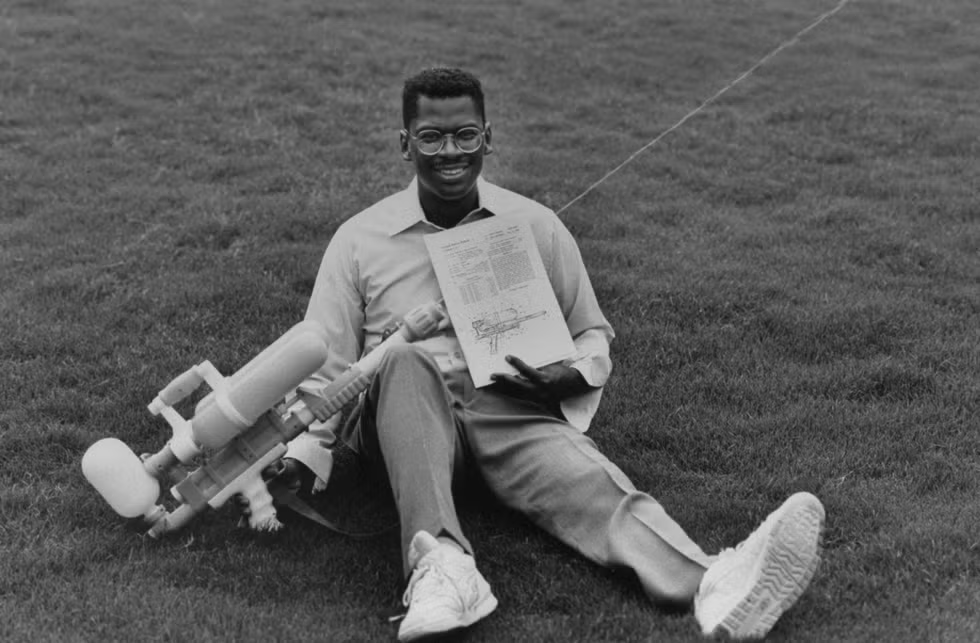
But commercial success did not automatically guarantee protection. Johnson entered into a legal battle against Hasbro for patent infringement. In 2013, arbitration awarded him approximately 73 million dollars. The ruling marked a rare victory for an independent inventor against an industrial giant.
The media image of the creator of a water gun obscures Johnson’s primary ambition: revolutionizing energy storage and conversion. He founded Johnson Energy Storage and developed the JTEC system, designed to convert heat into electricity with potentially greater efficiency than traditional engines.
His research focuses on advanced batteries, thermodynamic systems, and high-density storage technologies. In a global context shaped by the energy transition and dependence on fossil fuels, this work is strategic.
Johnson holds more than one hundred American patents, in addition to international patents. This productivity places his laboratory among the most active independent structures in the sector.
Johnson’s journey belongs to a tradition that includes figures such as Garrett Morgan and Lewis Latimer. Like them, he had to evolve within a system where access to capital, industrial networks, and media visibility remained unequal.
The issue goes beyond the individual. It raises questions about the way the history of innovation is told. Why do some figures become emblematic while others, equally decisive, remain marginal in collective memory?
Johnson now invests in scientific education and encourages young people of African descent to pursue careers in STEM. He emphasizes the importance of representation: seeing a successful Black engineer reshapes imaginations and opens new possibilities.
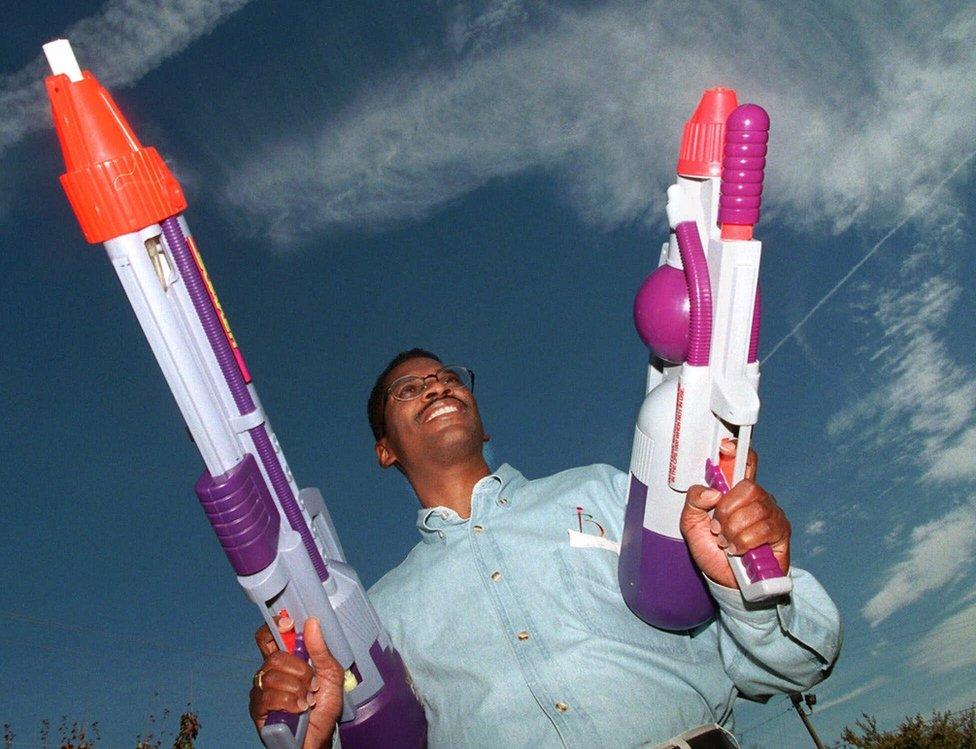
Lonnie Johnson is not simply the inventor of a cult toy. He is the embodiment of African-American scientific genius spanning aerospace, industry, entrepreneurship, and energy research.
His journey reveals a constant tension between popular visibility and scientific recognition. History may remember the Super Soaker. But Johnson’s most enduring legacy may well lie in energy and transmission.
Notes and References
- Lonnie Johnson, official biography, Johnson Energy Storage, accessed 2024.
- Tuskegee University, university archives and biography of notable alumni.
- U.S. Patent and Trademark Office (USPTO), patent database, research on Lonnie G. Johnson, accessed 2024.
- NASA, Jet Propulsion Laboratory, Galileo mission (1989–2003), NASA archives.
- Hasbro, arbitration ruling regarding the Super Soaker patent dispute, 2013.
- Smithsonian National Museum of African American History and Culture, profile of African-American inventors, Lonnie Johnson section.
- George Washington Carver, Tuskegee Institute archives.
- Garrett Morgan, National Inventors Hall of Fame.
- Lewis Latimer, Library of Congress archives.
- Bell, A., Chetty, R., Jaravel, X., Petkova, N., & Van Reenen, J. (2019). Who Becomes an Inventor in America? The Importance of Exposure to Innovation. Quarterly Journal of Economics. (Study on racial inequalities in innovation).

