

He was one of the first Black elected officials of the French Republic. A powerful, lucid, and combative voice that rose in the halls of power to defend his people. Today, the name of Étienne Victor Mentor has almost disappeared. Yet his struggle still resonates.
From the council of five hundred to a free Haiti
Amid the upheavals of the French Revolution, certain voices—dissonant, marginalized, yet irreducible—attempted to make the Republic resonate at the height of the Black man’s humanity. Étienne Victor Mentor, born free in 1771 in Saint-Pierre (Martinique), was one of them. A son of the Atlantic, he grew up between the rigidities of the colonial system and the tremors of abolition, on an island marked by racial hierarchies.
In 1797, at only 26 years old, he was elected deputy of Saint-Domingue to the Council of Five Hundred, one of the two chambers of the Directory. The event was historic: never before had a Black man sat so high within a metropolitan political institution. In Paris, Mentor was far more than an anomaly; he became the political embodiment of those whom the nascent Republic claimed to have liberated… without always listening to them.
Mentor did not betray his origins. He did not remain discreet. From the moment he entered the Council, he multiplied his interventions:
In July 1798, he demanded payment of the sums owed to colonists… but only to those who had not claimed compensation for enslaved people.
In October of the same year, he called for the cancellation of all debts linked to the sale of human beings.
In April 1799, he denounced the appeal made to the English by another deputy from Saint-Domingue, Perrotin, describing the maneuver as treason.
His speeches were clear, radical, and rooted in fidelity to the Constitution of Year III—the one that had proclaimed the abolition of slavery in 1794. For Mentor, Black freedom was neither negotiable nor postponable. It was a right, a historical debt, a republican imperative.
But history is not always persuaded by words. On 18 Brumaire Year VIII (November 9, 1799), Napoleon Bonaparte overthrew the Directory. Mentor voted for the motion of alarm: “the fatherland is in danger.” He was expelled from the Council. Then from Paris. The Republic no longer had a place for him.
He was exiled 30 leagues from the capital. In 1801, he obtained permission to embark for Saint-Domingue. At sea, he saved a sailor who had fallen overboard—a gesture that summarized his entire trajectory: risking his life to protect that of others. But France rejected him again upon his return. He was authorized to remain on metropolitan soil only on the condition that he never again approach Paris.
In 1804, Mentor joined Haiti. The island had become the first free Black republic in the world after a bitter and bloody war of independence fought against French troops. Mentor became aide-de-camp to Jean-Jacques Dessalines, who had just proclaimed the sovereignty of the new state.
But instability soon caught up with the utopia. In 1806, Dessalines was assassinated. Mentor then rallied to Alexandre Pétion, leader of southern Haiti and promoter of a more moderate republican model. After that, the traces of Étienne Victor Mentor disappear. He vanished from official history. No monument, no avenue in France bears his name.
How can this silence be explained? Perhaps because Mentor was neither a conquering soldier nor a romantic writer. He was a Black politician—demanding, committed—who called on France to live up to its promises.
He denounced the slave trade, the return of the slave order, compromises with colonists, and the hypocrisy of texts. He disturbed. He conceived Black freedom not as a favor, but as a debt of justice.
His struggle remains relevant. At a time when debates about recognition, reparations, and memorial justice are intensifying, Mentor’s trajectory sheds light on a little-known chapter of our shared history: that of Afro-descendant elected officials during the Revolution who attempted to imagine a truly universal universalism.
The French Republic has often claimed equality as a founding pillar. Étienne Mentor was one of its most ardent defenders. His life, marked by ruptures, exiles, and erasure, also illustrates the limits of that proclaimed equality.
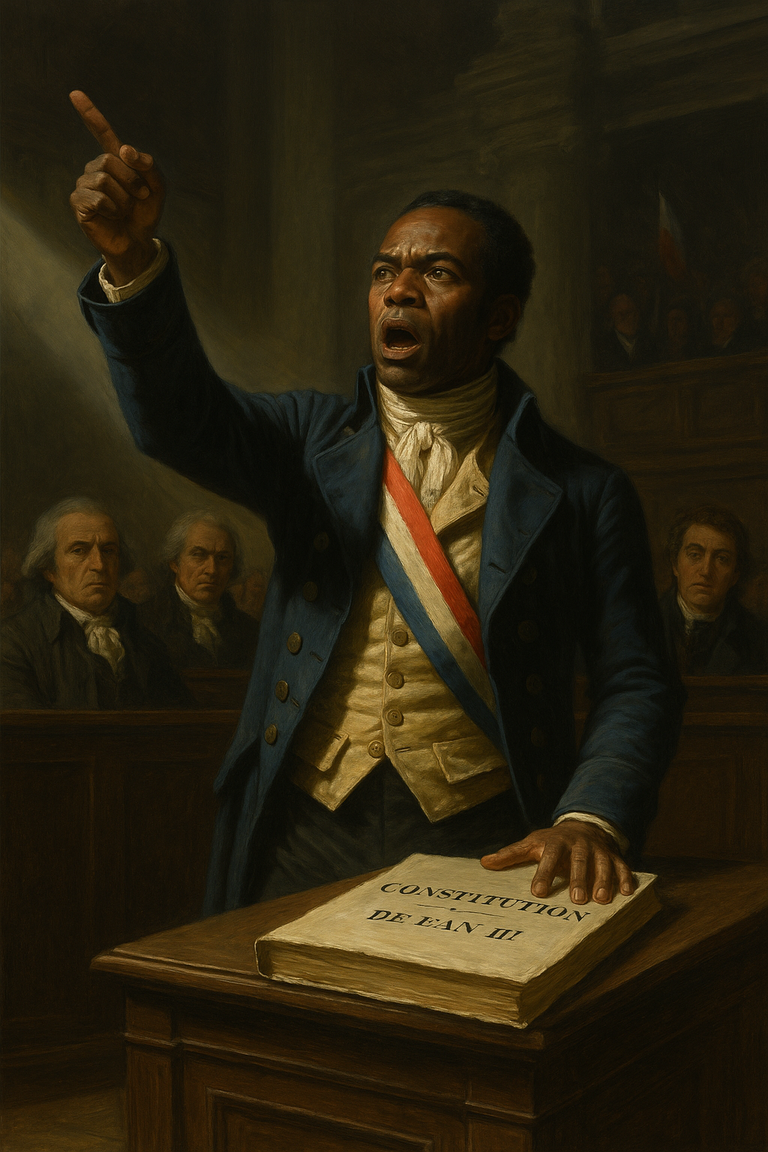
Paying tribute to Mentor is not merely an exercise in memory for memory’s sake. It is to recall that as early as the eighteenth century, Black men were demanding to be treated as citizens. It is to recognize that the universal is not decreed: it is built—in words, in struggles, and in sacrifices.
It is time for the name of Étienne Victor Mentor to return to our history books. Not as a footnote. But as a chapter in its own right.
Sources
Florence Gauthier, Triomphe et mort de la Révolution des droits de l’homme et du citoyen (1789-1795-1802), Paris, Syllepse, 1999.
Christopher L. Brown & Philip D. Morgan, Arming Slaves: From Classical Times to the Modern Age, Yale University Press, 2006.
Dictionnaire des parlementaires français (1789–1889), A. Robert & G. Cougny, Paris, Bourloton, 1889.
Summary
From the Council of Five Hundred to a Free Haiti
Sources


