

Long ignored or misunderstood, African matrilineal societies are today wrongly accused of having weakened the continent in the face of colonization. By tracing the history of maternal lineages from Ghana to ancient Egypt, this article dismantles misconceptions and places the question in a rigorous historical perspective, far from ideological fantasies. An investigation at the heart of African family structures, between symbolic power, cultural resilience, and geopolitical realities.
A controversial question, a need for clarity
For several years, intellectual debates within Afro-descendant diasporas have opposed two radically different visions of African family structuring. On one side, some Pan-Africanist, Afrocentric, or decolonial currents call for the rehabilitation of traditional lineage models, seen as closer to precolonial African historical reality. On the other, more critical voices, often influenced by Western patriarchal frameworks or essentialist readings of power, question the relevance or effectiveness of so-called “matrilineal” societies in the continent’s political history.
This debate, as current as it is sensitive, is often muddled by a major conceptual confusion. It is therefore necessary, from the outset, to make a clear distinction between two notions too often conflated: matrilineality and matriarchy. A matrilineal society does not mean that women exercise absolute or majority power (as the term “matriarchy” wrongly suggests), but only that inheritance, the family name, and sometimes power itself are transmitted through the maternal line. In Africa, these models often coexisted with forms of male authority, where the king or chief was designated through his mother or maternal lineage but personally exercised authority.
From this observation, a fundamental question arises: did the matrilineal structures of certain African societies contribute, in one way or another, to processes of destabilization or collapse of these entities when confronted with external powers (Arab, Ottoman, European)? In other words, can a link be drawn between a model of power transmission and a structural inability to resist colonial or imperial aggression? Conversely, would African societies organized on a patrilineal model have been more resilient, more centralized, better prepared for geopolitical conflicts?
These questions are legitimate. But to answer them seriously, one must step away from contemporary ideological constructions, often biased, and return to verified historical facts, the internal logic of African societies, and the real geography of precolonial power. The goal is not to defend or condemn matrilineality, but to objectively assess its place, effects, and limits in precise political contexts over the long term.
Only in this way can simplistic judgments (whether Afrocentric or Western-centric) be surpassed, allowing an analysis of African civilizational trajectories without fetishism or denigration. Such an undertaking requires a rigorous grounding in historical anthropology, geopolitics, and comparative political science—a method that we will apply here faithfully.
Historical mapping of matrilineal societies in Africa
Africa’s civilizational diversity precludes a unified reading of its social structures. At the continental scale, lineage-based societies fall into two major models: patrilineal systems, numerically dominant, and matrilineal structures, smaller in number but highly internally coherent. Far from being anecdotal, the latter exist within stable and enduring political configurations, often predating European penetration. To understand their role in history, it is first necessary to map them.
Matrilineal societies are neither marginal nor residual in African history. They are mainly concentrated in three major civilizational hubs:
Central Africa
- The Luba (modern DRC) organize their monarchy around a strictly matrilineal system, where the king’s power derives from his maternal lineage. The Balopwe (king) is chosen not based on his father but on his connection to the queen mother.
- The Bemba, a Bantu people of Zambia, follow a similar model: the supreme chief, or Chitimukulu, is designated among the nephews of the previous king’s maternal line, excluding direct descent.
- The Baluba of Katanga, neighbors of the Luba, maintain a comparable structure, with maternal uncles wielding predominant political and ritual authority.
- The Mongo, in Equatorial DRC, provide another example, though their matrilineality does not necessarily translate into explicit female power.
West Africa
- The case of the Akan is emblematic. This ethnolinguistic group (Ashanti, Baoulé, Agni, Fanti, etc.) in Ghana, Côte d’Ivoire, and Togo follows strict matrilineality for royal and property succession. Among the Ashanti, for example, the Asantehene comes from the queen mother’s clan (Asantehemaa), holder of the right to nominate.
- The Baoulé (Côte d’Ivoire), descendants of an 18th-century Ashanti migration, retained this matrilineal system, with chiefs from female lineages, even though actual power remained largely male.
East Africa
- Several dispersed Bantu groups (notably in Tanzania and Malawi) display matrilineal traits, especially regarding land inheritance and descent. However, political authority often remains patrilocal (residence with the husband).
- Among the Makhuwa (Mozambique), inheritance of customary power and land also follows the maternal line.
Special case: ancient Egypt
Although pharaonic society was generally patrilineal, significant traces of partial matrilineal practice exist, notably in kingly designation. The queen (royal wife or sister) sometimes served as dynastic legitimizer, and several pharaohs derived legitimacy from their mother, as seen in the role of the “Great Royal Wife” and royal titulature including the king’s mother’s name (e.g., Hatshepsut, Thutmose III).
Matrilineal systems cannot be reduced to mere genealogical curiosities. They entail specific and constraining political logics:
Transmission of power through the maternal line
- The king’s son is never the automatic heir. The son of the king’s sister holds dynastic rights, ensuring that royal blood always passes through the same female clan matrix.
- This logic prevents patrimonial accumulation of power and allows regulated dynastic rotation, preventing absolutist drift tied to direct father-to-son succession.
Political status of women
- While women rarely reign directly, they hold designation power via their status as queen mother, royal sister, or lineage matriarch.
- Queen mothers play a crucial role: arbitrating succession disputes, ensuring ritual continuity, and maintaining moral authority over the royal community.
Preeminence of maternal uncles
- In matrilineal societies, the mother’s brother is often more important than the biological father. He initiates children into rituals, prepares them for succession, and transmits clan symbolic secrets.
- This configuration creates a specific educational system, where the extended family plays a leading role, overshadowing the nuclear family model typical in Western societies.
In short, African matrilineality does not imply direct female domination but a power logic based on transmission through women, allowing male lineages to exercise authority while remaining under the symbolic control of the clan matriarchy.
Matrilineality as a structuring force in african kingdoms
Far from being a political weakness, matrilineal structures in many African societies facilitated dynastic consolidation, political stability, and social cohesion. By linking power, lineage, and economy around women without necessarily granting them executive authority, these societies established an original institutional balance, durable over the long term. Historical examples illustrate functional robustness.
The Ashanti Empire vividly demonstrates the political rationality of matrilineality. In this West African military-sacred confederation, founded in the 17th century by Osei Tutu, royal power rested on dual authority: that of the Asantehene (king) and the Asantehemaa (queen mother). The queen mother did not have a merely symbolic role: she co-held sovereignty and actively participated in selecting the sovereign.
Royal succession never passed from father to son. The king was always chosen from the queen mother’s uterine lineage, i.e., among her sisters’ sons. This rule ensured dynastic continuity independent of the reigning monarch’s personal ambitions and prevented the transfer of power to children from outside the royal clan.
Matrilineality also enabled control of marital alliances: by overseeing princes’ wives and female descendants, queen mothers guided power expansion and prevented dilution of royal blood in uncontrolled alliances. This lineage control secured stability across generations, observable in the Ashanti Empire’s institutional longevity until the confrontation with the British in the late 19th century.
Another direct effect was the reduction of succession conflicts, a common pathology in patrilineal systems where the king sought to impose his son at the expense of other claimants. In matrilineal kingdoms, a king’s son was never eligible for succession; the heir belonged to the deceased king’s sister’s lineage. This impersonal, sacred rule neutralized intra-family rivalry and reinforced the authority of lineage councils in choosing successors.
In segmentary societies (without centralized states), matrilineality provided a cohesion pole: women, especially matriarchs, acted as peacemakers, resolving disputes and mediating inter-clan diplomacy. Their arbiter role, grounded in lineage authority and absence of direct military interest, made them local stability actors, often involved in reconciliation rites or peace pacts.
In matrilineal African societies, subsistence and exchange economies heavily depended on female lineages. Women often managed farmland use and administration, even if ritual ownership remained male. This system ensured land transmission through the maternal clan, guaranteeing continuity of cultivation without chaotic partitioning.
Markets, in many African cultures, were entirely led by women, as with the Akan, but also among the Yoruba and Igbo (non-matrilineal societies with dominant female economies). Markets were not just trading spaces: they were arenas for social and political regulation, where women could influence male power in case of economic injustice.
Furthermore, artisanal, medicinal, and religious knowledge often passed through women within matrilineal lineages. They trained subsequent generations, preserved recipes, rites, and symbols, ensuring cultural continuity beyond political upheavals.
In short, matrilineality was neither an archaic relic nor an institutional accident. It formed a coherent civilizational logic, linking power, identity, and economy in ways adapted to African structures. It enabled political entities like the Ashanti, Bemba, and Luba to maintain dynastic order and internal stability, neutralizing lineage rivalries and closely involving women in social regulation. Far from causing decline, matrilineality was, in these cases, a key to pre-colonial African resilience.
A Geopolitical weakness exploited by foreign powers?
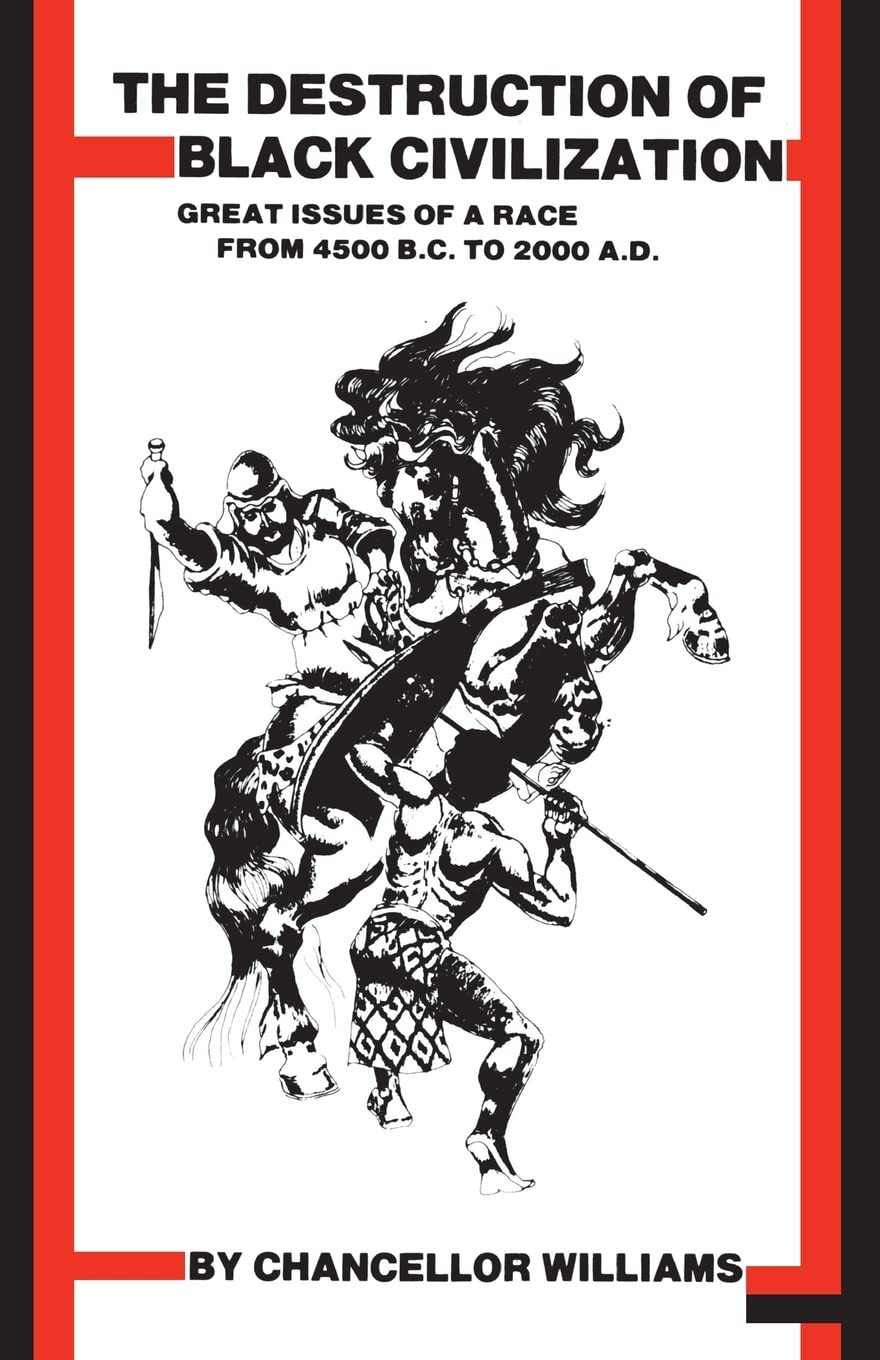
The thesis that matrilineal structures favored the political infiltration of foreign elements into ancient African societies, notably in Egypt, has been vigorously advanced by some Afrocentric authors. The most emblematic is Chancellor Williams, whose major work The Destruction of Black Civilization (1971) influenced a generation of Pan-Africanist thinkers. Nevertheless, this hypothesis, as stimulating as it is, requires critical reading based on primary sources and archaeological reality, far from ideological frameworks.
In The Destruction of Black Civilization, Williams argues that matrilineal succession systems eventually opened the doors of power to foreigners. In Egypt, according to him, non-African elites (from Asia, the Mediterranean, or later Greece) acquired political legitimacy by marrying women from African royal lineages.
According to Williams, this marital strategy allowed exogenous groups, initially without power, to infiltrate command structures and then modify cultural and religious foundations. Succession through the mother (when practiced) was exploited as a dynastic Trojan horse, with children born of these unions considered full members of the African royal lineage, eligible for sovereignty.
Williams sees in this dynamic the tipping point of a gradual civilizational collapse: replacement of black elites by mixed or foreign dynasties, progressive abandonment of traditional cults in favor of exogenous cosmogonies, and a shift from shared power to patriarchal concentration, following patterns from Asia Minor or the Hellenistic world.
This thesis culminates in the idea that ancient Egypt was defaced from within: not by military defeat alone, but by a process of soft acculturation, carried out at the heart of the dynastic household through marital ties. Williams concludes that this “genealogical hospitality” undermined the resistance of pharaonic Africa to external invaders.
As narratively seductive as it is, this hypothesis rests on historiographically fragile bases and deserves scrutiny with the rigor demanded by the analysis of ancient societies.
First, matrilineality does not equate to matriarchal power or automatic political transmission. The designation of sovereigns in ancient Egypt followed a more complex logic, often sacralized by the clergy (notably that of Amun in Thebes), and arbitrated by elite coalitions, rather than by a simple maternal line. Cases of throne transmission via royal wives exist, but remain exceptional and do not support a conclusion of a uniformly matrilineal structure.
Second, marriages between pharaohs and foreign women are documented in certain contexts, notably in the Ptolemaic period or during the 22nd and 25th dynasties, but never without strong ritual, military, or diplomatic negotiation. These alliances were more ad hoc strategic logics than a systemic phenomenon of cultural replacement. Moreover, foreign wives did not automatically hold a legitimizing queen-mother status: rank within the royal harem hierarchy mattered more than ethnic origin.
More fundamentally, the collapse of major African civilizations cannot be reduced to a single dynastic factor. In Egypt, the combination of military factors (Assyrian, Persian, then Greco-Roman invasions), climatic factors (delta aridification), economic factors (weakening of Nile circuits), and religious factors (temple system crisis) played a decisive role. Reducing this collapse to alleged lineage laxity neglects the complexity of imperial dynamics.
Finally, Williams’ thesis assumes cultural homogeneity of African structures, whereas the diversity of lineage systems (matrilineal, patrilineal, bilineal) in Africa contradicts generalization. Centralized empires like Mali or Kanem-Bornu, entirely patrilineal, also experienced infiltration or destabilization through external alliances. This demonstrates that the vector of collapse is not the nature of the lineage, but the magnitude of external pressure combined with internal vulnerabilities.
In conclusion, matrilineality does not appear as a geopolitical flaw per se, but as one modality of power transmission among others, perfectly functional in its original African context. Egyptian examples must be read with caution, as dynastic shifts are never attributable to a single factor, let alone supposed lineage naivety. African history here invites nuance, source interrogation, and rejection of mono-causal readings.
Matrilineality did not prevent resistance (historical evidence)
Contrary to critical theses that attribute structural weakness to matrilineality, suggesting it contributed to the collapse of African civilizations, historical evidence instead shows that societies organized around maternal lineage were often among the most resilient. At the crossroads of politics, war, and cultural transmission, matrilineality not only structured collective identities but also served as a foundation for armed and memorial resistance against foreign powers.
The most emblematic case remains that of Yaa Asantewaa, queen mother of the Ashanti (Asantehemaa), who, at over 60 years old, led the 1900 war against the British. In a context of brutal colonial expansion, where the British administration sought to seize the royal Golden Stool (Sika Dwa Kofi), a sacred symbol of Ashanti sovereignty, it was Yaa Asantewaa who summoned the chiefs and mobilized the kingdom’s armed forces.
Her authority did not stem from isolated charisma but from a political status anchored in the Ashanti matrilineal power structure: the king’s (Asantehene) designation depended on the queen mother’s approval, the holder of the maternal royal lineage. As guardian of this legitimacy, Yaa Asantewaa took up arms, demonstrating that matrilineality could underpin effective military and political authority even in a context of direct conflict.
The kingdom of Dahomey provides another compelling example. Although its political structure was mixed (dynastic patrilineality but significant influence of women in the palace), the queen mothers (Kpojito) exercised parallel power, both mystical and political. They led female initiation societies, played a central role in the appointment of kings and diplomacy, and could arbitrate the kingdom’s major decisions. Added to this were the famous “Dahomey Amazons,” an elite female military corps, whose very existence contradicts the stereotype that matrilineality is incompatible with war or power.
These cases prove that the presence of matrilineal structures or shared female authority was not a barrier to strategic initiative, but rather a lever for resistance.
Even when matrilineality was not always visible in state apparatuses, it played a crucial role in the survival of African cultures transplanted to the Americas, especially under slavery, where men were often separated from their offspring or eliminated.
In Creole contexts (Haiti, Brazil, the Caribbean), Black women were the primary vectors of identity continuity. Bearers of language, songs, rituals, beliefs, and medical knowledge, they ensured cultural transmission within families disrupted by plantations. In societies where the father’s name was erased or inaccessible, maternal lineage became the only stable basis for identification. This reality gave rise to matrifocal (mother-centered) and sometimes de facto matrilineal family models.
In Haiti, the role of mothers in transmitting vodou and overseeing maroon communities is well documented. In Brazil, in quilombos such as Palmares, clan leaders were identified as guarantors of fertility rituals and community cohesion. In Anglophone islands, the “mother clan” persists even in Creole linguistic practices, where an individual’s identity is often expressed in relation to their mother rather than their father.
This silent resistance of matrilineality in the harshest contexts of Black history testifies to its anchoring strength. Far from facilitating domination, it protected memory, supported social reconstruction, and allowed the symbolic continuity of African diasporas.
Thus, far from being a structural flaw, matrilineality appears in many cases as a force for organization, cohesion, and resistance. Whether in the aforementioned African kingdoms or in Black diaspora societies, it was one of the invisible mechanisms of survival and dignity in the face of collapse, invasion, and dehumanization. Historical evidence, when freed from contemporary ideology, therefore invalidates the thesis of matrilineality’s direct or indirect responsibility in the fall of African societies.
African patriarchal societies did not avoid colonization
Some modern critics of African matrilineal societies argue that they facilitated foreign infiltration or political decline. Yet it would be necessary to demonstrate that African societies with patriarchal structures would have resisted foreign domination better. Historical analysis refutes this simplistic hypothesis: the major patrilineal kingdoms and empires of the continent also succumbed to the combined effects of trade, attrition wars, and colonial penetration. Lineage structure alone cannot explain resistance or collapse.
The empires of central and western Sahel (such as medieval Ghana, Mali, Songhai, or later the Muslim states of Sudan, Kanem-Bornu, and Fouta Djallon) were all characterized by strictly patriarchal political organization, reflecting Islamic law imported by Islamized elites.
In these societies, power transmission relied exclusively on the paternal line, following a patrilineal, and sometimes strictly agnatic, logic (preference for succession among brothers before sons, in some cases). Power was fundamentally masculinized, with women excluded from public and political spheres, in accordance with Islamic order. Royal functions (mansa, mai, almami) were considered the prerogative of men from specific lineages validated by verified patriarchal ancestry.
Despite impressive military, fiscal, and religious organization, none escaped the dynamics of decline, whether internal (succession struggles, ethnic divisions, religious revolts) or external (European trade pressure on the coasts, infiltration by brotherhoods or African slave traders). The Songhai Empire, at its peak under Askia Mohammed (1493–1528), was annihilated in 1591 by a Moroccan army, even though Morocco had neither durable technological superiority nor territorial foothold in the region. This shock revealed primarily logistical fragility and military over-centralization, not a problem of lineage.
In the 19th century, Muslim Sahelian kingdoms could not contain French colonial expansion despite their rigid patriarchal organization. The Sokoto Caliphate, founded by Usman dan Fodio in 1804, fell into the British orbit by the end of the century. Fouta Toro, Islamized and patrilineal, was annexed by Faidherbe in the 1860s.
The Kingdom of Kongo, established in the 14th century and formally Christian from the 16th century, is a significant case of complex patrilineal organization, yet incapable of resisting fragmentation and acculturation dynamics.
Kongo’s succession system, though flexible initially, gradually became an agnatic transmission among male relatives. With increasing Portuguese influence from 1483 (arrival of Diogo Cão), the kingdom adopted European Christian monarchy models, reinforcing patriarchal and dynastic logic. The converted elite sought to imitate Iberian monarchic structures, ultimately locking itself into authoritarian patterns amid colonial clientelism.
The consequence was increased central power fragility: dynastic quarrels, often fueled by the Portuguese themselves, led to recurring succession wars. In 1665, King António I was defeated and decapitated by Portuguese troops at the Battle of Ambuila, sealing the kingdom’s definitive weakening. Subsequently, Kongo fell into prolonged political anarchy, with each claimant allying alternately with Lisbon, Luanda, or African slave-trading factions.
Patriarchal structure did not prevent diplomatic marriages, slave-related compromises, or the emergence of puppet rulers subordinate to Portuguese interests. The Kongo state thus became one of the largest slave suppliers on the Atlantic coast between the 16th and 18th centuries—not due to matrilineal weakness, but through instrumentalization of its patriarchal centrality for foreign commercial purposes.
These examples clearly reveal that African patriarchal societies were no more immune than others to geopolitical collapse or foreign interference. While their organization differed from matrilineal societies, they did not enjoy a lasting comparative advantage against the challenges of the era. In truth, resistance or collapse of African civilizations was determined not by lineage systems, but by a combination of strategic, economic, ecological, and military factors.
African collapse: a multi-factor perspective
For those seeking a single or ideological cause for the collapse of great African civilizations, history demands a nuanced answer. Neither matrilineal nor patrilineal structures were the primary cause of political disintegration on the continent. Historical truth lies in a systemic analysis of endogenous and exogenous dynamics that together undermined societal foundations. A rigorous approach requires broadening the analytical framework.
Over centuries, many African kingdoms, regardless of lineage structure, faced recurrent internal conflicts. These conflicts, often arising from dynastic rivalries or challenges to central authority from peripheral regions, generated chronic political fragmentation.
The Mali Empire, which fragmented into autonomous provinces by the late 14th century under local ambitions, is a telling example. Similarly, the matrilineal Lunda kingdom fell into succession crisis in the 18th century—not because of its lineage system, but due to inability to contain clan logic and regional ambitions.
In Manding regions and the Great Lakes, endogenous wars between rival lineages weakened political structures, disrupted internal trade, and facilitated foreign interventions under the pretext of mediation or alliance.
The failure of succession mechanisms (whether matrilineal or patrilineal) lies less in their nature than in the absence of a unifying framework to channel ambitions. It is not the matrix, but political management that determines stability.
From the 15th century, Africa gradually became a theater of foreign interventions that deeply unbalanced internal structures. Three predation axes emerged:
- The trans-Saharan trade, orchestrated by Muslim northern elites, depopulated sub-Saharan regions from the 9th century.
- The Eastern trade, centered on Swahili ports and the Gulf of Aden, supplying markets in Arabia, Iran, and India.
- The Atlantic trade, massive from the 17th century, with direct involvement of European powers (Portugal, Spain, France, England, Netherlands).
These trades could not have prospered without active involvement of African powers (both patriarchal and matrilineal) who exchanged captives for weapons, cloth, or alcohol. This short-term strategic complicity facilitated erosion of human capital and indigenous knowledge while increasing economic dependency on external networks.
In the 19th century, this imbalance worsened due to direct European military intervention, equipped with technical superiority (repeating rifles, cannons, river steamers), logistics (colonial networks), and science (cartography, tropical medicine). Often divided and rivalrous, African kingdoms could not mount effective resistance.
Colonial shock was total. Neither patriarchal chiefdoms of the Sahel nor matrilineal monarchies of Ghana or Kongo could offer lasting resistance. The collapse was continental and systemic.
From this perspective, the debate over lineage systems must be placed in its proper context. Matrilineality, like patriarchy, never constituted an absolute bulwark nor an insurmountable flaw. These structures were instruments of social organization, not drivers of expansion or decline.
The resilience of African societies depended not on maternal or paternal lines but on their ability to forge strategic alliances, ensure institutional continuity through successions, and preserve territorial unity against threats. These three pillars were undermined by lineage individualism, local wars, and the absence of a coordinated pan-African vision.
In short, lineage structure is neither guilty nor salvific. It was merely one framework among others, mobilized—or betrayed—by men (kings, chiefs, warriors, merchants, sometimes traitors). History does not judge cultural models on abstract principles but on historical effectiveness. And in this history, division, rather than lineage, opened the door to predators.
A false question, a true revelation
At the end of this analysis, one certainty emerges: accusing matrilineal societies of causing Africa’s fall is an intellectual anachronism and a profoundly erroneous reading of historical dynamics. It is a false trial, often fueled by ideological positions—whether Western-inspired patriarchy or Afro-centric but historically unfounded views.
African matrilineal societies were not drivers of collapse: they were witnesses, sometimes guardians, sometimes victims. In Ashanti, Dahomey, and among the Baluba, they ensured lineage cohesion, symbolic continuity, and the integration of women in political order in proportions unknown in most contemporary European civilizations.
What colonial and postcolonial history altered was not only territorial sovereignty but also our understanding of social foundations. Matrilineality, misunderstood, has often been equated with weakness, wrongly. In reality, this structure expresses another conception of kinship, power, and transmission. It cannot be evaluated using the analytical frameworks of a historically foreign world.
We must move beyond the sterile debate between patriarchy and matriarchy to examine what precolonial Africa really teaches: the plasticity of political forms, diversity of authority regimes, and capacity to innovate within specific lineage structures without concentrating power in a single sex or line.
Ultimately, Africa’s fall cannot be attributed to a single factor, and certainly not to a mode of filiation. Only the aggregation of endogenous causes (internal conflicts, dynastic rivalries, political fragmentation) and exogenous causes (trade, colonization, economic domination) explains the civilizational decline of the 19th century.
What is needed today is not to rewrite the past through contemporary debates, but to place facts in context, with rigor, method, and concern for truth. The question of matrilineal societies, instead of serving as a scapegoat, should be studied for what it reveals about traditional African logics, their subtleties, and limits.
To ideology, we oppose knowledge. To opinion, we substitute analysis. Africa will not fall a second time if it begins to understand what it truly was, not what one would wish it to have been.
Bibliography
- Arhin, Kwame. The Political and Military Roles of Akan Women. Legon: Institute of African Studies, University of Ghana, 1991.
- Allman, Jean Marie. The Quills of the Porcupine: Asante Nationalism in an Emergent Ghana. Madison: University of Wisconsin Press, 1993.
- McCaskie, T. C. State and Society in Pre-colonial Asante. Cambridge: Cambridge University Press, 1995.
- Williams, Chancellor. The Destruction of Black Civilization: Great Issues of a Race from 4500 B.C. to 2000 A.D. Chicago: Third World Press, 1971.
- Oxford Research Encyclopedias – African History. “Asante Queen Mothers and Power.” 2019.
- Study.com. “Ashanti Tribe: History, People & Culture.”
- Dangerous Women Project. “Yaa Asantewaa.” University of Edinburgh, 2016.
Contents
- A Controversial Question, a Need for Clarity
- Historical Mapping of Matrilineal Societies in Africa
- Matrilineality as a Structuring Force in African Kingdoms
- A Geopolitical Weakness Exploited by Foreign Powers?
- Matrilineality Did Not Prevent Resistance (Historical Evidence)
- African Patriarchal Societies Did Not Avoid Colonization
- African Collapse: A Multi-Factor Perspective
- A False Question, a True Revelation
- Bibliography


