
The Oyo Empire was one of the most powerful states in the history of Africa.
The Legendary Origins of the Oyo Empire
The origins of the state of Oyo before its imperial period are obscure. Traditions concerning these origins were collected relatively recently. According to many of them, Oyo was founded by Oran(mi)yan. The latter is a legendary Yoruba prince from Ife and the son of Oduduwa. Oranmiyan is also said to have founded the second dynasty of the Kingdom of Benin.
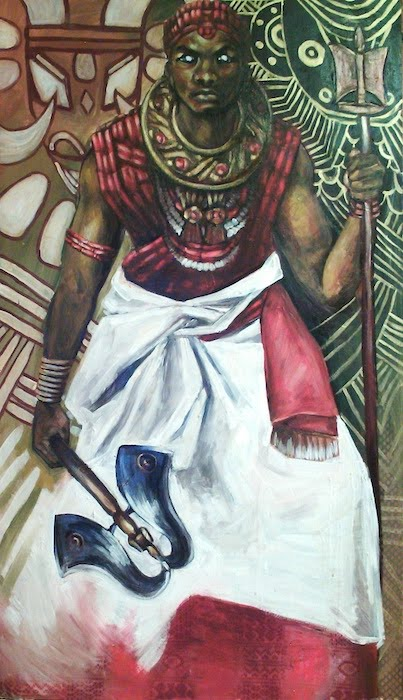
Another king of Oyo is particularly associated with this pre-imperial period. This is Shango. He is often presented as a son of Oranmiyan. Shango is said to have been a great warrior. He is believed to have freed Oyo from its tributary status to a rival state, Owu.
Source : traditionsremixedauction.blogspot.com
Shango is said to have been deified after his death. It is also possible that he was a humanized god. The cult of Shango would come to be regarded as the most important for legitimizing the power of the Alafin, the ruler of Oyo, who is considered his eldest son.
The Origins of Oyo According to the Study of Pottery
However, claims of descent from Oduduwa, the legendary founder of the ruling dynasty of Ife, are numerous among the rulers of the region.
They are most likely due to political and religious reasons. In the particular case of Oyo, archaeological data on this matter are contradictory.
The Nigerian archaeologist Akin Ogundiran has highlighted two major zones characterized by their types of pottery in Yorubaland and in Benin.
One developed in the 10th–11th centuries from Ife toward Owo and Benin. These two states claim descent from the founder of the Ife dynasty. By contrast, Oyo-Ile, the capital of the Oyo Empire located 200 kilometers north of Ife, is characterized by another type of pottery from its beginnings in the 10th–11th centuries through the 19th century.
A political, cultural, and religious influence from Ife on Owo and Benin therefore seems to be confirmed by pottery evidence. This does not, however, appear to be the case for Oyo. Archaeology nonetheless shows that the emergences of Ife and Oyo are indeed linked.
The Origins of Oyo According to the Study of Beads
The use of beads, particularly for crowns, had become at the beginning of the second millennium and under the influence of Ife a marker of royalty. Their export from Ife had contributed significantly to its economic development. Oyo was also a bead exporter, more specifically of red chalcedonies. Thanks to them, it also developed, notably by supplying Ife. Around the 13th century, Oyo became a centralized state. From this period onward, traces of the cultural influence of Ife can be found in Oyo.
This is the case with pavements made of pottery shards. It was also at this time that Oyo began exporting beads to places other than Ife. Oyo enriched itself in this way while weakening Ife. One of Oyo’s new direct trading partners was Benin.
The Origins of Oyo: A Synthesis
In conclusion, the legend of the descent of the emperors of Oyo from Oduduwa of Ife through Oran(mi)yan—who is also described as having founded Benin—can be interpreted as follows. The status of Oduduwa of Ife as the father of the founder of Benin and Oyo is probably due to the original cultural influence of Ife on the rest of the Yoruba world and on Benin. The status of Oranmiyan, son of Oduduwa, as the founder of the dynasties of Oyo and Benin is due to their contemporaneous emergence as the most powerful states in the region after the decline of Ife. The differences in pottery used in Oyo and in the rest of the Yoruba world are probably due to the former’s proximity to the savanna regions.
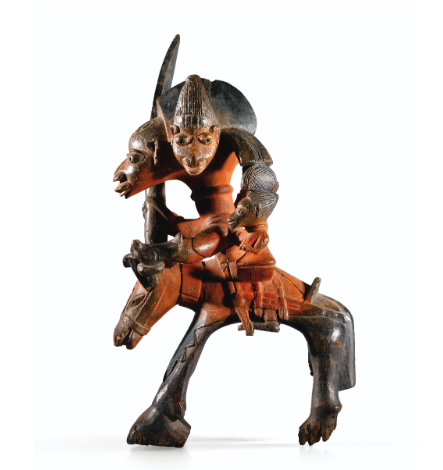
Located at the frontier of the Sahelian world, Oyo came very early into contact with the populations of these regions, such as the Nupe, the Bariba, and the Hausa. These populations had access to horses, which could not be bred farther south because of tsetse flies, to which they were vulnerable.
The Imperial Period of Oyo
An event during the pre-imperial period of Oyo would prove decisive for its future constitution as an empire. The Nupe are said to have invaded it, relying on their cavalry. Oyo was also conquered by the Bariba. It then equipped itself in turn with a cavalry by importing horses from farther north. Oyo subsequently regained its independence at the end of the 16th century, ushering in the imperial period of its history. Despite a failure against the Kingdom of Benin around 1600, Oyo’s territorial expansion to the east, south, and west was meteoric.
At the height of its territorial expansion at the end of the 18th century, the Oyo Empire controlled a large number of Yoruba territories. Its northern borders were the Bariba and Nupe kingdoms. To the west were the Yoruba kingdoms of Ketu, Savè, Porto-Novo, and the Egba country. To the east were the Ekiti, Igbomina, and Ijesha city-states, as well as Ife, Ondo, and Ijebu. This territory is considered the heart of the empire. At that time, the empire covered an area of approximately 46,000 square meters.
On the periphery, Oyo also dominated other territories. These vassals paid a heavy tribute to the Oyo Empire. They included Yoruba territories such as the Egba country and non-Yoruba territories such as Porto-Novo, Allada, and Dahomey. The latter had access to slave ports, which enabled Oyo to become extremely wealthy in the context of the transatlantic slave trade.
The Reigns of Gaa and Abiodun
In Oyo, a group of advisers assisted the Alafin (sovereign) in his reign. This group was called the Oyo Mesi. Their influence over the power of the Alafin was very great. They could thus force him to commit suicide if he did not display the appropriate qualities to rule. At the head of the Oyo Mesi was the Bashorun, who was also the general of the army of the empire’s capital.
In the second half of the 18th century, a Bashorun usurped the power of two successive Alafin, assassinating them in turn. This was Gaa. He is said to have conquered the north of the Egbado country.
At first, Gaa also usurped the power of the next Alafin, Abiodun. The latter later rebelled. With the help of provincial armies, he overthrew Gaa and had him executed.
The apogee of Oyo is associated with the reign of Abiodun. It was most likely under his rule that Oyo reached its maximum territorial expansion. He is said to have ruled with an iron hand. A former merchant, he is believed to have promoted trade, particularly with Europeans. He is said to have conquered numerous territories in the south and center of present-day Nigeria and Benin.
The Decline of the Oyo Empire
The death of Abiodun at the end of the 18th century marked the beginning of Oyo’s decline.
The Art and Architecture of Oyo
Because of this destruction, Oyo’s art is largely unknown, and some believe that this civilization did not possess architectural and artistic traditions worthy of its wealth.
However, the testimony of contemporary travelers and oral traditions illustrates the magnificence of Oyo-Ile:
“The pillars supporting the veranda and the doors of the royal palace and the houses of dignitaries are generally carved in bas-relief with figures.”
“The people [of Oyo-Ile] like to adorn their doors and the pillars that support their verandas with sculptures; and they also have statues or carved figures on their pillars and doors… [The main temple of the capital is] ‘the most extravagantly ornamented of all those of this type in the interior of Africa,’ although there are fifty others, less important and decorated, in the rest of the city.”
Despite this material destruction, Oyo’s influence survives in the world, where Shango endures as one of the most important Afro-descendant cults in the Americas.


