

Painted in 1849, The Punishment of the Four Stakes by Marcel Verdier depicts a scene of extreme violence at the very moment slavery had just been abolished in the French colonies. Between historical representation and aesthetic staging, the work questions the gaze cast upon the Black body, the memory of slavery, and the role of art in constructing narratives. More than a simple painting, it reveals the deep tensions between denunciation, fascination, and colonial legacy.
The body lies stretched out, arms and legs spread apart, pinned to the ground by an invisible tension. Four anchor points, four directions pulling flesh toward its limits. The eye does not immediately settle on the victim. It is first drawn into the scene as a whole: the warm, almost peaceful light, the figures arranged around it, the apparent ordinariness of the landscape. Then, gradually, the gaze returns to the center. To the body. To the violence. To that suspended moment when suffering becomes spectacle.
Painted in 1849 by Marcel Verdier, The Punishment of the Four Stakes belongs to a pivotal moment in French history. Slavery had just been abolished in 1848 under the leadership of Victor Schœlcher. Yet barely a year later, this work placed before the public once again a scene of extreme violence born from the slave system. Why represent such brutality at the very moment society claimed to be turning the page? And above all, what does this image tell us ; not only about slavery, but about the way it is viewed?
For this painting is not merely an illustration. It is a construction. A staging. A way of seeing and making others see.
The Punishment of the Four Stakes: Painting Violence, Looking at History
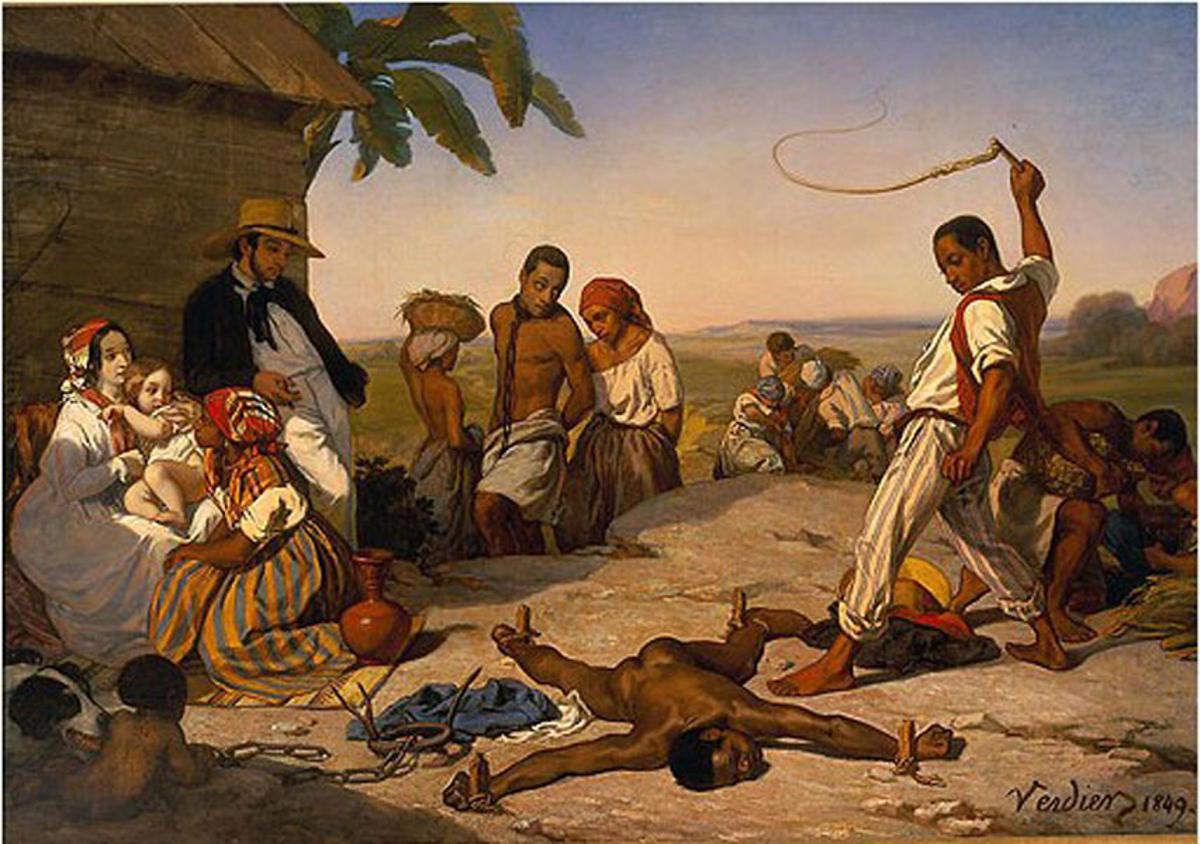
The strength of the work lies first in its composition. Nothing is left to chance. The tortured body, placed at the center, forms a horizontal cross stretched along the ground. This posture is not neutral. It evokes both absolute constraint and a form of sacrificial symbolism. The victim is not merely punished: he is displayed, offered to the gaze, transformed into a surface of demonstration.
Around him, the figures are distributed according to an almost theatrical logic. On the right, the executioner, whip raised, embodies action, movement, the continuity of violence. On the left, women, children, and men observe. Some slightly avert their eyes, others seem to watch the scene with a form of resignation. None intervene. None break the established order.
Light plays an essential role in this staging. It illuminates the body on the ground, heightens the contrasts, guides the spectator’s gaze. Yet it is not dramatic in the classical sense. It is soft, almost soothing. This contrast between the violence of the scene and the serenity of the light creates a disturbing effect: brutality is not shown as a rupture, but as a continuation of the represented world.
The landscape, finally, contributes to this normalization. Nothing signals the exceptional nature of the moment. No chaos, no visible tension in the environment. The scene appears almost ordinary. And perhaps this is where the work’s most disturbing power resides: in its ability to inscribe extreme violence within a form of banality.
The “punishment of the four stakes” was not a pictorial invention. It corresponded to a very real practice used in slave societies as a tool of discipline. Tying an individual to the ground, arms and legs spread apart, not only physically neutralized them, but also rendered them completely visible. The body became an open space, vulnerable, exposed to punishment.
This type of punishment was not aimed solely at the individual. It addressed everyone watching. It was a message. A demonstration of power. On plantations, violence was not merely punitive: it was pedagogical. It had to remind each person of the place they occupied and the limits they could not cross.
The tortured body thus became a medium of communication. It embodied the law, hierarchy, social order. It showed what happened to those who disobeyed. In this logic, suffering was not a side effect of the system. It was one of its constitutive elements.
By depicting this punishment, Verdier’s work does more than document a practice. It restores its symbolic dimension. It shows how violence is embedded within a system of control where the body is both the target and the vehicle of power.
The context in which the work was created is fundamental. In 1848, France definitively abolished slavery in its colonies. This event marked a major legal rupture, but it did not necessarily mean an immediate rupture in representations. The following year, in 1849, Verdier chose to paint a scene drawn from this system that was now officially abolished.
This gap raises questions. Why return to this violence at the very moment it was supposed to disappear? One initial answer lies in the function of memory. To represent is also to preserve, to bear witness, to inscribe into visual history what might otherwise be forgotten. The work can thus be read as an attempt to make visible a reality that abolition alone could not erase.
But this reading is not enough. For the image does not merely show. It organizes the gaze. It constructs distance. The spectator, placed before the scene, is not involved. They observe. They contemplate. They are invited to see, but not necessarily to act.
In this sense, the work belongs to a tension specific to the post-abolitionist era: how can slavery be represented without symbolically reproducing it? How can one denounce without aestheticizing? How can one show without transforming suffering into spectacle?
The central question remains: what does this image do? Does it denounce the violence of the slave system, or does it contribute to staging it in a way that renders it acceptable, even aesthetic?
The painter’s gaze is decisive here. Verdier, a European artist, was not depicting a scene he had personally experienced. He reconstructed it from narratives, imaginaries, and visual references. This distance can produce two opposite effects. On the one hand, it allows critical reflection, a form of distance. On the other, it opens the way to a visual treatment that may soften the reality of the brutality.
The spectator, too, is caught within this ambiguity. They are confronted with suffering, but within a controlled, aesthetic framework shaped by the codes of academic painting. The violence is visible, but contained. It does not overflow. It does not directly threaten the viewer.
This tension between denunciation and aestheticization lies at the heart of the work. It questions art’s capacity to represent violence without neutralizing it. It raises a broader question: can we truly look at another’s suffering without transforming it?
At the center of the scene, the victim’s body concentrates all these tensions. It is at once subject and object, presence and absence, individual and symbol. Stretched out on the ground, immobilized, it is deprived of all capacity for action. Yet it is also what draws the gaze, structures the composition, gives meaning to the whole.
This body is not merely that of a man. It is the body of an enslaved person, that is to say an individual whose existence is defined by a legal and economic status. He belongs to someone. He can be punished, sold, used. He is integrated into a system where the person is reduced to a function.
From this perspective, the body becomes a territory. A space upon which power is exercised. A place where relations of domination materialize. The punishment, inscribed upon the flesh, makes this power visible. Tangible. Undeniable.
But this body also carries another dimension. Despite everything, it resists reduction. It reminds us that behind the function lies an existence. A history. A humanity that the system seeks to erase, yet which persists within the image.
Around the victim, the secondary figures play an essential role. They are not mere decorative elements. They participate in constructing meaning. Their attitude, their position, their gaze reveal something about the way violence is perceived, integrated, normalized.
No character appears surprised. None seem ready to intervene. This absence of reaction should not be interpreted as individual indifference, but as the reflection of a social order in which violence is integrated into daily life. It is part of the system’s normal functioning.
The children, in particular, introduce an additional dimension. Their presence suggests transmission. What they see, they learn. What they learn, they will reproduce. Violence is not merely exercised: it is socialized.
Thus, the scene does not simply depict an act of punishment. It depicts a system perpetuating itself through gazes, attitudes, and silences.
Why This Work on Slavery Remains So Powerful
More than a century and a half after its creation, The Punishment of the Four Stakes continues to provoke reflection. Not only about what it represents, but about the way we look at it today. For our gaze is not neutral. It is shaped by history, memory, and contemporary debates.
In a context where questions linked to slavery, colonialism, and their legacies are increasingly present, this work takes on a particular resonance. It reminds us that the violence of the past is not entirely past. That it continues to structure imaginaries, social relations, and representations.
It also raises an essential question: what should be done with such images? Should they be shown, at the risk of reproducing the violence they contain? Should they be hidden, at the risk of erasing part of history? Between memory and exhibition, between denunciation and spectacle, the answer is never simple.
But one thing remains: to look at this work is to accept being confronted with a reality that exceeds the frame of the painting itself. It is to recognize that history is not limited to dates and events, but is also inscribed in images, gazes, and representations.
And that once seen, such images never completely disappear.

