

The legendary story of Agassou, the leopard prince of the kingdom of Tado, ancestor of the kings of Allada and Danxome, and divine figure in African and American cultures.
At the crossroads of legend and history, the name Agassou still echoes, from the coasts of the Gulf of Guinea to the mountains of Haiti. This emblematic figure, half-man, half-leopard, stands at the origin of stories linking the foundation of powerful African kingdoms, such as Allada and Danxome, to the painful epic of the slave trade. Deified centuries later, he is now a celebrated hero in the cultures of African descendants in the Americas.
Agassou, or the legend of a prince with an extraordinary destiny
The Fon and Ayizo traditions of southern Benin recount that Agassou, son of Princess Aligbonon of the Adja kingdom of Tado (present-day Togo), was born from a strange and supernatural union between his mother and a leopard. According to legend, his birth, marked by unusual physical traits—red hair, a hairy body, sharp nails—condemned him to a life on the margins. Yet his exceptional strength and bravery were recognized by all, although his uncommon appearance earned him distrust and mockery.
History tells that Agassou, although descended from a royal lineage through his mother, was excluded from the succession to the throne of Tado. Ambitious, he eventually killed the reigning king during a violent conflict, earning him the nickname Adjahouto, literally “the killer of Adja.” Forced to flee, he carried with him the ancestral symbols of his kingdom, his family, and his loyal followers. He thus founded the kingdom of Allada, a powerful state in southern present-day Benin, and established a royal lineage that would profoundly shape the history of West Africa.
The kingdom of Allada prospered for several centuries before one of Agassou’s descendants, Do Aklin, founded the famous kingdom of Danxome in Abomey at the beginning of the 17th century. The kings of Danxome, central figures in West African history, all claimed direct descent from Agassou, who was regarded as a divine and protective figure. Among them, King Agadja (1718–1740) conquered Allada and openly denounced the slave trade in a letter addressed to George I of England, an unprecedented act for the time.
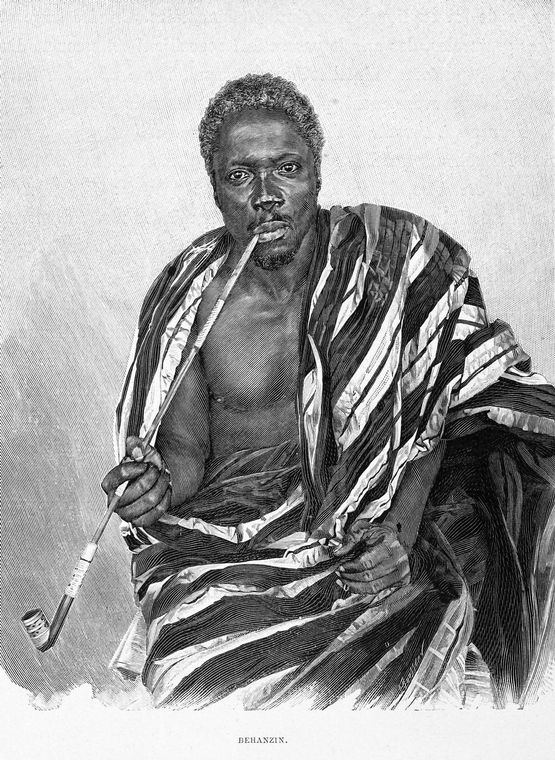
The last king of Danxome, Gbéhanzin, also embodied the fighting spirit of Agassou. Known for his fierce resistance to French colonization, Gbéhanzin was exiled to Martinique in 1894 before dying in Algeria, far from his throne. Through him, Agassou’s legacy crossed not only borders but oceans as well.
Agassou’s story does not end in Africa. Indeed, the name of the kingdom of Allada, transformed into “Rada” in the Caribbean, lives on in Haitian Vodou traditions. This faith, born from the syncretism between African beliefs and the realities of enslaved life, presents Agassou as a powerful divinity, protector of the descendants of populations deported from the Gulf of Guinea.
One of the most illustrious presumed descendants of Agassou is none other than Toussaint Louverture1, the iconic figure of the Haitian Revolution. According to Haitian tradition, Toussaint was the grandson of the king of the Aradas (Allada), further strengthening the spiritual and historical bond between Africa and the Americas. The spirit of Agassou—courageous and rebellious—seems to have inspired this revolutionary leader who led the first successful slave revolt in history.

Many historians have attempted to untangle myth from reality surrounding Agassou. Some see him as a war chief whose strength was comparable to that of a leopard, while others interpret his legend as a metaphor for the relationships between the different populations of the region. Despite the uncertainties, it is undeniable that the figure of Agassou has crossed centuries and continents, becoming a symbol of resilience and courage for the descendants of African populations.
Agassou, this prince with an extraordinary destiny, left an indelible mark on the history of Africa and the Americas. His descendants, whether the kings of Allada and Danxome or the heroes of the Haitian Revolution, carried his legacy through the ages. Today, his memory survives in the Vodou rituals of Afro-descendant communities, who continue to invoke him as a symbol of resistance and pride.
Through this legend, Agassou is more than a simple historical figure. He embodies the unbreakable ties between Africa and its diaspora, uniting millions of people through a shared past and an invaluable cultural heritage.
- Toussaint Louverture : Leader de la révolution haïtienne (1791-1804), il mena la révolte des esclaves qui aboutit à l’indépendance d’Haïti. ↩︎

