

On 1 December 1944, at the military camp of Thiaroye, near Dakar, African riflemen repatriated from France were gunned down by the French colonial army. They were demanding payment of their wages and compensations accumulated during their captivity in the German Frontstalags. The event, concealed for decades, stands as one of the darkest episodes of French colonial history. Reconstructed from fragmentary archives—often falsified or missing—and from painstaking historiographical work, the Thiaroye massacre reveals the deeper logics of the colonial system: structural inequalities, racial contempt, administrative impunity, and State silence.
Colonial history leaves, in the folds of its silences, tragedies that can only be understood by patiently reconstructing the chains of humiliations, neglect and violence that made them possible. The Thiaroye massacre belongs to this category of events whose facts, stolen from public knowledge, nonetheless remain decisive for grasping the political realities of an empire in decline.
It is not only about the death of several dozens (or hundreds) of African soldiers on 1 December 1944. It is about the exposure of a colonial system incapable of recognizing the equality of those who had just fought and suffered for France, nor of granting them justice when they demanded what was owed to them.
At Thiaroye, history is not a simple disciplinary conflict that spiraled out of control. It is the concentrated expression of structural power relations, fueled by decades of racial hierarchies, political inequalities and administrative interests. The riflemen, who had survived captivity in Germany, were refused—once back in Africa—what the law itself guaranteed them: their wages, bonuses, savings book balance, back pay, captivity indemnities. The denial of rights was the initial engine of protest. Repression was its outcome.
Thiaroye 1944: Understanding the massacre of the senegalese riflemen and the hidden historical truth
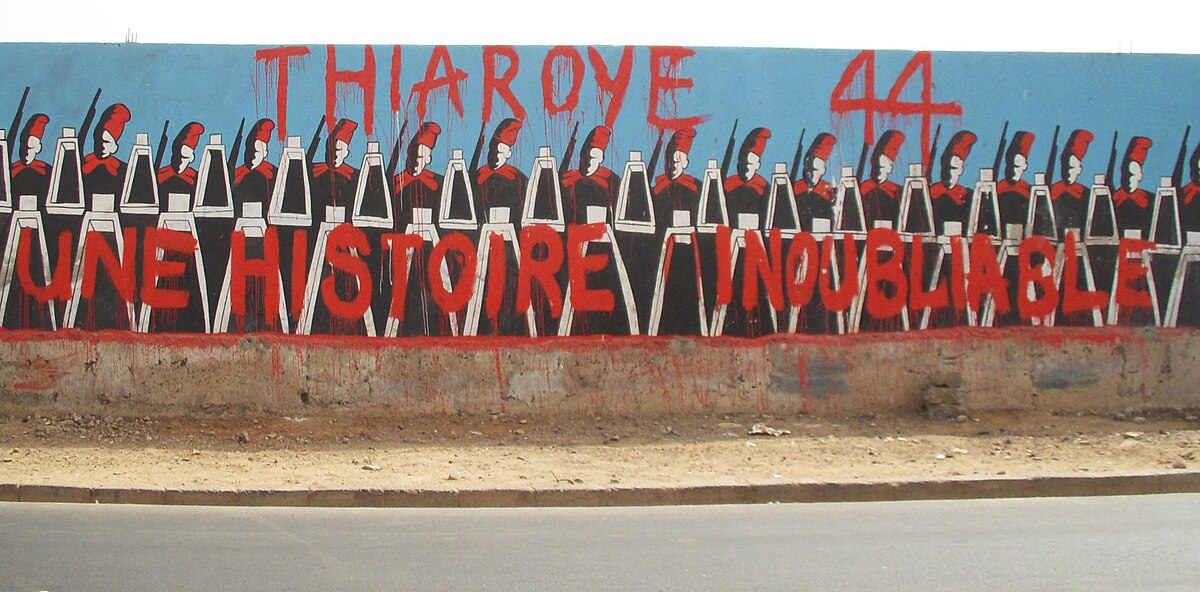
To understand Thiaroye, one must first recall what the trajectory of the Senegalese riflemen was during the Second World War. Sent to Europe as early as the Phoney War, they took active part in the French campaign. Many were taken prisoner in 1940.
In the German Frontstalags, living conditions were particularly harsh: undernourishment, lack of water, forced labor, high mortality. Documents consulted show that some riflemen received a work indemnity of 8 francs per day, deposited in savings books managed by the camps. But these wages would never be fully returned to them.
From 1943 onwards, according to the report analyzed in French archives, the Vichy regime sent French officers to supervise the camps on behalf of the occupier. Many riflemen experienced this situation as a double betrayal: France, which they had defended, abandoned them to discriminatory treatment. When they managed to escape or were liberated by Allied troops in 1944, their first feelings were fatigue, relief, but also the desire to return home and reunite with their families.
Documents from 1944 show that nearly 30,000 colonial prisoners were released, including about 15,000 Africans from French West Africa (AOF). The first repatriations were organized from Normandy and Brittany. Entire groups were gathered in transit centers in La Flèche, Versailles, Rennes and Morlaix.
It is in these centers that the first conflicts related to unpaid wages emerged: some riflemen received advances, others almost nothing. The archives note glaring inconsistencies: for the same center, documents contradict one another on the sums distributed, evidence of opaque management.
In Morlaix, in October 1944, 315 riflemen refused to embark until their rights were settled. The gendarmerie violently removed them, provoking the indignation of the local French population. This first episode prefigures Thiaroye: the demand was already a legitimate right, the response already a coercive force.
The riflemen eventually boarded the Circassia, a British ship that took them to Casablanca before Dakar. On 21 November 1944, they disembarked in Dakar. Despite an official welcoming ceremony, tensions were palpable: according to documents and collected testimonies, some riflemen were already expressing their exasperation over the lack of payments.
At the Thiaroye camp, located about fifteen kilometers from Dakar, the riflemen awaited the settlement of their rights. Their demands concerned the following elements, as mentioned in the military circulars of 1944: captivity pay, combat bonus, retention bonus under the flag, savings book balance, demobilization bonus, leave indemnity, travel pay. Nothing indicates that command intended to pay them immediately.
Generals Dagnan and de Boisboissel, responsible for demobilization in Dakar, informed of the protests, adopted an uncompromising stance. The archives reveal that one of the generals considered the riflemen “in a state of rebellion” even before the incident of 1 December. The conflict was therefore not analyzed as an administrative dispute but as a disciplinary threat to be neutralized.
The days preceding the massacre were marked by two essential developments.
The first was administrative: a circular (dated 16 November) abruptly modified the conditions for paying wages, to the detriment of the riflemen who were already embarked. It stipulated that all arrears had to be settled before departure from the mainland; which excluded the riflemen already en route or already arrived in Africa. A new injustice was added to the initial injustice.
The second was operational: General Dagnan prepared a “repression force,” according to the terms of several military reports of the time. This force included two infantry battalions, gendarmes, armored cars, an M3 light tank, and several companies of riflemen who remained loyal to the command.
This massive deployment—disproportionate in light of the wage demands—reveals the nature of the gaze cast upon the riflemen: not as demobilized soldiers claiming a due, but as “natives” whose revolt had to be prevented, according to a militarized and racially hierarchical vision.
According to several later testimonies, pits were dug the day before the massacre. No official document confirms this, but the information appears in oral collections cited in contemporary academic work.
On the morning of 1 December, the riflemen were ordered to gather on the camp’s esplanade. Military reports diverge on the exact hour and the origin of the first shot. Some evoke a “threatening” rifleman; others mention a warning shot fired by the security forces.
However, all military reports converge on one point: after some verbal exchanges, General Dagnan gave the order to fire.
Armored cars opened fire on the crowd. The gunfire lasted only a few seconds. According to the military documents preserved in the archives, more than 500 cartridges were fired.
The riflemen were unarmed or carrying only melee weapons. No material evidence proves they fired. Some fled toward the nearby village, where one of them was shot. Raids were organized during the day to find those who had escaped.
The number of dead remains one of the most controversial points. The official toll ranges between 24 and 70 deaths. Historical estimates based on administrative inconsistencies and “missing” individuals suggest that there may have been between 300 and 400 victims. This range is deemed plausible by several researchers, considering the nature of the weaponry used and the later documentary concealments.
In the days that followed, 48 riflemen were arrested. They were tried in March 1945 by a military tribunal composed of officers who had taken part in the repression. The charges were “rebellion,” “refusal to obey,” and “insult to a superior.”
The conditions of the trial violated fundamental principles of justice: absence of interpreters for certain languages, absence of evidence, contradictory testimonies, defense provided by officers themselves involved in the repression. Most riflemen were sentenced to punishments of up to ten years in prison, accompanied by orders of banishment and military degradation.
The convicted were sent to Gorée, Mauritania, or Thiès. Several died in detention.
This trial sealed the official version: the riflemen were guilty, the repression was legitimate.
For decades, the massacre was concealed in France. The 1944 censorship remained active, and no metropolitan newspaper mentioned it. In Africa, memory circulated orally, particularly within riflemen communities.
From the 1970s onwards, the first academic works appeared. In the 1990s, historiography accelerated, driven by Senegalese and French researchers. The partial opening of archives, research conducted in Dakar, France and the United Kingdom, and the discovery of documentary falsifications helped establish the reality of a premeditated massacre, masked and justified by an administration intent on avoiding any challenge to the colonial order.
In 2012, official French recognition mentioned 35 deaths. In 2014, it mentioned “at least 70.” Historians remind that these figures probably minimize the real scale of the tragedy.
The Thiaroye massacre cannot be reduced to a blunder. It combines several dimensions typical of the late colonial system.
First, a racial dimension. The riflemen were treated as subordinate soldiers, subject to a racial hierarchy that had already shown its limits in mainland France. Their participation in the Resistance, for some, gave them no special status within the colonial army.
Next, an administrative dimension. Documents show that circulars, orders and reports had the effect of depriving the riflemen of their financial rights. The repression also sought to avoid a precedent: yielding to African demands would have opened the way to other protests.
Finally, a memorial dimension. The systematic concealment, falsified archives, incoherent reports and silence of the authorities demonstrate a will to hide a State crime.
Understanding Thiaroye therefore means understanding the deep mechanics of a system in crisis which, faced with the legitimate claims of its African soldiers, found no other answer than force.
The Thiaroye massacre is a moment of rupture. It reveals that despite speeches about the “great imperial family,” colonial France did not consider its African soldiers as citizens with equal rights. These men, who had marched, fought, suffered, and survived captivity, were killed for having demanded the application of the law. Their story illuminates not only the end of the colonial empire but also the ongoing struggle of African peoples for justice and recognition.
To make Thiaroye visible is to restore history. And it is to remind that behind the missing archives, the disputed figures, and the institutional silences remain lives cut short, grieving families, and a memory that continues to demand truth.
Notes and References
Archives of the Service historique de la Défense, files relating to repatriated Senegalese riflemen (Frontstalags, 1939–1945)
Archives nationales d’outre-mer (ANOM), AOF fonds, Dakar, administrative files on Thiaroye (1944–1947)
Minutes of the Dakar military tribunal, March 1945 (Central Repository of Military Justice Archives, Le Blanc)
Fargettas, Julien. Les Tirailleurs sénégalais. Les soldats noirs entre légendes et réalités (1939–1945), Presses universitaires, 2018.
Mabon, Armelle. Prisonniers de guerre « indigènes », Éditions La Découverte, 2014.
Mourre, Martin. Mémoire de Thiaroye, doctoral thesis, Université de Paris, 2015.
Sembène, Ousmane. Camp de Thiaroye, film, 1988 (cultural memory source, not a direct historical citation).
Summary
Thiaroye 1944: Understanding the massacre of the Senegalese riflemen and the hidden historical truth
Notes and references


